Here is a bit of fun. I have taken a lot of photos over the 15 years this blog has been running, some of which I am pleased with. I have also taken plenty of awful photos, some of which are exquisitely bad. I present here a selection of them! In reverse order then...
6). Above is a Glanville Fritillary that was sitting perfectly still on my finger until I took the image.
5). The day I saw my first Quail, I had my camera on, ready to take the shot as I knew I was likely to flush them on this particular farm. When they did fly up, I turned my camera OFF and missed them, even though they were right in front of me. This is all I got (you can just about see them in the bottom right)...
4). On Jersey last year I was taking a sequence of shots of the amazing shrimp Periclcimenes sagittifer that lives among Snakelocks Anemones, the light was perfect! Shame I had it on the wrong setting!!! The problem with taking photos under water is you can't see what you are doing.
3). You know how it is, on a sunny March day you go for a walk around a site you've worked on for a decade when a Large Tortoiseshell flies by! This was the shot I got as it zoomed past me.
2). When you twitch the Beluga on the Thames.
And finally, the winner is...
1). And finally, that time a gorgeous adult Honey-buzzard glided low over head. Surely this would have made a brilliant photo. WRONG! There's always a bloody pylon in the way!
I've finally got a new camera! And I don't mean a fourth Coolpix. I only heard about the Olympus TG-4 about three weeks ago and have been counting down the days until the next tax year to get one. It's insanely good and easy in macro function, check out the awesome Horsetail Weevil Grypus equiseti which I found in a pile of litter at Waltham Brooks yesterday. This is the first record in Sussex since 1985.
Also yesterday was Philorhizus sigma, this being only the 2nd site for this (outside of Amberley next door) for this Na carabid.
This is the very cool Prasocuris phellandrii, which was all over one compartment yesterday. I've only seen this once before at Pevensey Marshes.
And here is a comparison between the normal macro and the photo stacking functions. Gotta learn my way around it but I'm pretty pleased with half an hour messing around in the garden.
I found this Hairy Crab today at Beachy Head. I've seen them before but I have never looked at them so closely. They are pretty cool with their distinctive club-tipped hairs. Check it's face out!
Miserable, overcast conditions can sometimes produce great macro-photography opportunities.
Many of you will be familiar with the common Green Tiger Beetle Cicindela campestris but it has a much scarcer cousin, the Heath Tiger Beetle Cicindela sylvatica which probably went extinct in Sussex several decades ago. This species is a Biodiversity Action Plan species and is nationally scarce (Na) with the major population centres being the New Forest and Surrey Heaths. The last unconfirmed sighting in Sussex was at Iping in the 1980s, so it was decided that this would be a good place to reintroduce it. Often confusingly called the Wood Tiger Beetle, this species is very much restricted to lowland heathland and is not really a woodland species. Here it is again in all its glory.
And the smaller and more brightly coloured Green Tiger for comparison.
Prior to the reintroduction, the reason the species went extinct on the site needed to be addressed first. This was loss of bare ground and pioneer heathland. We create this at Iping in a number of ways such as burning, scraping and turf-stripping but it is the turf-stripping that seems to produce the best results for the Heath Tigers and a suite of other scarce invertebrates. In 2007, six females were introduced followed by a further 16 in 2009. The species has been recorded annually in small numbers each year since then and would appear to now be established on site. Turf-stripping is carried out annually to ensure that there is always some suitable habitat and the turf is sold on to golf courses whereby new heathland is created there. Everyone is a winner! Here is the small turf-stripped area I saw the Heath Tiger on, immediately adjacent to the original release site.

When I came to write up this work over the winter, it became clear that we hadn't been keeping track of where and when this management had occurred so I went out there on the 1st May to digitally map and 'age' the scrapes. I also wanted to see what else was benefiting from the management. Heath Tiger emerges a little later in the year than Green so I was surprised to see one. I kept hold of it for an hour or so to cool it down and show the volunteers and it kept still enough to allow the above shots. Proof that the Coolpix 4500 consistently produces good macro shots! Not bad for a ten year old camera.
I picked up a few carabids on the turf-stripped areas but it wasn't until this morning that I realised that the Pterostichus I had picked up on one area only put in this winter was in fact the Heath Short-spur Anisodactylus nemorivagus! This generic looking carabid has as many letters after its name as the Heath Tiger Beetle (BAP and Na) and would appear to be only the third Sussex and second West Sussex record! I trapped it in a pitfall trap at Graffham Common in 2009 and Mark Telfer identified it. Peter Hodge also pitfall-trapped it in Ashdown Forest. This means that I am the only person to have seen this beetle alive in Sussex!
Anyway, after mapping and monitoring 55 turf-stripped scrapes, I recorded about 90 Green Tigers to my one Heath Tiger but it is still early in the season so I hope to see more spreading around the site later in the year.
Birds were good too with a singing Redstart in the same place it was recorded last year and a Hobby catching bumblebees on the wing.
Picture the scene. You've just spent your birthday ill in bed with a rotten cold and have taken the following day off sick too. Having finally dragged yourself out of a steaming hot bath at about 3.30 pm, you notice a missed call from Paul Marten. He tells me these is a Corncrake showing well at Beachy Head NOW! My head is spinning, I feel like death warmed up BUT Corncrake is THE only regular British bird that I haven't seen. There is no way I am letting a cold get the better of me. Then 30 minutes later I was looking at this, a ludicrously tame bird. I never thought I would see this, many of the birders present who were older than me were also saying the same thing. It seemed like a once in a life time opportunity.


The bird was feeding actively on very large earthworms the whole time I was there. It was so close that if filled the entire view finder on the scope. You can make it out on the track in these pictures. Thanks to all the birders whose scopes I borrowed to take these shots with the Coolpix 4500 but a huge thanks to Paul Marten for ringing me! What an awesome belated birthday present!
Dessertification:
The process by which a wild plant or animal, through being particularly well marked, rare and cute, is rendered down to the level of a sickly-sweet pudding in the eyes of drooling Internet obsessed naturalists.
I just had to get hold of some decent photos of the Desert Wheatear (or Dessert Wheatear as I think you'll find fits better - but Pudding Wheatear is a step too far?). A big thanks to Juliet and Chris Moore who took the top and bottom shots respectively. It really does look good enough to eat. In fact, I might put this bird right up there as one of my all time favourites. It leads to one burning question though. Is there a Starter Wheatear and what does it taste like? I mean look like?
No wheatears (of any kind) were consumed during the writing of this post and the author does not in any way condone the eating of wheatears. Now has anyone ever noticed how much Great Shearwaters look like Vienetta?
Beetling in the Brecks was great. It would have been far less great if Mark Gurney hadn't had a fork with him. Just a simple fork you would eat your dinner with but also just the right tool for turning over rosettes of low growing plants and picking through the top layer of the light sandy soils. I reckon he was finding ten beetles for everyone I found. I will be carrying a fork on my person from now on. Another amazing thing I saw Mark using was a photographic reflector and filter, that also doubles up as a beating tray! It's great for taking photos on very bright days AND it packs down to almost nothing. I have already ordered one. That and my new fork should be arriving any day.
Now, for some beetles. We went looking for Fingered Speedwell at a site near Lakenheath (Caudle Farm) but failed. We did find Breckland Speedwell, Grape Hyacinth and Bur Medick there though. There were a number of big, impressive mega weevils to get the blood pumping. Joint candidates for most impressive weevil of the day were the above Mogulenes geographicus and this Hypera dauci (that we found later in the short turf around Lakenheath RSPB car park). Both nationally scarce. Both new species for me. Now, I have not done much weevling. With around 600 species, they are a big chunk of the UK beetle fauna, some 15% perhaps. I can't afford to keep over looking them.


In the above two photos of Hypera dauci, king of weevils, you can see the difference between casting your shadow over the subject on a sunny day (top) and using the filter (bottom). The difference in the colours of the golden threads of the moss Brachythecium albicans is clear! The fork and the filter will be great for finding inverts and taking photos on chalk-grassland in Sussex. Spending time in the field with other naturalists is great for learning new techniques, even if it does make me feel a bit like a chimp with a type writer.
We also saw this nationally scarce (Na) carabid and Breckland specialist, Harpalus pumilus, our smallest Harpalus.

Here is Mark in action with
the fork in front of some
Grape Hyacinth.
Oh yeah, we also saw some birds this weekend. Without even trying really we saw
Stone-curlew and
Bittern. On the Saturday I also saw
Rough-legged Buzzard at Ouse Fen. I went there with another old friend and colleague from the RSPB, Matt Self. First time on a bike in seven years and I rode 45 miles! Here is Matt shortly before the Rough-legged Buzzard was spotted. Saddle sore is an understatement!
Towards the end of Sunday, Mark and I went on two last plant twitches, to Wayland Wood for
Yellow Star of Bethlehem. Very nice but mostly gone over.
And the odd Mezereon, again the flowers had mostly gone over. This plant had escaped from the enclosure.
All in all it was a great weekend and I was glad to see so many new species. The highlight for me was sadly none of the plants. It was getting back to the office and seeing a little slip of paper with 'look out for 'Hypera dauci' written on it. Peter Hodge's tip for beetling in the Brecks. Looks like we struck gold! I added at least 14 species and I end today on 3844. A massive thank you to Matt and Mark for a great weekend of excessive exercising and natural history!

I was pleased to see my Silver-studded Blue butterfly photo in the excellent journal British Wildlife today. Robin Crane has written an article on the South Downs National Park which I will be reading right about now. It's great that the Sussex Wildlife Trust reserves are getting a big mention and that lots of other friends have photos in there too!
A big thank you to Mark Telfer for selling me his old Coolpix. Since the start of July I have felt a little like part of me has been missing. My Coolpix began making a rather ungodly sound as I pointed it at an ovipositing Hornet Beetle nearly four months ago now. It might only have 4 megapixels but it is perfect for my blog. I look forward to taking more macro shots with it. Stuck at home today with a fever though, so it's not going to be today.
This is the Invisible Spider Drapetisca socialis, it's quite a common spider on tree trunks. I tend to see it on trees with smoother bark like this Ash or Beech. I was at Ditchling Beacon today repeating some fixed-point photography. I did get one tick, the unremarkable snail known as the Lesser Bulin Ena obscura which was also at rest on a tree trunk.
Perhaps the most surprising thing though was a very late and very tatty Silver-spotted Skipper nectaring on Devil's-bit Scabious.
I've been at Friston today and spotted a few nice moths. The highlight was my first Sussex Scarlet Tiger. I have not seen this since around 1994 in Cornwall (ouch, that's 17 years!). It is turning up in gardens in Brighton now but as I don't currently have a garden (Sussex is my garden!) I haven't seen one until today. There were quite a few Hummingbird Hawkmoths out there too.
I did have one tick, the local Pammene aurana that feeds on Hogweed, it seems both as a larvae and as an adult. If all tortrix moths stuck to simple blocks of colour in childish shapes like this one they would be so much easier to identify! I'm getting a little more used to the Canon G12 now too having found a few functions that are resulting in better shots.
Yesterday was a dark day. Too painful was yesterday's event that I could not even blog about it until 24 hours later. No, actually I was so busy running around from one end of the county to the other with work that I didn't get a chance to blog. Anyway. Picture the scene: I walk up to a tree at Cowdray which has been very productive to see an ovipositing Hornet Beetle Leptura aurulenta. I pull out the Coolpix, go to turn it on when it begins to make a very pained sound and refuses to turn on at all. At least it went out with style. I bought the camera second hand in 2005 and 95% of all the photos on this blog are taken using this 4 mega pixel fossil. Good job I bought a back up. Perhaps now I will finally figure out how to use this vastly superior camera!

Anyway, we had a good day with a number of species new to my list and many more for the site. Again, picking through fragments of beetles in old trees proved very productive and we might have found two RDB additions to the list using this method! Not so productive though for the pan-species lister.
I then went on to Friston to look for one of my bogey moths, the Lappet. We failed to see it but we did see Olive Crescent, Great Oak Beauty and one of my other bogey moths, the Fern (which flew off before I had chance to get a photo). We also saw a couple of Scallop Shells (haven't seen them for years), my first male Glow Worms, and this Brown Chafer Serica brunnea which was also new to me. I end the day on 3515 species. I also remembered that today has another signifigance. It's ten years ago today my career in conservation started as a volunteer at Dungeness RSPB Reserve. I may have to do yet another blog about that...
One last identification from yesterday is this male Neriene montana. Quite pleased with the photo, the dappled shade of the partially opened oak canopy provides a good light unlike this relentless sunlight that also super charges every invertebrate, even in the shade there is a lot of latent heat making everything very mobile. In other words, rubbish weather for photography out in the open but good for recording. I started surveying yesterday around 6.30 am and was too hot then in just a t-shirt! Starting to get close to the point when I can't carry enough water!
Well, this became quite interesting. As I'm borrowing Jo's Mac, I decided to count the Starlings in Photoshop so you can see just how many there are in the photo. My estimate was 2000 in the field, I was not confident with this so as I approached the flock, I got my camera out ready so I could capture them as they flew against the sky. In fact, there are 3630 Starlings in the above photo!!! More Starlings than I have seen species and the biggest flock I have come across during these farm surveys!
20 people submitted an estimate ranging from 700 to 9576 (Jo and Sarah, twelvety and three were not included in the analysis but thanks ever so much for your input). Only 7/20 came via the blog though, most were posted on Twitter and Facebook. The mean of the estimates was 2903 and the median was 2206. This meant that only 5 people over estimated while 15 people under estimated. The closest was Tom Burns at 4000 (out by a mere 370 Starlings). Nice one Tom!
Under-estimating large flocks is definitely something more people do than not and I am aware that I do it too so it's good to carry out an exercise like this to recalibrate my estimates. I find with birds in flocks over 2-300 that photography is the best way forward.
I usually like the first photo to be a shot of a new species or the focus of the post but I just really liked this photo for capturing just how cold and bleak today was. I went out at lunch time for no more than 15 minutes and was trying to get my head around the commonest lichens on the Alders in the little plantation at Woods Mill. By far the most abundant one is the grey lichen in the above photo which I think is Hypogymnia physodes. It's on all the trees and fence posts in the area. I'm not sure what the orange stuff you get on Alder bark is, I think I heard once it's an algae.
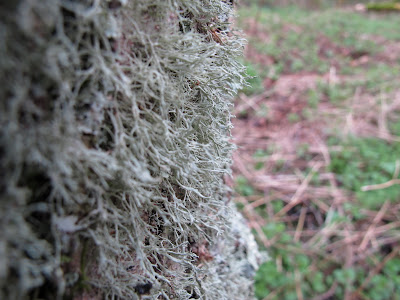
Anyway, I also saw this one which is new to me and I think is Ramalania farinacea. Other common lichens there include the big apple-green Flavoparmelia caperata and the branched Evernia prunastri. I also found the tiny Physcia adscendens on a nearby willow which was also new to me leaving me on 3132. I'm only just really branching into lichens so if you think any of these identifications are wrong, please let me know.
Jo and I went up to Old Lodge to play with our new cameras. I finally bit the bullet and bought the Canon PowerShot G12, which I have no idea how to use yet so I think it is going to take me a while to get used to it and start getting the quality of macro shots I am so used to with the Coolpix 4500. Anyway, first off is a moss known as Dicranum scoparium, it's very common but I'm really pleased how bright this came out despite it being such an overcast and lifeless feeling day (the only bird I saw all day was a Crow, although I did hear a Redpoll and a Raven). This next one is Hypnum andoi that grows on tree trunks and the shoots always grow vertically downwards.

I think I have exhausted the potential for many bryophyte ticks on heathland/woodland without a bit of help so I resorted to turning over logs and looking for invertebrates instead. I saw these two woodlice, the first being Common Shiny Woodlouse Oniscus asellus, believe it or not, one of the commonest five woodlice and a tick for me. I know I have seen this before many times but I have never keyed it out to species. The second is the Common Rough Woodlouse Porcellio scaber which I have bothered to key out before. The camera certainly picks up the textures of the two species.


After that I stumbled on a beetle which was quite unexpected. I keyed it out to be the tenebrionid Cylindrinotus laevioctostriatus. It's listed as developing in deadwood and also in peaty soils on heathland so not a strict SQI species. Either way, I have seen it before so I ended the day only two species up (I added another retrospective moss tick whilst I was trying to identify them in the field today). 3023 it is then! Anyway, I'm pleased with the new camera, taking a bit of getting used to after six years with the same trusty Coolpix but I'm sure I'll get the hang of it.


 Posts
Posts


