As my field season hurtles towards me, I better get part 2 of the trip to Isle of Wight wrapped up before I lose the window. This is mainly inverts and plants and is mostly based on two fantastic days out in the field with Mark Telfer. On the second day, Mark and I met up with Iain Outlaw, and as we got to the undercliff target area, before they had even said "here we are", I shouted "OIL-BEETLE!" And that's basically how the two days went.
Thanks to Mark, it turns out this one was a lifer for me! Black Oil-beetle, Meloe proscarabaeus my fourth oil beetle! So pleased to finally connect with this species. This male was much bigger than I thought it would be and very mobile.
Soon after this I was looking at the target species, the bryophyte Philonotis marchica.
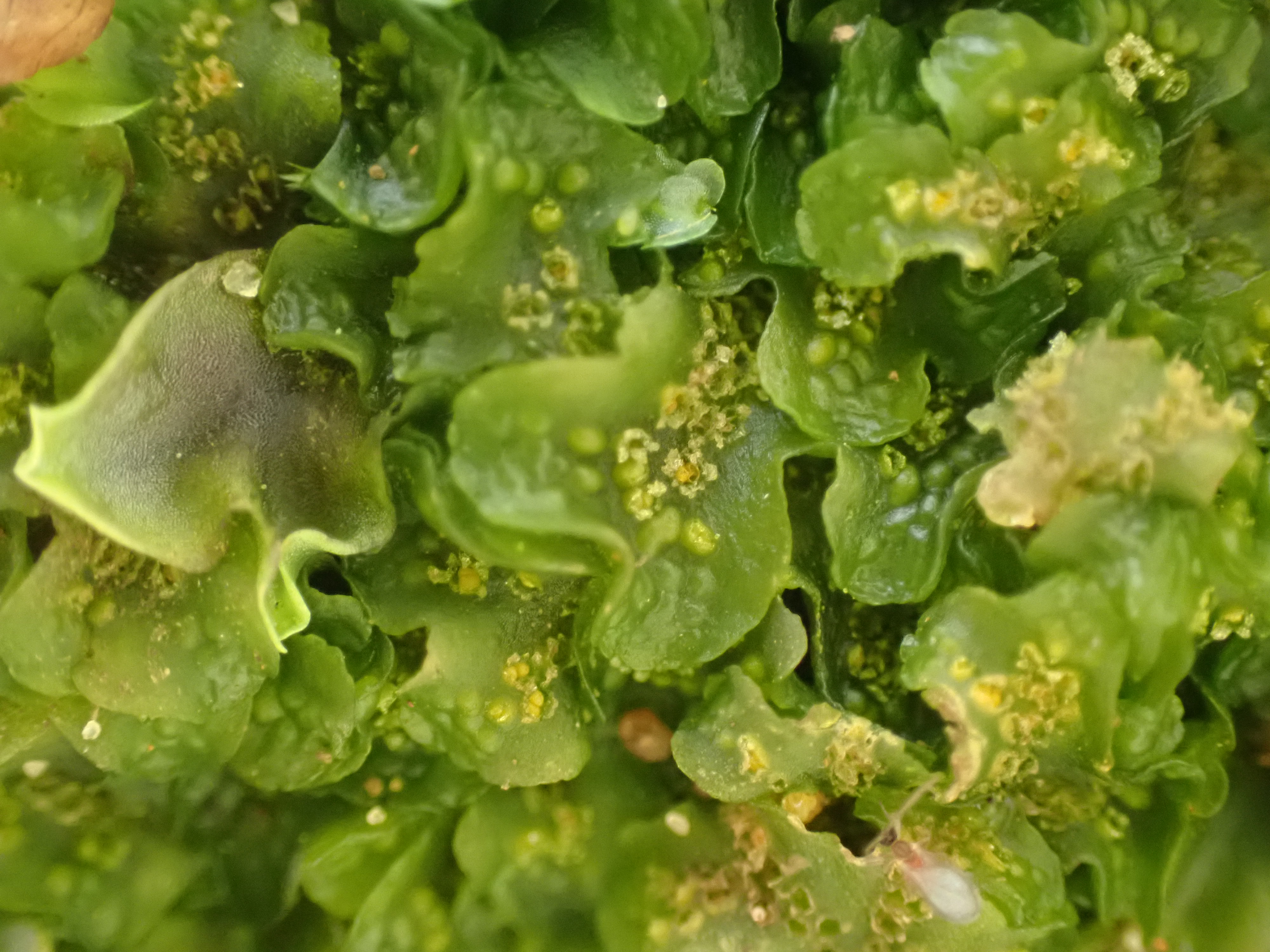
Yet despite how rare and restricted this is, it wasn't the bryophyte lifer on the cliff face I got most excited about. The cliff was covered in hornwort, and I have never seen a hornwort before! This is Phaeoceros laevis! Here is the female with the horns.
And the male plants.
Earlier that morning, Iain took us into Shanklin to see the incredible fungus Coccomyces delta that grows on the old leaves of Bay. Such weird triangular structures, spot the four-sided one doing its own thing. I salute it.
And a quick stop to a churchyard for a naturalised clubmoss tick, Krauss's Clubmoss.
I covered three quarries over the trip. A couple with Mark and Iain but also I had a look at a quarry down by the Needles with Karen and that was a great little spot. A new hectad record for Phaeocedus braccatus was a real find!
And the ridiculously common Agyneta mollis. Two new hectads for this on the island brings the post 1992 hectads for this spider to at least 98, it's hurtling towards not even being Nationally Scarce at this rate (I had it in a playing field by my house this week).
And a Scotina, but unfortunately I lost the specimen. All are rare on the island and given I was in a chalk pit, this is quite likely to have been Scotina palliardii. I will have to go back! I got a couple of money spiders new to the island at various locations over the week, Micrargus laudatus and Parapelecopsis nemoralioides.
Rewind to a few days earlier when I went to visit Mark and his magnificent new garden. He got me four new bryophytes, really by hammering some of the really small acrocarps. But it was a new pseudoscorpion that was most exciting for me, Pselaphochernes scorpioides.
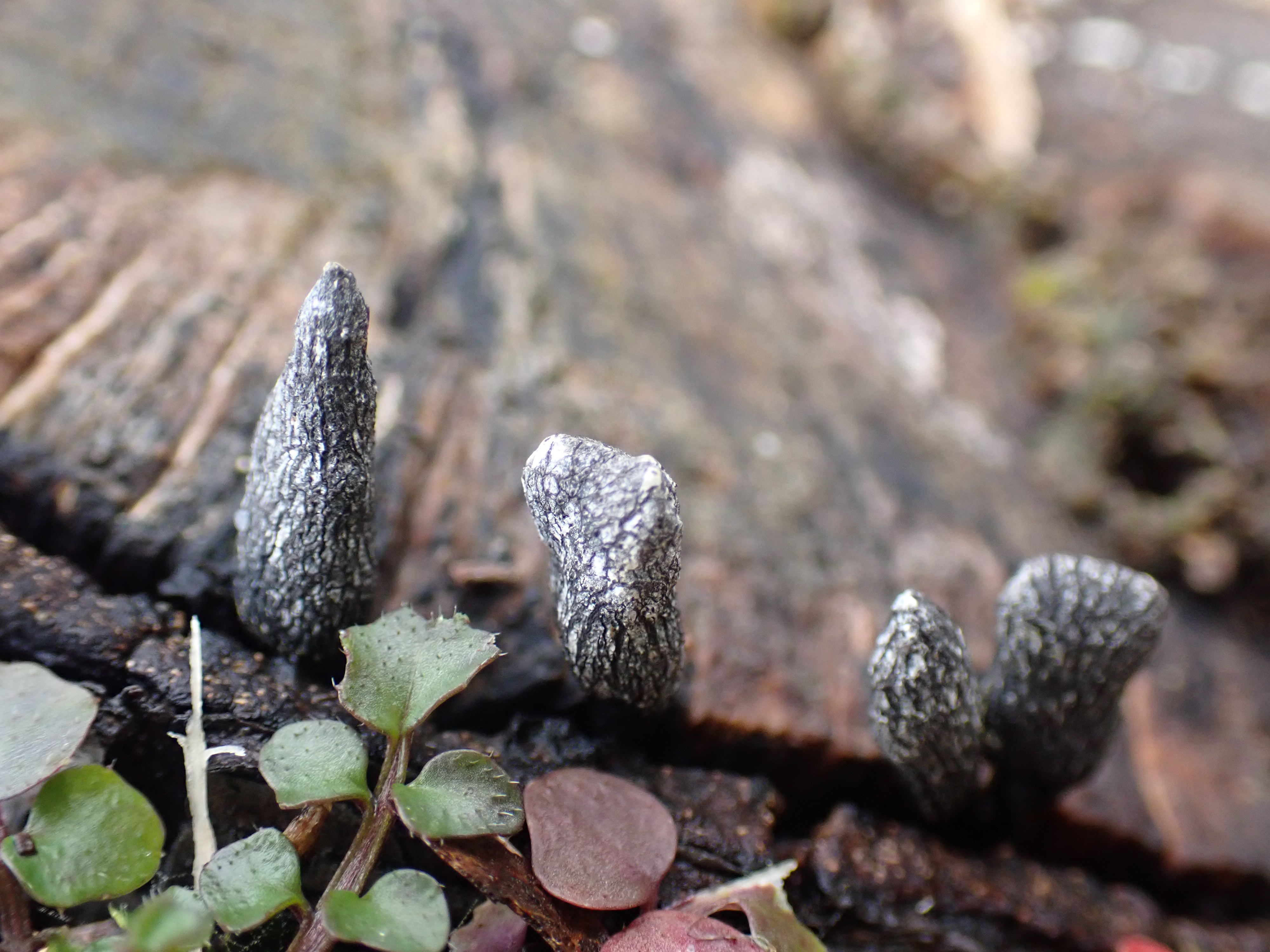
And a new fungus! This is Xylaria cinerea.
Then on to Ventnor Botanic Gardens. Mark had found this ant new to Britain sometime before my visit, it's Tapinoma ibericum. It's so numerous there that I spotted it on the first evening when Karen and I walked up to the gardens only to find them closing and I noticed it on the walls by the toilet block without realising the significance. They form impressive long lines.
A millipede that's only found here is, this one is particularly pale, Cylindroiulus apenninorum.
But Mark breaths first for Britain, so it didn't take long before he found one in the form of this weevil, under a rock. Likely to be associated with Cork Oak, Mark says it's in the genus Echinodera.
And another lifer in the car park for me. The rather odd looking reticulated slug, Tandonia cristata.
Karen and I went back to the gardens on a rainy day, when I discovered this fenced-off tunnel and just how good at light gathering the camera is on my new phone (I upgraded after nearly seven years). This was pitch black to the naked eye. The open end apparently comes out half way up a cliff, so no spidering in the for me.
And I turned a couple of stones and got the shelled slug we missed first time, Mark says it's most likely. Ear Shelled Slug Testacella haliotidea.
And no trip to the Isle of Wight is complete without visiting the Needles. I love the soils here.
So that's it for the part 2. What a week. It was a really great pan-species listing holiday, that was also in part research for the book on pan-species listing I am now 50,000 words into. A HUGE thanks to Mark for giving me so much of his time and knowledge, it was so much fun!
Yet my field season has started and I didn't quite get this out in time before I hit this period of high pressure (today is day four of a straight run of field work and I've already walked 19 miles since Sunday). I have made over 1000 records in the last three days and have just hit 200,000 records. So I think my next post will be a celebration of biological recording. I will leave you with my 2nd favourite photo of the week, a Carrion Crow that joined the ferry about a fifth of the way across and stayed with the boat all the way to the island!
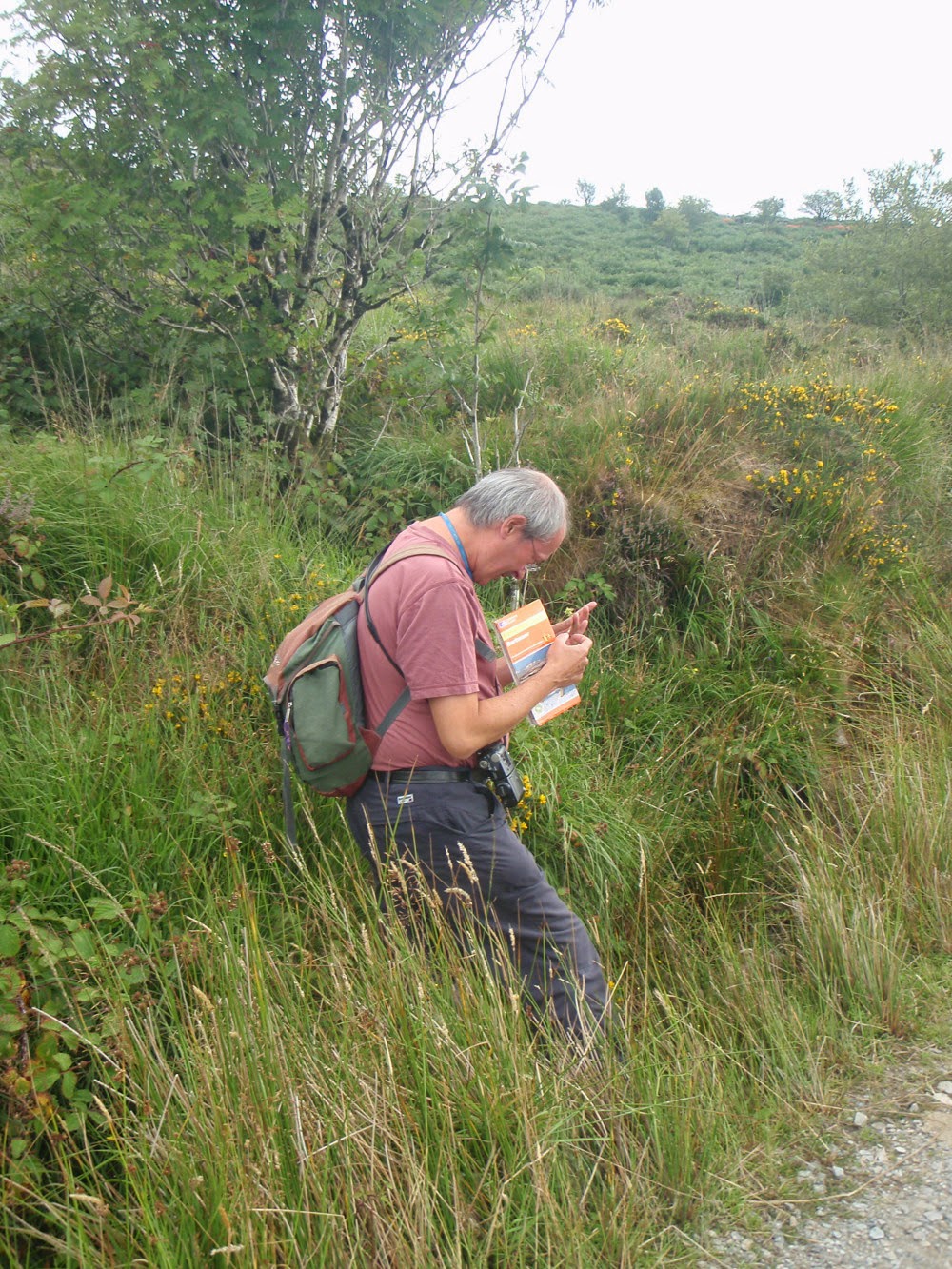
A couple of weeks ago at the annual Sussex Biological Recorder's Seminar I was approached by Brad Scott (above) during lunch who said "thanks ever so much for that course on Grasses, Sedges and Rushes that you ran several years ago, it really kick-started my interest in natural history." Now if I tell you that since this course, Brad has been on my Common Woodland Bryophytes course and has almost seen more mosses and liverworts than me now (have a look at the PSL rankings for bryophytes) it starts to put things in perspective. Yet this is just the start of Brad's natural history adventures!
It's exactly this kind of inspiration that I always hope my courses will provide. It's certainly not going to be everyone that gets the bug like this but even if we reach one or two people a year in this way we are making a difference. So, I asked Brad if he would mind writing a few words about his experience with the Trust's courses and this is what he put together...
"The first Sussex Wildlife Trust course I did was Graeme Lyons' fabulous weekend
on Grasses, Sedges and Rushes about five years ago. It really inspired me to
further explore the rich and varied habitats we have right on our doorstep. A
couple of years ago I also did the Mosses and Liverworts course too, and that
prompted me to find out more at the local field meetings of the British
Bryological Society and tentatively start recording. Not content just to look at
plants, starting a Pan-Species List has
provided me a focus for attempting to comprehend the diversity of all habitats.
In addition, appreciating that exploring the natural world is best shared with
other people, I've also been involved starting up a local natural history
group in Forest Row, and occasionally blogging. Wildlife Trust courses are clearly an
excellent way to learn, share, and ignite one's passion for all
wildlife."
This sort of thing really is music to my ears and inspires me in turn to keep going with these courses and produce new material annually. Brad's rather stylish and understated blog is a great read, particularly his post on wildlife recording and how a relative beginner really can contribute quite a lot if you work closely with more experienced naturalists. So to tie all this together myself, Brad and the country recorder for bryophytes are going to go looking for the rare and elusive Ghostwort in the Ashdown Forest one weekend in March. We will probably look something like this. Watch this space.
So why not book on one of the many fantastic courses
Sussex Wildlife Trust has to offer? I can't promise that you'll become a Ghostbuster but you will certainly learn something about the amazing wildlife of Sussex and have a great time in the process. Call 01273 497561 for more info (I resisted saying it!).
Here we have the liverwort, Scapania undulata, one of many scarce bryophytes I saw yesterday in a ghyll in Long Wood near Wakehurst Place. I think it looks a bit like mushy peas. Here is the same liverwort with the striking cranefly Tipula vittata.
Tom Ottley and Jacqui Hutson were kind enough to allow me to tag along and show me some of the scarcer ghyll stream bryophytes and this particular ghyll had lots of rare species.
Perhaps the rarest moss we saw yesterday was the strange and tiny Tetradontium bownianum but it is so small and grows in such shade that a photo wasn't an option. Second rarest was this tiny liverwort growing on a rock in a ghyll stream Jungermannia pumila, another species with a very north western distribution.
This a great big patch of the pleurocarp Hyocomium armoricum, another species of moss I have never seen before. Opposite-leaved Golden Saxifrage can be seen flowering along the ghyll too.
I finally connected with Hay-scented Buckler-fern!
Finally, not rare but one of the few common shield bugs I didn't have a photo of. This is the Bronze Shield Bug Troilus luridus.
I'm still feeling rough so I'm trawling through old files to find interesting tales from the past. In 2007 I spent a month working at Abernethy RSPB with Mark Gurney, helping them carry out bird surveys. There were lots of great things to see there but a day that really stood out was when we went up Cairn Gorm on the 5th May. We were in search of Ptarmigan and Dotterel and we had excellent views of both. Amazing how confiding these birds are.

I just love spending time in the mountains, so many new things to see! Lots of good plants such as Interrupted Club-moss, Alpine Hair-grass, Curved Wood-rush, Dwarf Cudweed, Sheathed Sedge and Stiff Sedge. But as is often the case, it's the things that you are not expecting to see that get you most excited. We saw a few of these little moths flying around in the sun shine that totally confused us. As we were looking through the photos afterwards, one of us was arguing for Black Mountain Moth and the other for Netted Mountain Moth. Of course, neither of these were anywhere near the mark. It's Broad-bordered White Underwing. This is quite a nice mountain moth and we were lucky to stumble across such a rarity!
By the way the moss in the background of the photo is Racomitrium lanuginosum. I have not been to Scotland since I left the RSPB. I really must get up there again soon...
Is one way of describing this bizarre looking creature. As for the four men who discovered it today up at Ditchling Beacon, carved from root vegetables might be more appropriate. Looking somewhere between the A-Team and Boyz II Men, we hit the site with all the natural history knowledge we had and we hit it hard. I got the bryophytes out of the way first and everyone else got lots of new species. I've featured these many times before and as I anticipate Steve Gale writing a blog with lots of photos in,
I have left space for a link here. It was nice to show people lots of new species though, Ditchling Beacon is great for chalk-grassland bryophytes.
Things started getting exciting for me when we went sieving moss though. We hooked up with another of the bizarre harvestman Anelasmocephalus cambridgei shown above. This one was much paler, exactly the same colour of the chalky soil. I recorded four new species, all from sieving. Two ground bugs being Cymus claviculus and Drymus ryei. We also found this Drymus brunneus which seems to have fungus bursting out of every orifice. Ouch.
Just when I thought I had ran out of interesting specimens I recorded a male Walckaenaeria antica (my fourth in the genus and 213th spider). Finally, what I thought was a Bembidion tuned out to be a carabid tick. Syntomus truncatellus! A cracking day out, more of this please! Sadly though I was hugely gripped by the size of Steve's club sandwich and that is not a euphemism for anything, there is just nothing worse than ordering the wrong meal.
More mosses I'm afraid. Another day out on reserves with Tom Ottley. This time at Ditchling Beacon and again we get a thumbs up for our management in terms of bryophytes. I added six new mosses to my list and a lichen. This first one wasn't a new one for me but is a chalk-grassland specialist. Fissidens dubius.
We have lots of the attractive moss Hylocomium splendens.
And Scapania aspera is all over the place in small patches. This liverwort is a key species for the site and the only species that makes up the 'southern hepatic mat' that occurs at Ditchling Beacon.
I was finally able to put a name to this golden pleurocarp, it's Campylium protensum.
Tom showed me this moss in the quarry, which was new to me. Fissidens incurvus.
Finally, here is my new lichen. Growing in amongst the liverwort Cololejeunea minutissima. The lichen is Normandina pulchella. That puts me on 4178 species.


Last week I was out again with the bryologists Sharon Pilkington and Tom Ottley. This time at Marline Valley, my first real opportunity to walk the length of the ghyll stream there and see some of the rarer mosses and liverworts along its length. Now this is tough going. The valley gets quite steep while fallen trees and 'course woody debris' make progress slow. A lot of recent rainfall made the waders a good decision but slippy clay makes climbing the valley sides very difficult which you have to do often to avoid fallen trees. You really have to want to go down here. However, the first things I have to say is just how stunningly beautiful this place is. What is also great is that it's so untouched. There are no signs of people or management except the inevitable odd bit of litter and in this case the bryophytes are ticking along just fine under natural processes. It's hard to see how this could ever have been different. A real wild oasis just on the edge of Hastings. Waterfalls, sandrocks, base-rich flushes, plunge pools, hard bottomed sections, iron ore seepages. This stretch of stream is really quite something, every turn seems to throw up something new. Wild Garlic is showing its head and the banks are sometimes covered in Greater Woodrush.


This is the nationally scarce Fissidens rivularis growing along rocks on the edge of the stream.
The rather strange looking moss Hookeria lucens grows all along the steep sides of the ghyll.
There really is no management we can do to enhance the bryophytes here. All we really need to do is monitor the species and keep an eye on any potential pollution events. I saw 12 bryophytes new to my list putting me on 4168 species!
On the 9th January I met up with Sharon Pilkington and Tom Ottley to look at some of the rare bryophytes growing on the sandrocks at Eridge Rocks. It was an interesting day, I managed to see seven species I hadn't seen before (4156) including some quite scarce ones for this region. It was good to talk about the management of these often over-looked plants and to see that we are mostly getting it right too. Tom thought that the rocks were probably looking the best they had done in the last 50 years for this rare assemblage of tiny plants. A few tweaks that we could make include clearing brambles from some of the boulders and removing some of the lower branches from evergreen shrubs to let the dappled sunlight that these plants demand (direct sunlight or complete shade are a sure way to eradicate most of the species).
Here are a few of the species we saw. This first was perhaps the rarest of the mosses,
Dicranum scottianum (we only saw three tiny plants) but I was particularly pleased with this shot. It is taken with the lens looking directly up the side of the sandrocks. It was an incredibly dull, overcast day which I think the Coolpix 4500 does well in.
This TINY liverwort is known
Scapania umbrosa and was yet another species the bryologists were quite excited by. Nearby, this boulder, with a birch growing from it, was also a hot spot for a few scarce bryophytes.
Including this endearing little acrocarp (did I just say that). Tiny luminous-green sea urchins spring to mind. It's yet another species that can thrive on the sandrock,
Campylopus fragilis.

A phrase that kept popping up in the species accounts in the literature for these scarce species was 'hyper oceanic', essentially meaning of a far north-westerly distribution close to the Atlantic. In the Weald, we have many of these species, particularly on the sandrocks, but they are often very rare in the region (where they might be common in the north-west). It must be a specific set of climatic and substrate conditions that are provided here but it is something well worth holding on to. Without the appropriate management at Eridge we would certainly lose these plants to succession as Holly, Yew and Rhododendron cast their dense winter shade over the rocks. This is a great example of monitoring and management working hand in hand with the specialists feeding their knowledge and advice straight to us at the Trust in the field. If we want to hold on to rare and scarce species that have such specific requirements, we cannot rely on a 'one-size fits all' approach to their management and natural processes here would be damaging. Species-assemblage focused management is therefore vital if we are to maintain the more unusual plants and animals at Eridge. Small scale management like this is often referred to as 'gardening' by some conservationists these days. Call it what you like, I see it as
exactly what is required to maintain a rare and precious assemblage and that's exactly why I have conservation written through me like a stick of rock!


 Posts
Posts