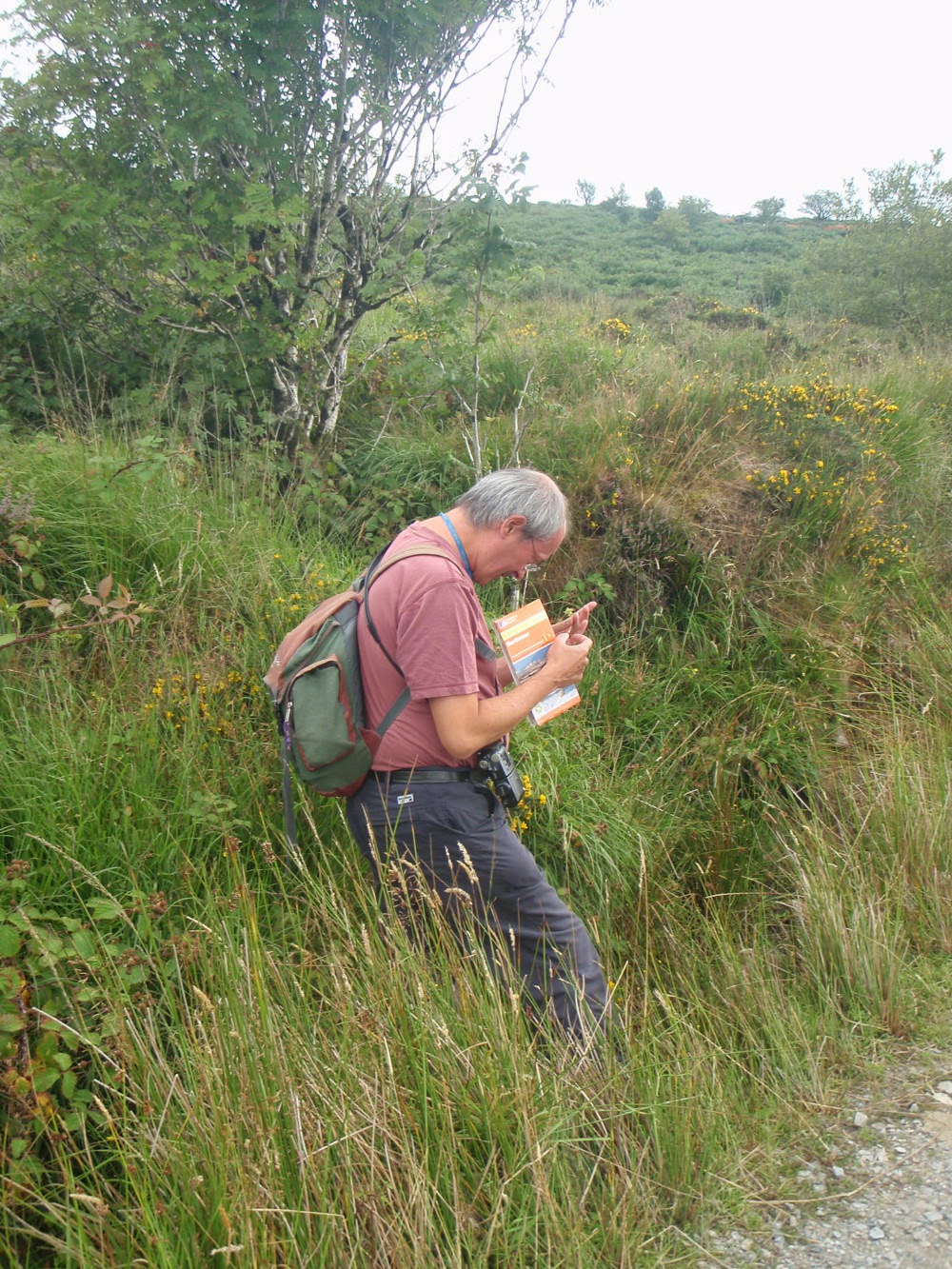
...yet we managed just that on the course I ran there on the 8th November. This is the third year I have ran the 'introduction to fungi' course there and despite a huge site list, we usually find something new there. The aim of the course is to show the limits of what can be done without microscopy. After a brief indoor session talking the attendees through the anatomy of fungi, we headed out onto the site. In 2016 we recorded around 50 species in the field, last year it was 60. This year it was a little less at just over 40 due to the dry autumn. It is perhaps a little unfair that some of the most exciting species were identified after the course but I will start with one of them as it was so striking.
First up we have a fungus with a conservation status. Not new to Ebernoe (last seen there in 2004) but it was new to me. This is the Gilded Bolete, a Near Threatened species that has only a couple records in Sussex and these were both from Ebernoe. Well done to the attendee who spotted this one. It keyed out really well using Kibby due to the small size, pink & slimy cap and exceedingly bright (the photo above does not do it justice) and large pores. Here it is from above, you can see flies and other detritus stuck to the slimy cap. I was pleased that Martin Allison agreed on the ID.
This species has been turning up all over recently, it wasn't too much of a surprise that one attendee spotted Plicatura crispa (I was surprised to see it now has an English name in Recorder being Crimped Gill). I recorded this new to all reserves two years ago at Flatropers, it's now been recorded on four of our reserves at least.
We bumped into Pete Flood who I met a couple of years ago on a lichen day in the New Forest and he tagged along and was a great help. I was pleased that by weight of numbers, we were able to find Holly Parachute without too much effort in the poor light. Thanks to Pete for letting me use this photo. I had never noticed how much this looks like human skin with hair coming out of it. Like someone crossed a fungus with a person. What a weird little thing, love that it only grows from dead Holly leaves.
Nearby (and another one of Pete's photos) we found some Pipe Club.
The Spectacular Rustgill we found was a candidate for one of the biggest mushrooms I have ever seen. It was utterly spectacular but without anything in the image to scale, I was left with an underwhelming brown mass in the photo below that looks like a Vic Reeves drawing of a face. Seriously, it was amazing. You had to be there.
Visual highlight of the day would have to go to Parrot Waxcap in the churchyard. We went on our annual pilgrimage to Ebernoe Cricket Pitch and for the first time ever, there was not a single waxcap anywhere to be seen. Sadly no Pink Waxcaps in the churchyard this year.
And Scarlet Caterpillar Clubs were also good value.
Who doesn't love a Magpie Inkcap?
But it was this earthstar that turned out to be the real highlight. First up I need to apologise to everyone for incorrectly identifying this in the field. Last year there were earthstars in the same area that were spotted by Mark Colvin and I was pretty sure we had identified them as Sessile Earthstars and that's what I incorrectly called this as on the course. When I got home and looked at the photo I came to think it might actually be Rosy Earthstar. A quick text to Mark and he was able to go and locate the exact specimen the next day and get it to Martin. It was in fact Arched Earthstar, which I have knowingly seen only once before in Easebourne Churchyard. This is a great record being not only new to Ebernoe Common but also new to all SWT reserves! Thanks Mark and Martin.
And this moth was also new, not an easy thing to get for Ebernoe being heavily 'mothed' over the years. Grey Shoulder-knot, the 659th moth recorded there.
We have recorded 1389 species of fungi on our 32 reserves so far and 967 of them have been recorded at Ebernoe Common, that's 70.0% from one site! No wonder it is one of only around 10 sites in the UK to be designated for its fungi. I love that we are still learning about that too. How long will it take to find another 33 species and get to a 1000?! A big thank you to everyone who attended and also to Pete, Mark and Martin for their input too.
Here is the full species list for the day (those marked with an asterisk were confirmed before or after by Martin Allison):
| Vernacular |
Species |
| Arched Earthstar |
Geastrum fornicatum * |
| Bay Bolete |
Boletus badius |
| Beech Jellydisc |
Neobulgaria pura |
| Beech Milkcap |
Lactarius blennius |
| Beech Woodwart |
Hypoxylon fragiforme |
| Birch Polypore |
Piptoporus betulinus |
| Blackfoot Polypore |
Polyporus leptocephalus |
| Blusher |
Amanita rubescens |
| Blushing Bracket |
Daedaleopsis confragosa |
| Butter Cap |
Rhodocollybia butyracea |
| Candlesnuff Fungus |
Xylaria hypoxylon |
| Clouded Funnel |
Clitocybe nebularis |
| Clustered Bracket |
Inonotus cuticularis * |
| Crimped Gill |
Plicatura crispa |
| Dead Moll's Fingers |
Xylaria longipes |
| False Death Cap |
Amanita citrina |
| Fluted Bird's Nest |
Cyathus striatus |
Fly Agaric
Garlic Parachute |
Amanita muscaria
Marasmius alliaceus |
| Gilded Bolete |
Aureoboletus gentilis * |
| Glistening Inkcap |
Coprinellus micaceus |
| Glue Crust |
Hymenochaetopsis corrugata |
| Golden Waxcap |
Hygrocybe chlorophana |
| Hen Of The Woods |
Grifola frondosa |
| Holly Parachute |
Marasmius hudsonii |
| Lemon Disco |
Bisporella citrina |
| Lilac Bonnet |
Mycena pura |
| Magpie Inkcap |
Coprinopsis picacea |
| Oak Bracket |
Pseudoinonotus dryadeus |
| Parrot Waxcap |
Gliophorus psittacinus |
| Pestle Puffball |
Lycoperdon excipuliforme |
| Pipe Club |
Macrotyphula fistulosa |
| Porcelain Fungus |
Oudemansiella mucida |
| Saffrondrop Bonnet |
Mycena crocata |
| Scarlet Caterpillar Fungus |
Cordyceps militaris |
| Scurfy Deceiver |
Laccaria proxima |
| Sheathed Woodtuft |
Kuehneromyces mutabilis * |
| Snowy Waxcap |
Hygrocybe virginea |
| Spectacular Rustgill |
Gymnopilus junonius |
| Stump Puffball |
Lycoperdon pyriforme |
| Sulphur Tuft |
Hypholoma fasciculare |
| Tawny Grisette |
Amanita fulva |
| Tiered Tooth |
Hericium cirrhatum |
| Trooping Funnel |
Clitocybe geotropa |
| Turkeytail |
Trametes versicolor |
| Tyromyces chioneus |
Tyromyces chioneus * |

Back on the 16th June (how can six weeks feel like a lifetime away?!) I ran a short half-day course for the RSPB at Wiggonholt Common, part of Pulborough Brooks RSPB Reserve. The remit of the course was to teach a whole load of RSPB staff about heathland invertebrates. This recently restored heathland coming out of pines is fairly under-recorded, so we were likely to get some good records for the site. I used the picture of the Pantaloon Bee Dasypoda hirtipes just to attract your attention, although a nice 'bare ground' species, they are well known from the car park at Pulborough Brooks! Those hind legs are spectacular but I am sure I have seen them somewhere before...

By far the best thing we found was this Dalman's Leatherbug Spathocera dalmanii found by one of the attendees! It's actually my first Sussex example of this species (I have only recorded twice before, once in Hampshire and once in Dorset). It's also only the third Sussex record and the most easterly in the county! Well done.
What I really wanted to do was to show just how few heather specialists occur on a heath. In the table below, I have written a very quick one or two words about the most significant habitat requirements of that species. Now please note these are quick notes and someone is bound to object to the odd detail. So unless I have made a glaring mistake, please don't bother! It's a rough guide and this sort of analysis works by weight of numbers. For those that came on my chalk-grassland invertebrate course, I am working on a similar post but with twice the species, this is taking a little longer than I had hoped.
| Taxon
group |
Recommended Common Name |
Resource |
| Beetle |
Ampedus balteatus |
Deadwood |
| Beetle |
Anoplotrupes stercorosus |
Woodland, dung |
| Beetle |
Athous haemorrhoidalis |
Roots |
| Beetle |
Cryptocephalus fulvus |
Grassland |
| Beetle |
Cryptocephalus parvulus |
Birch |
| Beetle |
Dasytes aeratus |
Deadwood |
| Beetle |
Dune Chafer |
Roots, sandy soils |
| Beetle |
Green Tiger Beetle |
Bare ground |
| Beetle |
Heather Beetle |
Heather |
| Beetle |
Hemicrepidius hirtus |
Roots |
| Beetle |
Luperus longicornis |
Generalist |
| Beetle |
Malachite Beetle |
Deadwood |
| Beetle |
Nalassus laevioctostriatus |
Deadwood |
| Beetle |
Oedemera lurida |
Flowers |
| Beetle |
Small Heather Weevil |
Heather |
| Beetle |
Stenurella melanura |
Deadwood |
| Beetle |
Striped Ladybird |
Pines |
| Beetle |
Strophosoma melanogrammum |
Trees & bushes |
| Beetle |
Vine Weevil |
Roots |
| Beetle |
Welsh Chafer |
Roots |
| Bug |
Aphrophora alni |
Trees & bushes |
| Bug |
Evacanthus interruptus |
Generalist |
| Bug |
Rhyparochromus pini (Nb) |
Bare ground |
| Bug |
Spathocera dalmanii (NS) |
Acid grassland |
| Bug |
Ulopa reticulata |
Heather |
| Bug |
Zicrona caerulea |
Leaf beetle predator |
| Butterfly |
Green Hairstreak |
Gorse/broom |
| Butterfly |
Meadow Brown |
Grasses |
| Dragonfly |
Black-tailed Skimmer |
Aquatic larvae |
| Dragonfly |
Broad-bodied Chaser |
Aquatic larvae |
| Earwig |
Common Earwig |
Generalist omnivore |
| Fly |
Dasysyrphus venustus |
Woodland margins |
| Fly |
Dioctria atricapilla |
Grassland predator |
| Fly |
Helophilus pendulus |
Wetland |
| Fly |
Neoitamus cyanurus |
Woodland predator |
| Fly |
Scathophaga stercoraria |
Dung |
| Hymenopteran |
Ammophila sabulosa |
Bare ground |
| Hymenopteran |
Bombus pascuorum |
Flowers |
| Hymenopteran |
Cerceris rybyensis |
Bare ground |
| Hymenopteran |
Dasypoda hirtipes (Nb) |
Bare ground |
| Hymenopteran |
Formica fusca |
Generalist predator |
| Hymenopteran |
Honey Bee |
Flowers |
| Moth |
Beautiful Yellow Underwing |
Heather |
| Moth |
Brindled Beauty |
Trees & bushes |
| Moth |
Brown Silver-line |
Bracken |
| Moth |
Common Footman |
Lichens |
| Moth |
Endotricha flammealis |
Generalist |
| Moth |
Silver Y |
Migrant |
| Moth |
Vapourer |
Trees & bushes |
| Orthopteran |
Common Ground-hopper |
Generalist omnivore |
| Orthopteran |
Mottled Grasshopper |
Bare ground |
| Orthopteran |
Speckled Bush-cricket |
Generalist omnivore |
| Spider |
Araneus quadratus |
Generalist predator |
| Spider |
Arctosa leopardus |
Bare ground |
| Spider |
Cercidia prominens (NS) |
Scarce generalist |
| Spider |
Evarcha arcuata (NS) |
Heather |
| Spider |
Evarcha falcata |
Generalist predator |
| Spider |
Labyrinth Spider |
Generalist predator |
| Spider |
Mangora acalypha |
Grassland predator |
| Spider |
Marpissa muscosa |
Deadwood & fence posts |
| Spider |
Neottiura bimaculatum |
Trees & bushes |
| Spider |
Xerolycosa nemoralis (NS) |
Bare ground |
| Tick |
Ixodes ricinus |
Mammal parasite |
Of the 63 species we recorded in around two hours, only five (7.9%) were thought to be directly associated with heathers. In total, six (9.5%) had conservation status which is pretty good. So generalists, bare ground species, woodland & scrub and deadwood species ALL outnumber those species that are tied to the heathers. Yet of these, it's only really the bare ground species that fall into what we would call a 'heathland invertebrate'. Not that the others are not welcome. Additionally if we count the acid grassland species and those on sandy soils, that's a total of 14 out of 63 species. So about 22.2% could perhaps be considered 'heathland invertebrates' but this is becoming more subjective as you group the species in this way.
This is a really interesting exercise in showing that a healthy heathland is not just about dense blocks of heather, far from it. A healthy heathland has a wide range of resources held in an intricate mosaic. This is not an easy thing to achieve, and requires careful management to hold these sites, often poised at the point of collapse, so that all of these resources can be present in some amounts all of the time.
Last Friday I ran a course for the first time. An Introduction to Spiders at Iping Common. This fantastic reserve is Sussex's best site for spiders, with 204 species recorded there and a quarter of these having conservation status, it's one of the best places to see spiders in Sussex (along with Rye Harbour).
The aim was to show how much can be done in the field and also how much needs to be done at the microscope. The very first spider we recorded on the first Gorse we beat was the nationally scarce Araneus angulatus! All in all we recorded 21 species. Only one of these was identified at the microscope. Tibellus oblongus. Despite taking several very spotty Tibellus, we didn't manage to add Tibellus maritimus to the site list, a useful lesson in how some ID features are only a guide with spdiers. In fact, it's getting really hard to add a new spider to this site! Here are the spiders we saw with the year they were last recorded and their conservation status.
| Species |
Cons status |
Last record |
| Aelurillus v-insignitus |
NS |
2017 |
| Agalenatea redii |
|
2017 |
| Agelena labyrinthica |
|
2017 |
| Anyphaena accentuata |
|
2012 |
| Araneus angulatus |
NS |
2012 |
| Araneus diadematus |
|
2017 |
| Araneus quadratus |
|
2017 |
| Arctosa perita |
|
2017 |
| Cercidia prominens |
NS |
2017 |
| Euophrys frontalis |
|
2007 |
| Evarcha arcuata |
NS |
2017 |
| Evarcha falcata |
|
2017 |
| Hypsosinga sanguinea |
NS |
2018 |
| Mangora acalypha |
|
2017 |
| Philodromus histrio |
NS |
2017 |
| Pisaura mirabilis |
|
2017 |
| Salticus cingulatus |
|
2012 |
| Simitidion simile |
|
2017 |
| Thomisus onustus |
NS |
2017 |
| Tibellus oblongus |
|
2012 |
| Xerolycosa nemoralis |
NS |
2018 |
That's a whopping 38% of spiders with conservation status! Stars of the show included the jumping spiders and of course Thomisus onustus shown above. We found one adult male and two immature females. It's the male featured in the image above and below. I think it looks like cooling lava against the black heath.
This is the female (although this image was taken some years ago of an adult - wow it was over eight years ago now).
Well done everyone who attended and help find the spiders, if any course attendees have any photos they would like to share on this post from the day I will gladly do so. It was a great day. But it didn't end with the spiders. We had two species new to Iping Common. Both bugs, being Leptopterna ferrugata and Aradus cinnamomeus. The rare beetle Cryptocephalus biggutatus also showed up in the sweep net.
"This is a snakeskin jacket! And for me it's a symbol of my individuality, and my belief...in personal freedom". Sailor, Wild at Heart.
I suspect only the hardcore David Lynch fans will have even the remotest clue as to what I am wittering on about here. Anyways, last week I ran my 'Introduction to Fungi' course at Ebernoe for the second year. It was another great day, it aims to show people that although limited, you can still do quite a bit of mycology in the field before you end up on a spore drive (see what I did there?). So our aim was to beat the 53 or so species were recorded last year and maybe a get a species new to Ebernoe like the Parasitic Bolete we recorded last year. We succeeded on the former but failed on the latter. It's hard to get a new species of fungi at Ebernoe, especially one identifiable in the field when 963 species have already been recorded there. Anyway the highlight was this Snakeskin Grisette. Only the second time I have seen this, the first being on the 1000 species challenge with Dave Green and that was at 2.00 am and I hardly had time to stop and appreciate it. Well done to the attendee who found the specimen!
We picked up some Heath Waxcaps in Leconfield Glade, the first record for the reserve for over 20 years so that was probably the most exciting record. Other highlights included Sinuous, Trumpet and regular Chanterelles, Sulphur Knight, Fluted Bird's-nest Fungi, White Saddle, Horn of Plenty, Magpie Inkcap, Pink Waxcap and a very VERY sloppy Tiered Tooth and a few little extras at the end on Ebernoe Cricket Pitch...
The same attended that found the Snakeskin Grisette found this freaky little oddity that after some discussion with Martin Allison, we think is a young Mosaic Puffball. So, we will be running the course again next year. If you fancy a romp around Ebernoe looking for some of our most charismatic fungi, then please come along.
Yesterday I ran a new course for the Trust entitled 'Invertebrates of a Heathland'. The idea was to show the participants how to find and identify some of the many species of invertebrate that thrive in this habitat. So where better to run it than at our third most speciose site and arguably the richest heathland in Sussex than Iping & Stedham Commons?
It was a good group with 11 in attendance including staff from Sussex Wildlife Trust, Surrey Wildlife Trust, Species Recovery Trust, National Trust and Thames Basin Heaths Partnership. My approach was to get them to get their hand's dirty, so nets and pots were handed out and id didn't take long until we built up quite an impressive list. I have included below the whole list as promised to the course attendees with some notes on the species they saw. 'N' is new to the site (14 in all), 'NN' is new to the site AND the reserve network (amazingly there were three of these!) and GL was new to me. I had four new species taking me into 7th places on the PSL rankings.
| Taxon group |
Species |
Status |
| beetle |
7-spot Ladybird |
|
| beetle |
Cream-streaked Ladybird |
|
| beetle |
Exapion ulicis |
|
| beetle |
Heather Beetle |
|
| beetle |
Heather Ladybird |
|
| beetle |
Micrelus ericae |
|
| beetle |
Neliocarus sus |
|
| beetle |
Paradromius linearis |
|
| beetle |
Pine Ladybird |
|
| beetle |
Poecilus cupreus |
|
| beetle |
Protopirapion atratulum |
N |
| beetle |
Silpha atrata |
N |
| beetle |
Sitona lineatus |
|
| beetle |
Sphaeriestes castaneus |
NN |
| beetle |
Striped Ladybird |
|
| beetle |
Welsh Chafer |
|
| butterfly |
Gatekeeper |
|
| butterfly |
Red Admiral |
|
| butterfly |
Small Tortoiseshell |
N |
| butterfly |
Speckled Wood |
|
| centipede |
Lithobius forficatus |
N |
| centipede |
Lithobius variegatus |
N |
| crustacean |
Porcellio scaber |
|
| dragonfly |
Azure Damselfly |
|
| dragonfly |
Black Darter |
|
| dragonfly |
Emperor Dragonfly |
|
| earwig |
Common Earwig |
|
| harvestman |
Paroligolophus agrestis |
N |
| harvestman |
Phalangium opilio |
|
| hymenopteran |
Ammophila pubescens |
|
| hymenopteran |
Apis mellifera |
|
| hymenopteran |
Bombus lapidarius |
N |
| hymenopteran |
Bombus pascuorum |
|
| hymenopteran |
Bombus terrestris |
|
| hymenopteran |
Cerceris arenaria |
|
| hymenopteran |
Colletes hederae |
N |
| hymenopteran |
Epeolus cruciger |
GL |
| hymenopteran |
Formica fusca |
|
| hymenopteran |
Formica rufa |
|
| hymenopteran |
Formica sanguinea |
|
| hymenopteran |
Neodiprion sertifer |
NN, GL |
| hymenopteran |
Nomada rufipes |
|
| hymenopteran |
Philanthus triangulum |
|
| lacewing |
Chrysoperla carnea group |
|
| moth |
Angle Shades |
|
| moth |
Beautiful Yellow Underwing |
|
| moth |
Eupoecilia angustana |
N |
| moth |
Fox Moth |
|
| moth |
Horse-Chestnut Leaf-miner |
|
| moth |
Large Yellow Underwing |
|
| moth |
Lesser Yellow Underwing |
|
| moth |
Rush Veneer |
|
| moth |
Setaceous Hebrew Character |
|
| orthopteran |
Bog Bush-cricket |
|
| orthopteran |
Common Ground-hopper |
|
| orthopteran |
Long-winged Cone-head |
|
| orthopteran |
Meadow Grasshopper |
|
| orthopteran |
Mottled Grasshopper |
|
| orthopteran |
Roesel's Bush-cricket |
|
| orthopteran |
Speckled Bush-cricket |
|
| spider |
Agalenatea redii |
|
| spider |
Anelosimus vittatus |
|
| spider |
Araneus diadematus |
|
| spider |
Araneus quadratus |
|
| spider |
Arctosa perita |
|
| spider |
Argiope bruennichi |
|
| spider |
Evarcha arcuata |
|
| spider |
Evarcha falcata |
|
| spider |
Gibbaranea gibbosa |
|
| spider |
Hypsosinga albovittata |
|
| spider |
Labyrinth Spider |
|
| spider |
Linyphia triangularis |
|
| spider |
Mangora acalypha |
|
| spider |
Metellina segmentata |
|
| spider |
Philodromus histrio |
|
| spider |
Pisaura mirabilis |
|
| spider |
Simitidion simile |
|
| spider |
Theridion sisyphium |
|
| spider |
Thomisus onustus |
|
| spider |
Trochosa terricola |
|
| spider |
Xerolycosa nemoralis |
|
| spider |
Zygiella atrica |
|
| true bug |
Birch Shieldbug |
|
| true bug |
Drymus sylvaticus |
|
| true bug |
Gastrodes grossipes |
|
| true bug |
Heath Assasin Bug |
|
| true bug |
Hairy Shieldbug |
|
| true bug |
Himacerus apterus |
|
| true bug |
Kleidocerys resedae |
|
| true bug |
Macrodema micropterum |
|
| true bug |
Nabis ericetorum |
|
| true bug |
Neophilaenus lineatus |
N |
| true bug |
Orthotylus ericetorum |
|
| true bug |
Phytocoris insignis |
NN, GL |
| true bug |
Pilophorus cinnamopterus |
|
| true bug |
Rhyparochromus pini |
|
| true bug |
Scolopostethus decoratus |
|
| true bug |
Stenodema calcarata |
|
| true bug |
Tortoise Bug |
|
| true bug |
Ulopa reticulata |
|
| true fly |
Chrysotoxum festivum |
|
| true fly |
Dasysyrphus tricinctus |
N |
| true fly |
Episyrphus balteatus |
|
| true fly |
Hornet robberfly |
|
| true fly |
Machimus atricapillus |
|
| | |
The most exciting find for me was Phytocoris insignis. This rare heathland species that looks like a small and dark Phytocoris varipes was swept from Heather on Stedham. It's only the second Sussex site for this RDB3 species.
But the stars of the show were the Hornet Robber Fly and Thomisus onsitus. Hornet Robber Fly because it was new to all the attendees and was the biggest one I had ever seen. What a beauty! Thomisus onistus because one of the attendees stated at the beginning how much they wanted to see this strange spider. I instructed that it was best to sweep Bell Heather and after some furious sweeping, she turned up the only one!
Bee Wolf was EVERYWHERE!
And Epeolus cruciger was a new one for me. It's hard to believe this is a bee!
Spiders came in at 22 species, with the stonking Philodromus histrio a real favourite.
Another attendee found Ivy Bee new to the site too. So it was really great to not only give people some guidance but also to show that they can directly contribute to the recording of such well recorded sites. Of the 105 species mentioned above, 14 were new to the site! This really surprised me and some of them seem like they might be errors on my part when I put the master spreadsheet together (Small Tortoiseshell and Bombus lapidarius particularly). The reserve network now boasts records of some 9908 species and 2781 of these have been recorded at Iping & Stedham. We didn't add any new spiders though, it's really tough going to find a new spider for this site. No Heath Tiger Beetles but we were cut short on that one by a monster of a storm. It was a great atmosphere and I would definitely run this kind of course again.
What a weekend! What a line up. It's been a long time since I invested in some training, this weekend being the
British Myriapod and Isopod Group's recording event in the south east. I couldn't miss it and a big thanks to Paul Lee for organising. Now, I've already blogged about the
beetle highlight for me being the second record for Sussex of
Mesosa nebulosa. So here I am gonna talk about myriapods and isopods.
Myriapods predominantly include the millipedes and centipedes. Here is a huge, greenish, rapidly-tapering centipede we found in a compost heap at Wisley RHS. This is Henia vesuviana. Even though I saw more millipedes, it was the centipedes I was more into, as many of them were identifiable in the field.
Such as this one that is often found under pine bark being Geophilus carpophagus.
There are around 60 species and there is a
good key by FSC. Now, I saw lot of millipedes but didn't manage a photo beyond a blurred shot of the species we came to know as 'Millipede X' (no one was sure what this was exactly - you see we have quite a few alien species). There are about 60 species of these too but new alien synathropic species are being discovered so I can't be sure on this. You can find out more about identifying myriapods and isopods
here. I learnt a great way to tell Tachypoidulus niger in the field and how easy it is to see and adult male
in the field.
Now thanks to Steve Gregory I saw two new woodlice (Trichoniscoides albidus & Ligidium hypnorum) but photographed neither. There are around 40 species with only relatively few very common ones. This is Porcellionides cingendus. I see it now and again (including today in the suction sampler) in rush litter at Woods Mill.
I also had a few other interesting species, such as this Green Celar Slug Limacus maculatus. Although due to its camo-pattern, I refer Combat or Battle Slug.
And good old Staphylinus dimidiaticornis put in a show too.
A massive thank you to all the people who helped but particularly Paul Lee, Steve Gregory and Keith Lugg. I've already put into practice what I learned and I'm looking forward to finding some more myriapods and isopods sometime soon! I have three fairly common woodlice on my wish list to look out for now too...
A couple of weeks ago at the annual Sussex Biological Recorder's Seminar I was approached by Brad Scott (above) during lunch who said "thanks ever so much for that course on Grasses, Sedges and Rushes that you ran several years ago, it really kick-started my interest in natural history." Now if I tell you that since this course, Brad has been on my Common Woodland Bryophytes course and has almost seen more mosses and liverworts than me now (have a look at the PSL rankings for bryophytes) it starts to put things in perspective. Yet this is just the start of Brad's natural history adventures!
It's exactly this kind of inspiration that I always hope my courses will provide. It's certainly not going to be everyone that gets the bug like this but even if we reach one or two people a year in this way we are making a difference. So, I asked Brad if he would mind writing a few words about his experience with the Trust's courses and this is what he put together...
"The first Sussex Wildlife Trust course I did was Graeme Lyons' fabulous weekend
on Grasses, Sedges and Rushes about five years ago. It really inspired me to
further explore the rich and varied habitats we have right on our doorstep. A
couple of years ago I also did the Mosses and Liverworts course too, and that
prompted me to find out more at the local field meetings of the British
Bryological Society and tentatively start recording. Not content just to look at
plants, starting a Pan-Species List has
provided me a focus for attempting to comprehend the diversity of all habitats.
In addition, appreciating that exploring the natural world is best shared with
other people, I've also been involved starting up a local natural history
group in Forest Row, and occasionally blogging. Wildlife Trust courses are clearly an
excellent way to learn, share, and ignite one's passion for all
wildlife."
This sort of thing really is music to my ears and inspires me in turn to keep going with these courses and produce new material annually. Brad's rather stylish and understated blog is a great read, particularly his post on wildlife recording and how a relative beginner really can contribute quite a lot if you work closely with more experienced naturalists. So to tie all this together myself, Brad and the country recorder for bryophytes are going to go looking for the rare and elusive Ghostwort in the Ashdown Forest one weekend in March. We will probably look something like this. Watch this space.
So why not book on one of the many fantastic courses
Sussex Wildlife Trust has to offer? I can't promise that you'll become a Ghostbuster but you will certainly learn something about the amazing wildlife of Sussex and have a great time in the process. Call 01273 497561 for more info (I resisted saying it!).
When I left Newhaven on Sunday morning to go to France for a couple of hours, I wasn't expecting to get a new species of cetacean on my British list. The first dolphins we saw turned out to be White-beaked Dolphins. This is hugely significant in the English Channel as this species is associated with more northern waters, particularly the North Sea. They were quite large dolphins with obvious pale markings but their most striking feature was the frequency with which they were breaching, sending splashes of water high into the air, almost looking like the blow of a whale. This was my 11th species of cetacean but only my 5th in British and Irish waters. We also saw Bottlenosed Dolphins and Harbour Porpoises.
The trip was arranged by
MARINElife as part of a two day course and was well attended. I was impressed by the knowledge of the instructors and I will definitely be signing up to do some volunteer surveys.
Gannets were as ever the most frequent and abundant species. We did see a few nice things too, which included a Bonxie, a couple of Little Gulls, Black-throated Diver and Arctic Tern. It was amazing that we didn't see a single Swallow. Even during the two hours we spent in Dieppe, we didn't see a single one.
A big thank you to Adrian Shephard and Carol Farmer-Wright for organising this course. Thanks also to Adrian for allowing me to use his photo of the White-beaked Dolphins dorsal fin above.
I have finished my courses for the year and today was a good one. I enjoy giving Habitat Management for Invertebrates as it's easy to see people's minds open up to new ideas. Whilst describing ecotones and showing the sort of Blackthorn that Brown Hairstreaks are fond of laying their eggs on I tried an experiment. I sent the 10 attendees into the edge of the scrub to look for eggs and without really knowing what they were looking for except for a verbal description from me (and where to look - the axils of the twigs), someone found one within two minutes. Pretty little things under the hand lens but the photo didn't really pick it up.
Today I am running a new course at Woods Mill being: 'An Introduction to Woodland Bryophytes'. I am quite looking forward to it and yesterday I went out into Hoe Wood to look for additional species to show the attendees, I wasn't expecting to get three ticks out of it. Firstly though, I found some of one of my favourite liverworts. Not all that scarce down here but a smart little thing, ridiculously little in fact. It's English name is Fairy Beads Microlejeunea ulicina. The leaves are a fraction of a millimetre across. It looks like green dust to the naked eye. This is not a new species for me but it illustrates a point. This is perhaps the only English name of a bryophyte that I use and know (apart from the rare Goblin Gold that I am yet to see but is more of a western species I'm told). They are generally poor and uninspired, with a very taxonomic approach that fails to leave anything to the imagination.

The fungi in Hoe Wood are doing very well now with masses of Clouded Agaric including this 8 m ring. Also present were Aniseed Funnel, these Tawny Funnels, Buttercaps and plenty of Wood Blewits.
I then stumbled across a load of epiphytes in the centre of the wood including this strange thallose liverwort. It looked a little like the very common Metzgeria furcata but the branches were thinner, sticking out and were covered in gemmae at their tips. This species is Metzgeria fruticulosa and was new to me.
On the same branch was this orthotricale which due to the shape of the capsules had to be Ulota bruchii. That leaves me on 3682 species.


 Posts