As my field season hurtles towards me, I better get part 2 of the trip to Isle of Wight wrapped up before I lose the window. This is mainly inverts and plants and is mostly based on two fantastic days out in the field with Mark Telfer. On the second day, Mark and I met up with Iain Outlaw, and as we got to the undercliff target area, before they had even said "here we are", I shouted "OIL-BEETLE!" And that's basically how the two days went.
Thanks to Mark, it turns out this one was a lifer for me! Black Oil-beetle, Meloe proscarabaeus my fourth oil beetle! So pleased to finally connect with this species. This male was much bigger than I thought it would be and very mobile.
Soon after this I was looking at the target species, the bryophyte Philonotis marchica.
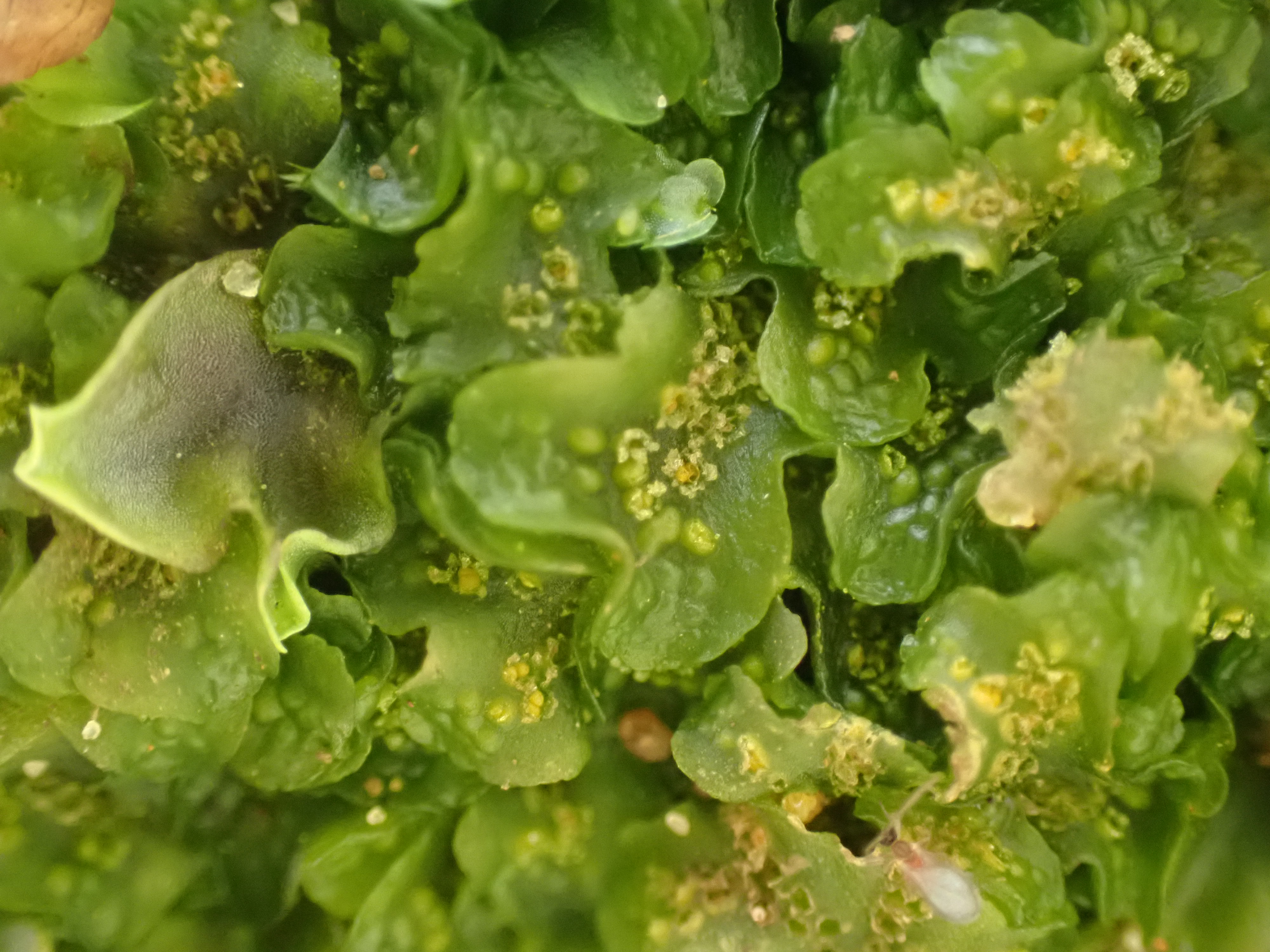
Yet despite how rare and restricted this is, it wasn't the bryophyte lifer on the cliff face I got most excited about. The cliff was covered in hornwort, and I have never seen a hornwort before! This is Phaeoceros laevis! Here is the female with the horns.
And the male plants.
Earlier that morning, Iain took us into Shanklin to see the incredible fungus Coccomyces delta that grows on the old leaves of Bay. Such weird triangular structures, spot the four-sided one doing its own thing. I salute it.
And a quick stop to a churchyard for a naturalised clubmoss tick, Krauss's Clubmoss.
I covered three quarries over the trip. A couple with Mark and Iain but also I had a look at a quarry down by the Needles with Karen and that was a great little spot. A new hectad record for Phaeocedus braccatus was a real find!
And the ridiculously common Agyneta mollis. Two new hectads for this on the island brings the post 1992 hectads for this spider to at least 98, it's hurtling towards not even being Nationally Scarce at this rate (I had it in a playing field by my house this week).
And a Scotina, but unfortunately I lost the specimen. All are rare on the island and given I was in a chalk pit, this is quite likely to have been Scotina palliardii. I will have to go back! I got a couple of money spiders new to the island at various locations over the week, Micrargus laudatus and Parapelecopsis nemoralioides.
Rewind to a few days earlier when I went to visit Mark and his magnificent new garden. He got me four new bryophytes, really by hammering some of the really small acrocarps. But it was a new pseudoscorpion that was most exciting for me, Pselaphochernes scorpioides.
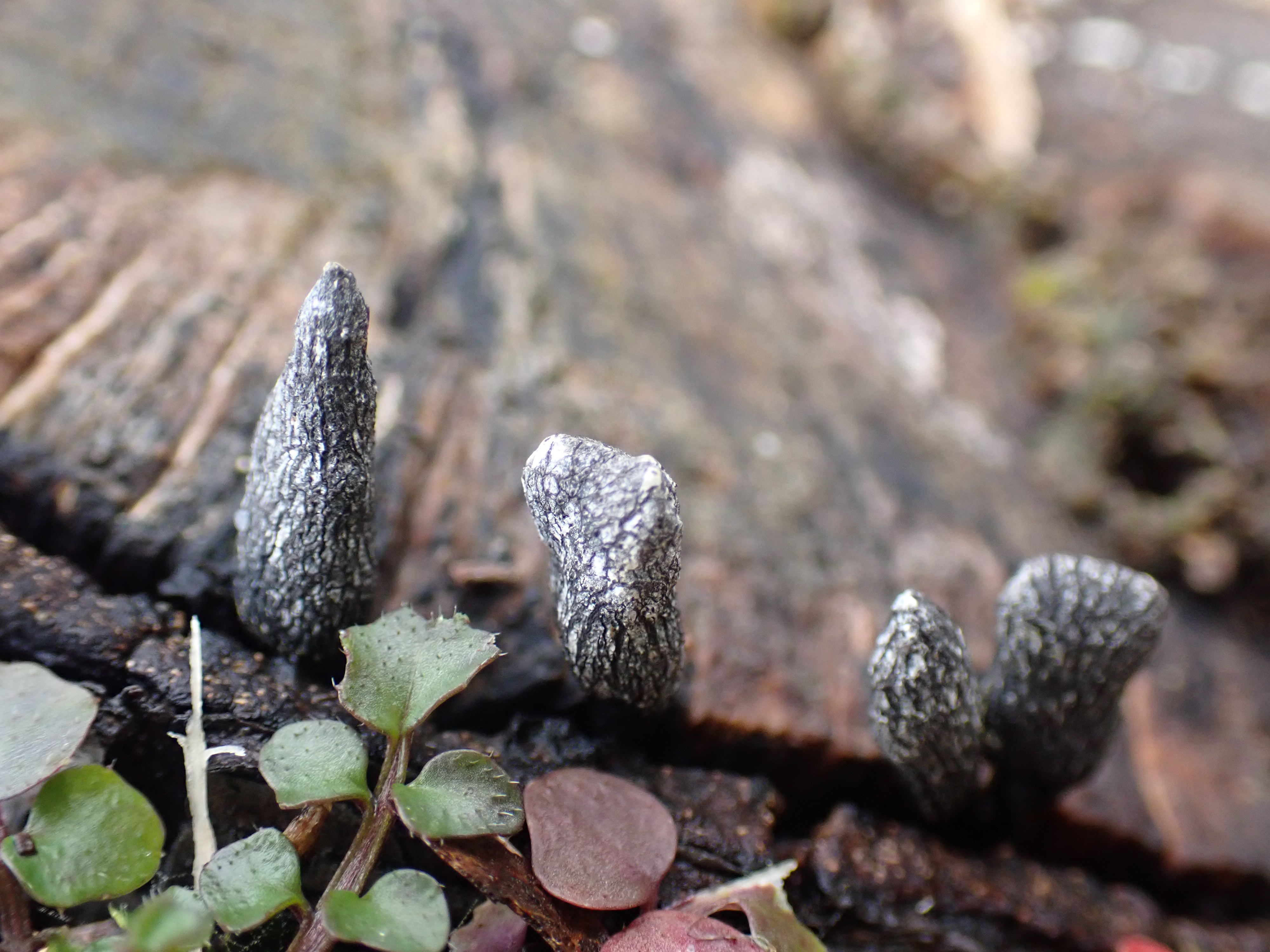
And a new fungus! This is Xylaria cinerea.
Then on to Ventnor Botanic Gardens. Mark had found this ant new to Britain sometime before my visit, it's Tapinoma ibericum. It's so numerous there that I spotted it on the first evening when Karen and I walked up to the gardens only to find them closing and I noticed it on the walls by the toilet block without realising the significance. They form impressive long lines.
A millipede that's only found here is, this one is particularly pale, Cylindroiulus apenninorum.
But Mark breaths first for Britain, so it didn't take long before he found one in the form of this weevil, under a rock. Likely to be associated with Cork Oak, Mark says it's in the genus Echinodera.
And another lifer in the car park for me. The rather odd looking reticulated slug, Tandonia cristata.
Karen and I went back to the gardens on a rainy day, when I discovered this fenced-off tunnel and just how good at light gathering the camera is on my new phone (I upgraded after nearly seven years). This was pitch black to the naked eye. The open end apparently comes out half way up a cliff, so no spidering in the for me.
And I turned a couple of stones and got the shelled slug we missed first time, Mark says it's most likely. Ear Shelled Slug Testacella haliotidea.
And no trip to the Isle of Wight is complete without visiting the Needles. I love the soils here.
So that's it for the part 2. What a week. It was a really great pan-species listing holiday, that was also in part research for the book on pan-species listing I am now 50,000 words into. A HUGE thanks to Mark for giving me so much of his time and knowledge, it was so much fun!
Yet my field season has started and I didn't quite get this out in time before I hit this period of high pressure (today is day four of a straight run of field work and I've already walked 19 miles since Sunday). I have made over 1000 records in the last three days and have just hit 200,000 records. So I think my next post will be a celebration of biological recording. I will leave you with my 2nd favourite photo of the week, a Carrion Crow that joined the ferry about a fifth of the way across and stayed with the boat all the way to the island!
It's been a rough start for the year but despite this, I am ahead of the game for once with work. I needed a new project to focus my recording efforts. In 2021, some of my most exciting spider finds were in chalk pits, at Amberley Chalk Pits (chiefly, Centromerus albidus found whilst looking for other rarities - a species not seen in the UK since 1969!) and at a small pit at Iford. This got me thinking, how many more of these small sites are there out there and what might be hiding there? Many of them seem to have never been looked at for biodiversity in anyway.
They are often not that inviting, the one in the image above was huge but mostly vertical and clearly only the base was accessible, while others are a little easier to record. There are loads of them, peppered around the South Downs (just drive along the A27 and look for big white patches) and I am only just starting to get a mental map of where they are and who owns them, so that I can start gaining access.
I have data for nine sites so far, six of these are historic (and two of these represent full surveys) and three are from new sites I have looked at in the last two weeks.
I have pulled all this data into one matrix, with species down the side and each quarry listed as a column on the spreadsheet. Amazingly, this is already up to 97 species of spider and even more amazing, 18 of these have conservation status (18.5%). Clearly, chalk pits hold a significant number of rare and specialised spiders. Of these 18, five species are listed as Nationally Rare.
It's not just spiders, I have recorded 531 species so far in these nine pits, 384 of which are invertebrates.
What are the outputs of this survey, I hear you ask?
- Enjoy myself at a relaxed pace.
- To find and access as many chalk pits as possible with landowner permission and get me to some new, bite-sized, close-to-home, unrecorded areas of Sussex.
- To record as many spiders as possible in these pits.
- Use some subterranean/pitfall traps in a few places.
- To record other taxa in a casual way, whilst doing the above.
- To take some very basic chalk pit biometrics.
- Percentage chalk/vegetation
- Slope
- Aspect
- Presence of scree
- Presence of sievable moss
- Write it all up at an undetermined timescale. I'm talking years not months.
- Use the data collected to generate a list of "Chalk Pit Indicator Species" (CPIS) of spiders and analyse using the biometrics to assess and the rank the assemblage of chalk pits in Sussex for their spiders and other wildlife.
I visited a new site yesterday, and recorded four spiders with conservation status. The highlight was the Nationally Scarce Hahnia pusilla, a spider I have only ever seen in bogs before. Here is the 1.5 mm spider showing her epigyne. It's only my 3rd record (out of 28,551 spider records).
The others were the ubiquitous Agyneta mollis (this over-designated spider is listed as Nationally Rare, Near Threatened and Section 41). My hunch is that it should not even be Nationally Scarce. It is now the most frequently recorded spider with status that I record, and the third most frequently recorded invertebrate with status that I record (after Small Heath and Lygus pratensis). I am working on proving this spider is not a conservation concern, it's not habitat restricted, it just likes open places. I have even found it on boring lawns with the sucker. The other two were both surprises. Theridiosoma gemmosm and Monocephalus castaneipes (this latter is not a common spider in Sussex).
In bryophytes, the base of the quarry was covered int the liverwort Leiocolea turbinata (Top Notchwort). And a singing Marsh Tit was a pleasant surprise.
But all of this was eclipsed by a "WTF is that?!" moment! I love that there are so many beetles, that you could bump into one you have never even heard of before (this being my 1624th species of beetle in the UK) just a few miles down the road. This is the Hop Root Weevil Mitoplinthus caliginosus (Nationally scarce a) and Mark Gurney tells me it's really scarce and hard to find, as it lives in litter and soil. Sieving it from moss then is probably the way you are most likely to find it, like I did.
What I think is also really cool, is that the entire insect is covered in huge pits, each filled with muddy chalk. It's a walking chalk pit assemblage, and a fitting find for the start of my chalk pit survey. It's also a great thing to find when you are writing a book about pan-species listing, as it goes to show that when you are surveying for one specific thing like spiders, if you have an approach where everything counts and anything is fair game, then you can come away with your highlight being something totally different, in this case a stonking weevil!
If you have a chalk pit, have access to one or know of one that you think I might not know of, please get in touch. Small ones can be good but the thing is, they need to be at least partially open (grown over with trees is no good) and at least some exposed chalk. Those with scree and thick (sieveable) moss on top of this, tend to have more diversity too.


 Posts
Posts