After the Snowy Owl, we headed to Norfolk. The first port of call was Holm. If you're just joining this now it's 20th February 1991 and I'm 12...
We set up and looked at the shore there were lots of waders, two seals (I did not see these) and lots of flocks of Eider.
I spotted an unusual bar tailed godwit, in summer plumage! And the hole beach was littered in worm casts and cuttlefish and we found four spiny sea urchins.
Then it came, pouring down with rain, we took u-turn headed back to the car, we saw the bar tailed godwit again we found a tuna's (not sure if it says that as I have no memory of this and my writing is a bit off at times) skull and lots of moth of pearl, we saw a pair of shelduck and then we saw a dead, Mr Gardner took its wings (informative Little Graeme but you kind of missed a key word out of this sentence - what was it?!), we also found a rather mangled guillemot. We headed back to the car and the rain was so bad, we decided to go to titchwell.
Next up, my first encounter with a Hen Harrier!
2014 was a great year of natural history for me. My database now stands at nearly 26,000 records, over 5000 added in 2014 so far. So here is my annual top ten highlights of the year in reverse order.
10) Spending some time in sand dunes
There isn't much good sand dune habitat in Sussex, so I had to go further afield.
Here is a selection being from top to bottom: Dalman's Leatherbug, Dune Waxcap, Marpissa nivoyi, Fallen's Leatherbug and Marram Grass Chelifer.
9) Flatropers Wood invertebrate survey
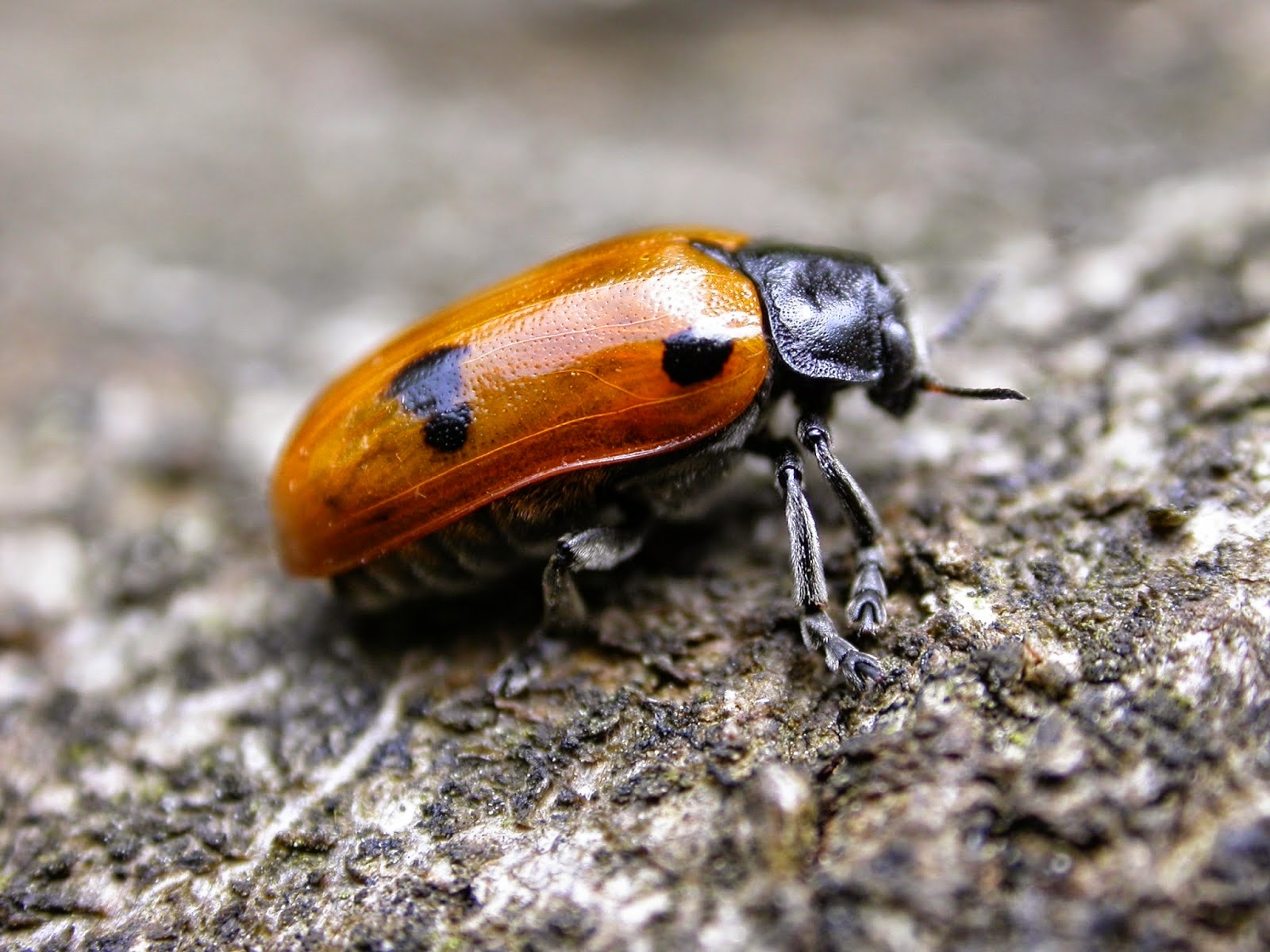
Flatropers isn't even an SNCI and it has shed loads of rare invertebrates. Here we have Xysticus bifasciatus and the two myrmecophiles: the Scarce Seven-spot Ladybird and Clytra quadripunctatus.
8) New Forest antics
I love finding lots of new species in a very small area. Micro-botanising overload.
7) If Darth Maul were a beetle...
Pilemostoma fastuosa. A very cool tortoise beetle from Knepp.
6) Gower power
Rock pooling on the Worm's Head produced this Green Sea Urchin among many other things.
5) Lappet
Always wanted to see one and one finally turned up in the moth trap.
4) Jurassic Carp
A trip with Seth and Tony to Kimmeridge Bay produced my first Cornish Sucker!
3) Burton Pond invertebrate survey
Here we have Xysticus audax, Alder Leaf Beetle (new to Sussex and found by Adrian Holloway) and the beetle Agapanthia villosoviridescens.
2) Creating the PSL website and article in British Wildlife
It has been a great year for pan-species listing and I'm pleased to have been able to contribute so much to the movement.
1) My first freelance invertebrate surveys struck gold!
Finding only the 7th known site for the rare Pondweed Leafhopper and also plenty of 13-spot Ladybirds was my highlight of the year. This cracking little private nature reserve just is a great example of what can be done to benefit wildlife.
So hopefully I will get back in the saddle in the new year but for the time being I'm still rather estranged from it. It's reminded me how much I love wildlife though writing this post so who knows.
Four nights, three men, two countries and one camper van. I've been on a bit of an adventure for the last few days taking in an eclectic range of species from Wild Boar to Pilchard. Small Cushion Star (above) to Heath Grasshopper. Where better to start though than the end? The end of the world. Well, the end of the Gower in South Wales or the Worm's Head to be precise...
...we (Seth Gibson, Danny Copper and I) decided to go rock-pooling along the Welsh Atlantic coast so we drove to the end of the Gower. The Worm's Head is an impressive island (it looks a bit like a dragon) that is accessible for 2.5 hours either side of low tide. We got there a little after low tide but we had plenty of time on the second day too for rock-pooling. Ricocheting Choughs bounced along the thermals around the car park, this is a striking landscape.
Fish were on my mind but the smaller, shallower more sheltered rock pools were providing lots of new species other than fish. This Elegant Anemone was quite a looker.
Compared to the more intricate and subtle beauty of the Daisy Anemone.
However, I think my favourite new species was the Green Sea Urchin. Exactly the same colour combo as a Snakelocks Anemone!
Saddle Oyster, Black-footed Limpet and Trophon barvicensis were all knew molluscs for me but the fish were pretty quiet. Shanny was the most abundant with a few Five-bearded Rocklings and singletons of Long-spined Sea Scorpion and Butterfish. Then we stumbled upon a rock pool full of fish!
We hoyed a few out and after a bit of deliberation and an expert second opinion, we believe they are in fact Pilchards (fin position and radial marks on the gill covers clinches it). Quite an unexpected tick and with Transparent Goby added retrospectively from Rye Bay in August, I'm now on 78 fish. Next up it's the Wild Boar story...
I beat this very cool ladybird off a fallen Scots Pine at Graffham yesterday after a very early start surveying birds and then the deployment of twenty pitfall traps. It's the 18-spotted Ladybird Myrrha octodecimguttata and a species I had never seen before. Superficially, it looks like the Cream-spot Ladybird but the spots themselves are more varied in shape and arrangement than those in that species. Off the same tree I had three more lifers, the common weevils Otiorhynchus singularis and Cimberis attelaboides and the Nb running crab spider, Philodromus collinus. It's all about the fallen pines!
The bird survey was good too, with Woodlark, Hobby, Yellowhammer and Spotted Flycatcher all present.
The pitfall traps are a repeat of traps I ran exactly five years ago and I hope to show some really positive changes due to the management we have carried out there since then. Whilst I was placing the last trap my eye was drawn to an oddly symmetrical shape in the mineral soil. Sitting on the surface was this amazing fossilised sea urchin!
We've just got back from four days in Teesdale but before that we spent a great few days at Rachael's folk's new house in Whitley Bay. I hadn't prepared myself for how much wildlife, literally just on their doorstep, we were going to see. Within fifteen minutes of arriving we were sat in the garden when a Spoonbill flew over flying north! the next morning I was up early for a sea watch in the hope of a skua or two but sea watching into the Sun isn't much fun. I was rewarded with a Hen Harrier flying north out to sea being mobbed by terns. Close in Eiders remind you of how far north you are.
I soon discovered that the rocks around St Mary's Lighthouse are pretty good for rockpooling and on Monday at about lunch time a very low tide was due. We headed out and found quite a few goodies but the net that I bought on the sea front lasted me about 5 minutes. The above Common Sea Urchin Echinus esculentus was a new species for me. I caught a Shanny which bit me. We also saw Long-spined Sea Scorpions and Butterfish.
The strange Broad-clawed Porcelain Crab put in a show.
And the first squat lobsters I have seen in almost a decade, this one is Galathea squamifera and looks like the ones I saw on Anglesey in 2003.
Strangest of all though was this 'armoured worm'. I have keyed it out tentatively to Lepidonotus squamatus. The plates are referred to as elytra in Hayward & Ryland.
Next time I go though, I will be prepared for some serious rock pooling as I suspect that Lumpsucker is not out of the question. It's pretty amazing having all that on your doorstep!


 Posts
Posts


.JPG)