An Alternative Natural History of Sussex.
This blog shows the highlights of my day to day findings as a naturalist and ecologist living and working in Sussex. Delivered with a pinch of nihilism, a dash of sarcasm and absolutely no tweeness, here is my attempt to show natural history as it really is: Brutal, beautiful, uncompromising and fascinating...and occasionally ridiculous.
I have been studying natural history for some thirty years, nineteen in a professional capacity. I currently work in Sussex as a freelance entomologist, ecologist and botanist and specialise in nature reserve and rewilding management advice based on the interpretation of the surveys I carry out. I also run a number of identification courses. An advocate of the pan-species listing approach. My main areas of interest are birds, plants and invertebrates and a lot of my spare time is spent in the field. I am the county recorder for spiders and bugs.
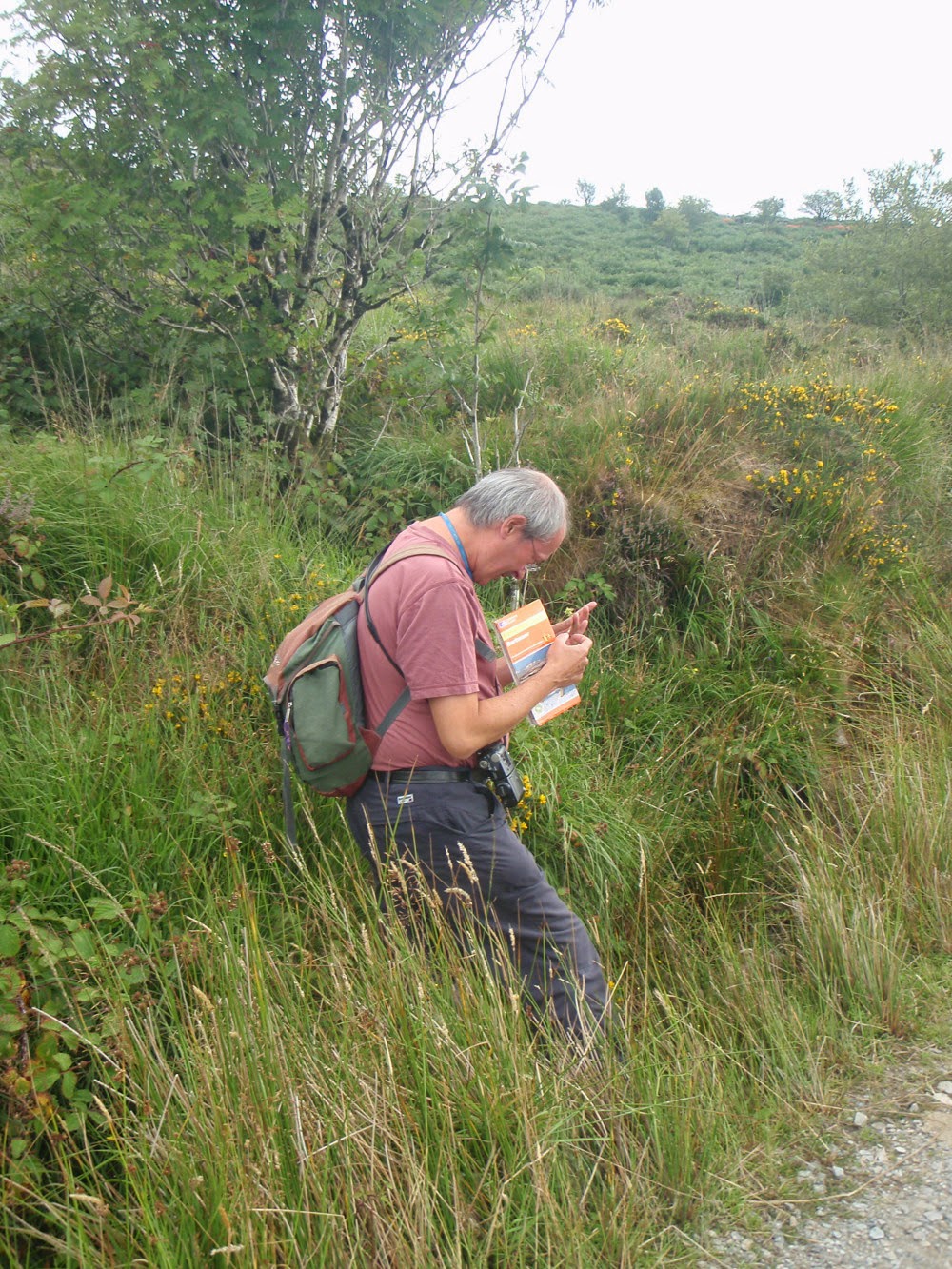
A couple of weeks ago at the annual Sussex Biological Recorder's Seminar I was approached by Brad Scott (above) during lunch who said "thanks ever so much for that course on Grasses, Sedges and Rushes that you ran several years ago, it really kick-started my interest in natural history." Now if I tell you that since this course, Brad has been on my Common Woodland Bryophytes course and has almost seen more mosses and liverworts than me now (have a look at the PSL rankings for bryophytes) it starts to put things in perspective. Yet this is just the start of Brad's natural history adventures!
It's exactly this kind of inspiration that I always hope my courses will provide. It's certainly not going to be everyone that gets the bug like this but even if we reach one or two people a year in this way we are making a difference. So, I asked Brad if he would mind writing a few words about his experience with the Trust's courses and this is what he put together...
"The first Sussex Wildlife Trust course I did was Graeme Lyons' fabulous weekend
on Grasses, Sedges and Rushes about five years ago. It really inspired me to
further explore the rich and varied habitats we have right on our doorstep. A
couple of years ago I also did the Mosses and Liverworts course too, and that
prompted me to find out more at the local field meetings of the British
Bryological Society and tentatively start recording. Not content just to look at
plants, starting a Pan-Species List has
provided me a focus for attempting to comprehend the diversity of all habitats.
In addition, appreciating that exploring the natural world is best shared with
other people, I've also been involved starting up a local natural history
group in Forest Row, and occasionally blogging. Wildlife Trust courses are clearly an
excellent way to learn, share, and ignite one's passion for all
wildlife."
This sort of thing really is music to my ears and inspires me in turn to keep going with these courses and produce new material annually. Brad's rather stylish and understated blog is a great read, particularly his post on wildlife recording and how a relative beginner really can contribute quite a lot if you work closely with more experienced naturalists. So to tie all this together myself, Brad and the country recorder for bryophytes are going to go looking for the rare and elusive Ghostwort in the Ashdown Forest one weekend in March. We will probably look something like this. Watch this space.
So why not book on one of the many fantastic courses Sussex Wildlife Trust has to offer? I can't promise that you'll become a Ghostbuster but you will certainly learn something about the amazing wildlife of Sussex and have a great time in the process. Call 01273 497561 for more info (I resisted saying it!).
At the start of our adventure, we went to see Bill Urwin at Shapwick Heath. Now Bill was very kind and sacrificed some of his bacon lardons as bate for the bottle traps he put out. I've never seen these in action and boy are they good at catching large water beetles! I've always been frustrated at never having seen any other Dytiscus other than Dytiscusmarginalis so I was pleased to see our biggest Dytiscus, Dytiscus dimidiatus (above). How many more times can I fit Dytiscus in this Dytiscus themed paragraph?! None.
This is Hydaticus transversalis, quite showy for a water beetle. Bright colours and patterns are not much use in a ditch, so water beetles are mostly a drab lot. Not this beast though, what a looker!
The Lesser Silver Water Beetle Hydrochara caraboideswasn't in the bottles, this was netted in an area of Floating Sweet-grass. Three new beetles for me!
It was a cracking few hours and the bottle are definitely something I'll have a go at in the future. A big thanks to Bill and NE for their time. Whenever you're down this way Bill, I'll take you out for the day in Sussex! So there concludes (in reverse order) the posts about our little adventure. Or does it? Next time, the exciting prequel of our trip (it's not that exciting). I'm dragging this out like Peter Jackson's Hobbit!
Yesterday I carried out a reccy for an NVC survey I have planned at Castle Water this year, just north of Rye Harbour. Chris Bentley gave us the guided tour and we made good progress understanding what NVC communities are present and how they fit together. U1 acid grassland is present on top of many of the old shingle ridges as well as areas where sand was left behind after being washed from gravel. In one such area there is an abundance of Common Stork's-bill and Bearded Fescue and Chris told us to look under the leaves of the former to find a rare weevil called Limobius mixtus.
I found one within 10 seconds of searching and it wasn't long before Chris and Adrian spotted one too. This is one rare beetle and Chris tells me that this is the only known location for this in the UK!
However, what happened next was really surprising and resulted in two new species for the reserve, one of which might even be a county first! It just goes to show what happens if you stop and look with keen eyes. Adrian spotted an unusual bug which I was able to identify as Fallén's Leatherbug Arenocoris falleni. There is only one record in the SxBRC data base for this species and as I am now the county recorder for bugs, I believe this record is actually a mistake. This could therefore be a county first, it's certainly a new on for Castle Water. It doesn't have a conservation status but it certainly doesn't seem to be common. Guess what it feeds on? Stork's-bill.
Whilst I was bending down taking a photo of the above leather bug, I spotted this ground bug running around on the sand which I didn't recognise. This turned out to be the Nb Megalonotus praetextatus, a ground bug that feed on...stork's-bill! Only 10 records for this in Sussex.
Then Chris made a characteristic 'Ooo!' and became very animated. Soon we were looking at this Lesser-streaked ShieldbugOdonotoscelis lineola. Another new species for the reserve and with only two records for Sussex! I have only ever seen the nymphs in the car park at Lakenheath in the Brecks. And you've guessed it, it feeds on stork's-bill! And it's nationally scarce (Nb).
This illustrates a number of points: Firstly, one species of plant when growing in profusion in just the right conditions can harbor many other species. Secondly, that if you stop and get down on your hand and knees you often see a lot more than when you are walking (no surprise there). And finally, there are still species to be found in this highly recorded part of Sussex which is great as far as my NVC is concerned!
I swept this incredible caterpillar from Burton Pond last week. It puked up all over the net in quite a horrific manner, I've never seen anything like it (other than on the Exorcist) where it thrashed its head from side to side. It was pretty huge and being so striking, I didn't think I'd have any problem identifying it. Despite going through Porter THREE times, I didn't come up with a single candidate. I swept it of Purple Moor-grass with some young birch growing through it.
So I tried a different tactic. Working through the larger moths of the macro fauna, Googling the Latin names (with the word larva) whilst keeping an open mind. So I started on the first large moth on the first page of the book I opened it at. This just happened to be Red Sword-grass. Bingo! That was it. This is a really scarce moth in Sussex and it's great to have confirmed breeding at Black Hole! It just goes to show that not only do caterpillars vary as they grow older (just look at the larvae of the Alder Moth - which we also saw at Burton by the way!) but they also vary greatly between individuals and one photo is just not enough, even with a striking larva like the Red Sword-grass.
I'm still feeling rough so I'm trawling through old files to find interesting tales from the past. In 2007 I spent a month working at Abernethy RSPB with Mark Gurney, helping them carry out bird surveys. There were lots of great things to see there but a day that really stood out was when we went up Cairn Gorm on the 5th May. We were in search of Ptarmigan and Dotterel and we had excellent views of both. Amazing how confiding these birds are.
I just love spending time in the mountains, so many new things to see! Lots of good plants such as Interrupted Club-moss, Alpine Hair-grass, Curved Wood-rush, Dwarf Cudweed, Sheathed Sedge and Stiff Sedge. But as is often the case, it's the things that you are not expecting to see that get you most excited. We saw a few of these little moths flying around in the sun shine that totally confused us. As we were looking through the photos afterwards, one of us was arguing for Black Mountain Moth and the other for Netted Mountain Moth. Of course, neither of these were anywhere near the mark. It's Broad-bordered White Underwing. This is quite a nice mountain moth and we were lucky to stumble across such a rarity!
By the way the moss in the background of the photo is Racomitrium lanuginosum. I have not been to Scotland since I left the RSPB. I really must get up there again soon...
Almost ten years ago I carried out an NVC survey of Cliffe Pools reserve in north Kent when I worked in the ecology department of the RSPB. Now I am off sick today and found myself looking through some old photos hanging around on CDs. The most striking of which is this grass, Annual Beard-grass. This strange looking grass is listed as nationally scarce but I saw more of this in this one place than I have seen since and before combined!
I believe the centre photo to be the hybrid between Annual Beard-grass (left) and Creeping Bent (right).
In fact, I notched up masses of new species there. Lots of rare coastal plants such as Borrer's Saltmarsh Grass (below), Curved Hard-grass, Sea Clover and Toothed Medick.
I stumbled across the nationally scarce b Rosy Wave which I have not seen since.
Birds were good too. I found my only ever Blue-headed Wagtail. A Terek Sandpiper turned up within hours of me being on site and there was a nice twitchable Trumpeter Finch a few miles down the road.
I also saw the Shrill Carder Bee Bombus sylvarum which again I have not seen since. I have not been back to Cliffe since 2005 and I really should. It is a cracking nature reserve with dynamic communities. I do hope the rare early successional habitats there a still thriving. If only I was more switched on to beetles when I was there!
First off, all the photos in this blog were taken by Mark Gurney using his new digital SLR and I thought I would use these and see how they compare to my old Coolpix. To make things a little more dramatic, I have added a piece of music by John Murphy from Danny Boyle's much underrated sci-fi Sunshine. Possibly one of the best pieces of music used in cinema in years, the frequency that it has been used on other films and adverts is testament to this. It also goes some way to demonstrate just how hot it was at Amberley this last week. The only shade out there was that cast by the horseflies and we were begging the jet stream to return. I even bought a hat!
So I did get a few plant ticks. I finally caught up with Whorl-grass (top photo). This aquatic grass grows in the middle of the ditches. I often wondered if I had been overlooking this but it is very distinctive. And of course, it's glaucous so it's instantly better than all non-glaucous plants in my book.
Cut-grass was harder to spot this year than last year as it is not as advanced but we did see it in a number of ditches.
A couple of Chrysolina herbacea on Water Mint. I asked Mark what they were doing but he wouldn't tell me. I think the one at the back is trying to push the other one off the leaf.
I think where a digital SLR really comes into its own is photographing narrow spindly plants in harsh light. I may have to invest in one. I couldn't have got that shot of Whorl-grass with the Cooplix. A big thank you to Mark and if you haven't read the article about Mark in this edition of 'Birds' then do, it's really good. Another big thanks to Mark, Sarah, Rachel, Dave and Frances for allowing this joint project to happen, I couldn't have done it without them, there are just too many ditches!
It's strange going back to the same places at the same time of year, year after year. You cannot help but measure yourself against these seemingly static landscapes, I feel like I'm drawn into the monitoring process! So in my report I would have to say that this particular taxa is doing very well compared to this time last year! I started the ditch surveys at Pevensey yesterday and ticked Lesser Water Plantain and Thread-leaved Water Crowfoot as well as seeing a gravid female Fen Raft Spider and four nursery webs!
I had a great (although very hot) week at Amberley last week with Mark Gurney and Sarah Fisk from the RSPB. We were finishing off an aquatic plant survey of the ditches that we started this time last year. I had a few new species including Whorl-grass but the real excitement came in the form of this sedge. True Fox Sedge Carex vulpina is much, much rarer than False Fox Sedge Carex otrubae. We left the ditches that True Fox Sedge was last recorded in, by James Cadbury, until the last day. Sarah spotted this sedge and I thought it looked quite different with a darker and broader inflorescence, shorter bract and more winged stem. We called Mark over and he began to get quite animated. Well, for Mark! He was keen to take some specimens to clinch the ID and it's the epidermis of the utricles at magnification which confirmed it. Here is True Fox Sedge with roughly square cells:
And False Fox Sedge with its elongated cells. A big thank you to Mark for sending the photos over.
So it's simple. We had True Fox Sedge. But how can we be sure that it wasn't just False Fox Sedge lying? You could just watch this and make your own mind up...
OK so it might not have been eight years since I last posted (just over two weeks) and my central character is hardly Bane (it's actually an alien grass called Harestail Grass Lagurus ovatus) but I finally feel like I might be coming out of my self imposed blogger's exile. At West Beach near Climping yesterday I spotted this funny looking grass growing in the sand dunes and I thought it was perhaps one that I had not seen. It's a cute little thing alright! It was indeed the first new species I have stumbled upon in weeks that I have felt compelled to identify. Now the weather has turned, will I take back to the streets of Sussex in the tumbler after being holed up in Wayne Manor for weeks? Enough of the Batman references, I don't have a tumbler. Or a cape. Or a bat cave but I do have a Fiesta, a butterfly net and a microscope so we're not all that different Batman and I. OK, we share the same number of limbs and I have a utility belt (for entomology) but that's something hey?
And yes I did see 'Rises' yesterday on the opening day at 11.00 am and yes it is bloody good! Now the sun is shining and I am off to Seaford Head...
I have been working on an NVC map of Seaford Head again today as a freelance project. There is a tiny bit of saltmarsh there with tiny fragments of saltmarsh NVC communities. Sea Couch, Saltmarsh Rush, Sea Mayweed, Greater Sea-spurrey and Rock Sea Lavender all grow there in strips measured in centimetres not metres. The above photo is a cool little weevil called Gronops lunatus that is abundant in this area. I think this is a darker colour variant of the same weevil. I'll have to check it though as it does look very different.
Sea Pearlwort, I was surprised to find out, was a tick for me.
In just a very small area and a very small amount of time I collected a lot of specimens to be identified. Dispite its small size, it seems to hold many interesting species. I picked up a male Bledius with a huge horn coming off the pronotum so I'll report back on that and an Ozyptila I found on a tiny strip of vegetated shingle.
I went into the gents at work today and looked up to see this little critter. It's a Buzzing SpiderAnyphaena accentuata. I've only seen this spider once before at Eridge Rocks last summer. It's not all that scarce but if you look at the spider atlas, there appears to be a dearth of records in central and western Sussex. Is this the true distribution or is it just down to a lack of spider recording in Sussex? It's a nice spider all the same and really easy to identify, not only being the only one in the genus but the only one in the family!
I was chatting with Patrick Roper last week and he was telling me all about tussocking, something I have never tried. Simply sawing off a large grass tussock close to the ground (these ones were Cock's-foot) and shaking the tussock onto a white tray or sheet. So, Penny Green and I headed to the valley field with a saw and some white trays. I was surprised at just how much we saw, rove beetles were the most frequent beetles, followed by carabids and one leaf beetle. A few spiders and woodlice too. I have plenty of identifying to do down the microscope but that will have to wait for another day...
I went to Chailey Warren briefly on Tuesday. I went there to carry out an NVC survey. In winter you ask? In the snow? Well, yes. It's a small site and I had already mentally assigned the vegetation there to a very small number of communities so it was simply a matter of rolling up with an aerial and drawing on the handful of polygons. In the centre of the site, there is an area of under grazed Molinia mire (NVC community M25). The tussocks of this deciduous grass can be seen more clearly in the snow. It's been under grazed due to a lack of access to the site. Things have changed now though and the reserves team are currently putting a new fence line in so we can graze and add some structure as well as help slow down the encroachment of birch and bramble. This management should help the Marsh Gentian which was still present on the site during a visit in 2011.
I did get a new moss for me, a very common species that I am amazed I have not seen before being the Common PincushionDicranoweisia cirrata. That puts me on 3753 species.
Whilst surveying the ditch flora at Amberley I spotted this Dotted Fan-foot. Like the ones I saw at Woods Mill two years ago, it was very close to some Brown Sedge. We didn't see much today that we hadn't already seen but Flowering Rush is always a welcome sight. A juvenile Marsh Harrier provided the air support and the only new beetle I had was Scirtes hemisphericus (thanks to Mark Gurney for guiding me away from the leaf beetles on this one). I didn't manage a really decent shot of the rarest plant, Cut-grass. as it is not really in flower yet. It's quite hard to pick out from other non-flowering grasses but once you get your eye in it is easy enough. Here is a nice patch growing on the edge of a ditch, its typical habitat. We must have walked miles along those ditches and I'm feeling pretty knackered now!
It's my annual grasses, sedges and rushes course at Woods Mil this weekend. I always enjoy running this course but it did not stop me getting two ticks (a bug and a beetle) in the process. They were Deraeocoris flavilinea (the bug) and Plagiodera versicolor (the beetle) which puts me on 3490, only ten to the half way mark! This latter was found at rest on one of the course attendees backs! The photo is of neither species. The only soldier beetle I saw at all today in the meadow were these small Cantharis nigra of which there were quite a few. It's resting on a panicle of Yorkshire Fog. Each spikelet is completely enclosed by the two glumes. Right, enough grass anatomy, I need a pint!
So I have finally ticked Wild Gladiolus. I managed to find four plants but it wasn't in flower and looked very like Creeping Soft-grass from a distance that was growing everywhere. I feel slightly cheated at not having seen the flowers but then the leaves are glaucous so who needs a big pink show off? Other than that today was pretty quiet. I did get a few shots but nothing else new. The Rose Chafer that landed in front of us gave me some excitement when I thought I had found a Noble Chafer. It flew off before I could get a good look at it but I am sure it was just a Rose Chafer. Here is Triplax russica that I found near some fungus on fallen Beech.
I should have known this in the field but I realised today that I didn't know the song of Mottled Grasshopper. Anyway, here it is with its distinct clubbed antennae.
I was really pleased to find another Stictoleptura scutellata today but this time an ovipositing female! This is still the only longhorn beetle I have seen in the New Forest. Off to the Isle of Wight for the first time tomorrow!
A quick visit to Woodvale after work to look for Bulbous Meadow-grass was successful. Couldn't find any in flower but it was distinctive enough. As I was photographing it I heard a Firecrest singing too which was nice. Woodvale is where I saw my first Firecrest perhaps 15 years ago. Considering how much time Jo spends in the field with me I was surprised to hear her say 'Is that a normal seagull, it looks pretty different'. My reply was 'No Jo, that's a Wood Pigeon'.
Earlier in the day I started the Woods Mill CBC and picked up a Green Sandpiper on the new stretch of river and a Little Egret as well as the male House Sparrow that has moved in recently. I spent the afternoon finishing off a map at Ditchling Beacon. I was checking out a water butt for any unlucky inverts that had landed in it when this beetle bounced off my face. It's a species of Helophorus and is actually an aquatic but it doesn't really look that well adapted to life in the water. There are quite a few species though so I will have to key it out later when I am not tired.
Well today started bad. Got up at 5.00 am to do a bird survey, got in the car at 5.45 am to find that I had left the lights on when I came home from work ill a few days ago. Survey aborted. After a £62 update to my RAC cover, I finally got the damn thing going again. A glorious day awaited so I went to Southerham to see what I could see. Lots of Aphodius beetles on the wing. I saw a beautiful spider that was identifiable in the field although I didn't get a photo (too fast!). A male Alopecosa barbipes with hairy segments on the front legs. A real handsome beast, Google it! Tightly grazed chalk-grassland certainly seems like a typical habitat according to the texts. Tick number one. I found these two tiny snails under an old post. Bear in mind that each snail is under 3 mm. The snail on the left is new to me and is the Moss Chrysalis Snail Pupilla muscorum. Tick number two. The snail on the right is the tiny but beautiful Ribbed Grass Snail Vallonia costata.
I then had time to have another look for Early Meadow-grass at Shoreham. Third time lucky. I found it on the causeway along the river close to the airport. Not much fun dodging dock muck, swooping police helicopters and wet dogs. It's funny how as soon as you bend down you become fair game to any dog. The moment I found the grass and then bent down to take a shot was ruined by a wet dog that jumped over me, the grass and my camera before it's mate came up and shuck half the contents of the river all over me! Anyway, here is the grass. Very vibrant green, reminded me of the colour of Marsh Club-moss.
Here it is on the right next to some of the ubiquitous Annual Meadow-grass.
I was worried that it would be hard to spot as you often see AMG that is small and yellowish but with EMG all the plants are consistently the same shade of yellow-green throughout. The leaves are also quite short and stubby. The arrangement of the florets on the spikelets and the shape of the anthers are the clinchers though. I was going to call this post 'Is that it!?' but I actually think this little grass is quite smart. Tick number three. Finally, I had a moss tick growing near the Early Meadow-grass which was Syntrichia intermedia being my fourth and final tick of the day leaving me on 3159 species. I finished the day off by giving a talk to BC on moths which seemed to go down quite well. Now for the the lasagne Jo made which is magnificent!


 Posts
Posts