An Alternative Natural History of Sussex.
This blog shows the highlights of my day to day findings as a naturalist and ecologist living and working in Sussex. Delivered with a pinch of nihilism, a dash of sarcasm and absolutely no tweeness, here is my attempt to show natural history as it really is: Brutal, beautiful, uncompromising and fascinating...and occasionally ridiculous.
I have been studying natural history for some thirty years, nineteen in a professional capacity. I currently work in Sussex as a freelance entomologist, ecologist and botanist and specialise in nature reserve and rewilding management advice based on the interpretation of the surveys I carry out. I also run a number of identification courses. An advocate of the pan-species listing approach. My main areas of interest are birds, plants and invertebrates and a lot of my spare time is spent in the field. I am the county recorder for spiders and bugs.
Last weekend was another really good set of low tides. Which meant I spent four sessions out in the rock pools; once at Ovingdean with a gang, once at Felpham with a slightly smaller gang, once at The Pound at first light solo, and finally again at The Pound that same evening with a different gang. It was knackering and involved the first and only time I have ever got cut off and had to wade through waist deep water (I'll come to that).
First off, an afternoon session at Ovingdean. I promised nudibranchs, and found eggs under the third rock I turned. Soon after Mark Colvin found some more eggs and a neat little Goniodoris nodosa. They breed on one very specific location down there. This is the first of three nudibranchs I saw that weekend. Between myself and the brothers Greaves, we've now recorded four nudibranchs from Ovingdean, I wonder how many more species there are within the confines of Brighton & Hove?
Susy Dixon-Jones found a Toothed CrabPirimela denticulata.
Simon Van Toller netted this Conger Eel larva. I was at first convinced it was something completely different like an oarfish! But the head shape gave it away. It was so strange and completely flat, like sellotape!
And Kim Greaves found this Black-headed Shrimp Philocheras fasciatus (I have only seen these on The Scillies and Isle of Wight before). I did get one lifer, the tiny Needle Whelk Bittium reticulatum swept from weed.
The following evening we headed to Felpham where James Chisnall and son were our tour guides on some rocks I have never visited before. The strange colonial tunicate Molgula socialis was a new one for me. The bizarre sand-encrusted shapes cover much of the sand there. I stupidly didn't get a photo but a verbal description was enough for Gerald Legg to help we with an ID.
The rocks were very good for crabs but fish were restricted to the usual suspects; Worm Pipefish, Rock Goby, Five-bearded Rockling and Tompot Blenny. We found three or four young Congers too (all much more opaque than the one above) and no nudis (although Solar-powered Sea Slugs were present in one area). Under one rock I spotted a purple patch of colour. I hoped for a nudi but soon realised it was a flatworm.
Pretty sure this is Cycloporis papillosus. What an awesome looking beast, it was quite fast! And a lifer too.
By this point I was feeling really weary. So I set my alarm for 4.00 am and got to The Pound at Eastbourne for first light (5.20 am and one hour before low tide). The sun came up just as I got there on a wonderfully warm and still morning. It was like an alien landscape, utterly sublime.
Instead of going to the south of the lagoon and working north up the edge of the reef to the gap where the water drains out like I usually do, I went north and across the lagoon and worked it all the way south. Once I got to the reef, under the first rock I turned was this leviathan of a Shore Rockling! I have only ever seen this once before on the Scillies, it was one of the biggest fish I have seen in a rock pool!
A couple of rocks later, a young Lobster!
Then nothing much for an hour or or more. The rocks were increasingly covered in mud, making it harder to see things so I looped back to where I started towards the north of the lagoon where the water and rocks are much clearer than the south end. I found this nice Snapping Prawn Alpheus macrocheles.
And the first time I have seen Golf Ball Sponge Tethya citrina there.
But what I really wanted were nudibranchs. On the Isle of Wight and also historically at The Pound, I have found quite a few goodies by sweeping the sea weed, especially the invasive Wireweed. In fact, four of the fourteen species of nudibranch I have seen, I have only seen doing this and one of them, Trapania maculata (read this blog here to get the full story on why I wanted to get some better shots of this seemingly quite scarce nudi), is a target for mee to refind. But after about 30 or more good sweeps and the associated cleaning and sorting of weed in the tray, I had not seen a single thing of note. Then further north along the lagoon I spotted two people who were also clearly doing natural history, I thought it might be Gerald Legg so went to so say hi. It was in fact the algal specialists, Ian Tittley and Claire Lathbury.
We became engrossed in conversation about sea weeds, sea slugs and more. Now it's nearly two hours after low tide at this point and they were wearing wetsuits. I had thigh waders on. I tried a few more sweeps and found a Trapania maculata!!! As Claire was taking a few quick snaps of it I looked up at the river of water streaming along between us and the beach and just said "Oh bugger!". I hastily grabbed the sea slug, and legged it but it overtopped the waders and I was wet up to my waist. There was quite the current! It was quite scary and I am convinced it happened because we were all distracted, I am much more careful on my own! I made it back to the beach with about 10 pints of sea water in each wader and then attempted to get a shot of the nudi but lost it immediately. Fortunately Claire took these but I am gutted that I have twice now failed to get a decent shot of this amazing looking species...
I will bee investing in a wet suit after that. I am so glad my phone was in water proof case.
So, was I put off? Was I heck. I was down there again 10 hours later for the next low tide. Despite about 60 or so sweeps, not a single nudibranch. Evan found this large Sea Lemon though. This one looks more like a lemon than had fallen down the back of the cupboard for six months. There were loads of goodies I didn't photograph though, like Sea Gooseberry, Sea Gherkin, Lightbulb Sea Squirts, Boot-lace Worm, Strawberry Worm and Keyhole Limpet.
This adult male Corkwing Wrasse pretty much caught itself, it's by far the brightest one we had ever seen.
Finally, these strange little sponges were everywhere, as yet unidentified. Evan found a stalked pink one too.
That was a mad few days, it was physically quite demanding but I can't wait for the next lows. Will I ever write another terrestrial post again?
So, I have just ticked what seems to be quite a rare sea slug, Trapania maculata. Four years after I took the photos at The Pound in Eastbourne. How then did this happen? Probably easiest to give a timeline. In reverse.
Now: Whilst writing this book www.pelagicpublishing.com/products/pan-species-listing, I was trying to find some photos on my external hard drive of Black Sea-bream. I didn't find them but got distracted by other files. This is story is very much brought to you by ADHD.
Oct 2023: I went out sea-fishing and took lots of photos of line caught fish and then put them somewhere 'safe' for future Graeme to find.
Aug 2020: In my weird year of hanging around with TinyRecorder, I went to The Pound for a rock-pooling session with him. I was keen to refind the amazing Polycera quadrilineata I had found in Mar 2019. To my amazement, I found one quickly and took a series of poor photos, little did I know it was actually the much scarcer Trapania maculatauntil I find the files four years later and in the intervening time, develop an obsession with nudibranchs. Here are the best shots I took of it and the one featuring Tiny last.
I wish I had got a better photo but this is good enough to clinch the ID. It has that odd equilateral triangle on the back, more yellow on the siphonophores (which are a different shape, with a thin bit at the end), lacks the six tentacles at the front of Polycera, four yellow appendages at the sides like folded up legs (instead, just two larger and less yellow ones at the back) and overall looks quite different.
March 2019: Here's Polycera quadrilineata so you can see how I could have made the mistake. Especially when your're specifically looking for one amazing looking yellow and white sea slug in the exact same place you've found it before, in the exact same way (sweep netting weed in the lagoon). Anyway, the water was really murky when I saw the Trapania too, unlike in March when I found the actual Polycera.
A quick look on the NBN and there are only 24 records for Trapania maculata, where as for most of the other 11 species of nudibranch I have seen there are usually over a 1,000 or in a few cases, hundreds. I am so pleased as this could have remained unnoticed for ever. And I have really missed the nudibranchs since getting back from Jersey. What is most odd, I had lost all memory of this encounter until I saw the photos. As I did very little blogging in 2020, but lots of TinyRecorders which are lost in Facebook, I have not remembered many of these wildlife encounters in the same way I normally would.
Anyways, proper stoked with this find! Also a massive shout out to Bernard Picton & Christine Morrow's for their laminated book of dreams, AKA Nudibranchs of Britain, Ireland and Northwest Europe. I would not have got to the ID so quickly today without it. I love this book and I think spending time just flicking through it recently is why I clocked that as being different instantly today but didn't notice at all four years ago.
Right, need to find that Black Sea-bream photo now...
I was meant to be going to Cornwall early this morning, but late last night I remembered it was quite a good low tide today, at the ungodly hour of 7.13 am. So, 4.30 am the alarm went off and I was at Holywell for 6.30 am, and got utterly soaked within about 15 minutes. It was a really stupid idea, especially as the water was so murky due to all the recent rain. And the light was so bad. So here are basically a load of things reflecting my ring flash back at you.
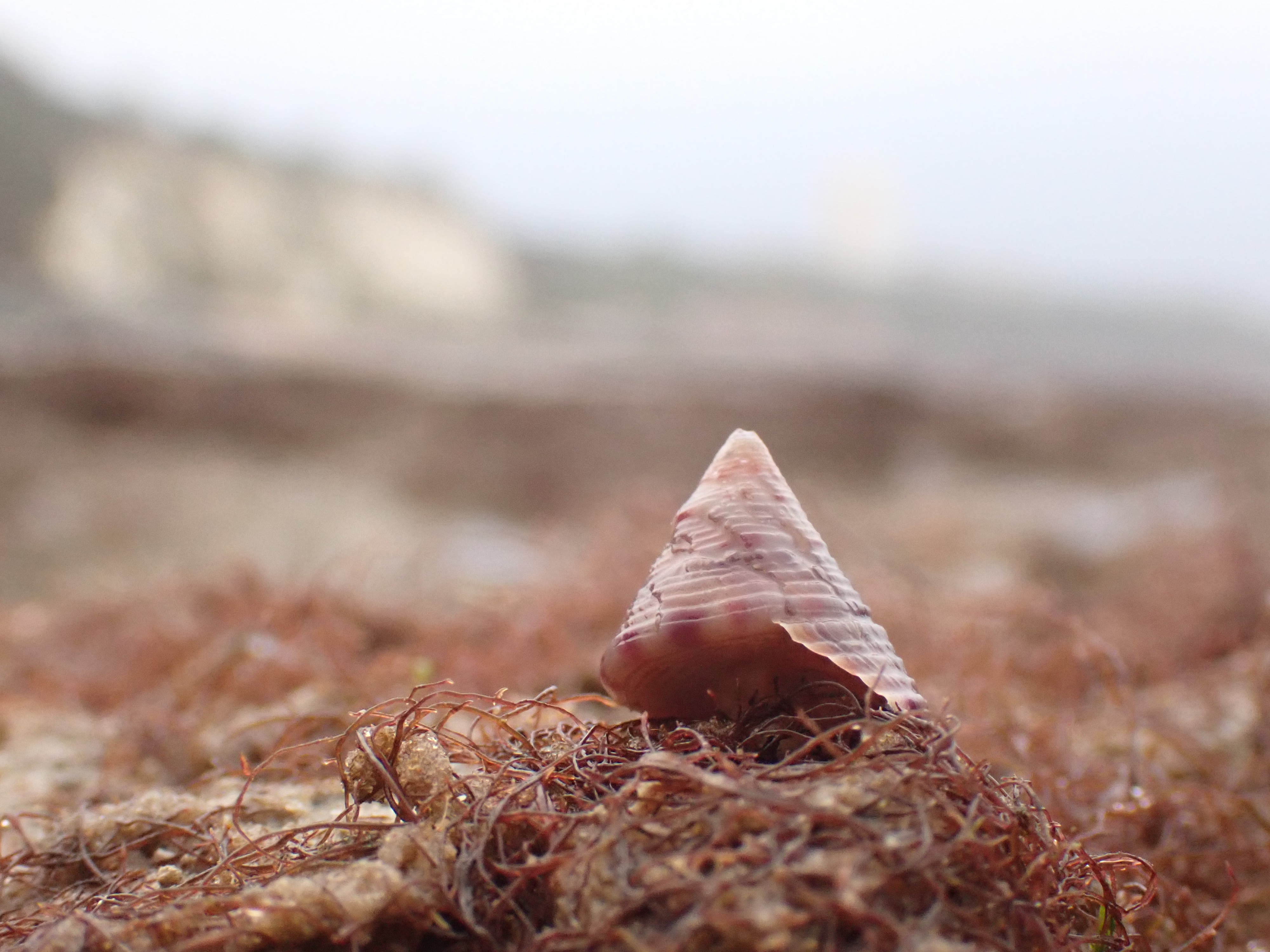
First up, my first Sussex Painted Top Shell! I love these things, so was very pleased to see a young on under one of the last rocks I looked under and quite close to the shore. It's quite tall in proportion to width, but I think we can rule out Jujubinus.
I saw four species of fish. Loads of Shanny (including c10 under one rock), a couple of Rock Gobies and one Tompot Blenny. You tend to only see these on the lowest tides. The water was so murky though, even the Ferrero Rocher container wasn't working, it just made this Tompot Blenny look like a Guild Navigator from David Lynch's Dune. "I did not say this. I am not here."
And four Worm Pipefish, I had no idea how amazing they were up close. I thought it was gonna look like a bit of old shoe lace! Look at that! The ring flash kinda ruins in but they eye is magic.
I think this must be a young Sea Gherkin, I have seen much larger, whiter ones here before.
And under the same rock, a similar sized translucent, shiny worm. I have never seen this before, no idea what it was. Quite like a large tipulid larva.
And one of the two large, hairy chitons in the genus Acanthochitona (probably crinitus).
And then right at the end, a couple of sea slugs under one rock. I think these are Acanthodoris pilosa. I have seen them here before but not often, and strangely this one seems to like it quite high up the beach. The tide was coming in by this point, along with the murkiest waters I have ever seen down there. This was taken through about 5 cm of water (the second shot was taken with the camera under water but wasn't much better).
Not bad considering the conditions. That's pretty much how I see my life right now. After Mum's funeral, I got straight back in the saddle and started writing the book on pan-species listing. I am about 45,000 words in now, hope to get to 60,000 by the end of March. Field season is looming ever closer though and I am now excited an energised to get going at the start of April.
On a very different note, I am becoming deeply worried about the lack of natural history expertise in conservation organisations, what is driving this trend? One thing I know for sure, I have never seen more people into nature (the PSL movement being just one thing that is changing the shape of natural history in the British Isles) than I do now, so why are there so few people with good natural history skills in some conservation NGO's? I am going to be writing a bit more about this over the coming weeks, and I know I am not the only one who is concerned. Until it's recognised by some organisations, the problem will continue to grow.
One thing I know for sure is that most life-long naturalists are idealists, and idealists can be a thorn in the side of the organisations they work for. An important thorn though, as they keep them on the straight and narrow and prevent mission creep, let alone bring the actual skills needed to manage nature reserves and organisations that manage nature reserves. Skills that often take decades to develop. These skills need to be rewarded and nurtured, not just dismissed, thrown away or forgotten about. If conservationists can't take natural history seriously, how do they expect the general public to?
So after work yesterday I went straight back to the Pound for an even lower tide (the lowest of the spring). It was however at 18:40 and was pushing dark. Torches were essential by this point but it was mild an calm. I met up with James Harding-Morris and Robert Jaques, both pan-species listers that I had never met. Everyone was buzzing after last night's haul but it was the Snakelocks Anemone photo that gets pride of place. This is taken under water with the TG4 with James' UV torch shining on it. The title of this post comes from a quote by Robert that I had to rip off. I really appreciated the amount of nonsense these guys came out with, a really fun evening. And I didn't have to turn any rocks again.
Now I think Polycera quadrilineata was on top of everyone's list after my post yesterday so we started sweeping sea weed with pond nets. On my first attempt, I got another lifer!!! Not a nudibranch but still a sea slug, and more closely related to terrestrial molluscs than sea hares (thanks to Cynthia Trowbridge for this info!), here is the incredible Solar-powered Sea Slug Elysia viridis.
And whilst I was taking these photos, James found Polycera quadrilineata effortlessly. Four in all in fact. And another two Elysia viridis! A really nice shot of the rhinophores here showing the detail, these are the 'chemoreceptors' of nudibranchs. You've got no chance of seeing this detail unless the animal (and camera!) is under water. The Olympus TG4 is just brilliant for this stuff. Just remember this and the above specimen were about 5 mm long.
Check out this shot of a Sea Lemon found by Robert crawling through weed.
Early on we spotted a few Dahlia Anemone.
And a Wentletrap!
A couple of White Tortoiseshell Limpets.
And a huge crustacean which must be Common PrawnPalaemon serratus (and not Crangon crangonas I originally labelled it - thanks Evan).
As for the fish, we wracked up (see what I did there) a whopping seven species (or eight in two days). Long-spined Sea Scorpion showing the diagnostic spines at the side of the mouth which are so easily visible when the animal is under water.
And beyond the kelp zone, Ballan Wrasse and Tompot Blenny were the commonest fish. This huge wrasse took some team effort to catch. It was cathartic because in this same area two years ago I bungled something that looked exactly like this and given how many we saw here last night, I was convinced that that was also a Ballan Wrasse but now I am not sure it's not a huge Corkwing thanks to Evan. The wrasse is the one on the left. Not sure what the other vertebrate is.
So in favour of Ballan: Smooth preoperculum, huge size (25cm), no black tail spot, lots of smaller Ballans present beyond the kelp zone. In favour of Corkwing: black kidney mark behind eye, larger scales that do not appear pale centred, blue fins beneath. OK, a third opinion is needed but Evan has started to sway me into thinking this is actually a massive Corkwing...
UPDATE: It looks like this is a big Corkwing male. Thanks to Evan and people from the Seasearch Facebook group for commenting. I'm amazed how different it is to all the other Corkwings I have seen, I really take the point that divers must see these animals much more frequently than I do. Amazing!
One the way back in I turned over a tiny rock (that's literally all I can do) and I found a clingfish! Now we have four clingfish species and I knew it wasn't Cornish Sucker or Connemara Clingfish. So it's either Two-spotted (the common one) or Narrow-headed (the scarcer one). I am not convinced I can tell which from these photos or even if it is possible at all. Using the Handbook of the Marine Fauna of North-West Europe it's about the relative placement of the fins but this doesn't seem to be a character used in more recent field guides. If it had two big spots then that's easy to ID as a male Two-spotted. Females are apparently not separable in the field. I think the head is about 1/3rd the length of the body and not the 1/4 required for it to be Small-headed. So I think this is likely to be a female Two-spottedClingfish. And in hindsight, I believe all the individuals I have seen of this species pair are likely to be that too.
Beyond the kelp zone, I spotted a piece of red sea weed dancing around in a rock pool. It was clearly a crustacean. What a strange creature. I have just keyed this out and I believe this is a type of skeleton shrimp called Caprella linearis. Other marine crustaceans new for me were Siriella armata and Gammarellus angulosus.
Another incredible evening's natural history. I was amazed that there wasn't a soul there again yesterday. If you want to get a big list of species it's really key to hit the lowest tides of the year.
A real highlight was walking back up the cliffs into the back of Eastbourne. The Alexanders was covered in moth and beetles. Upwards of 20 Oedomera femoralis feeding on the flowers but also Common Quaker, Satellite, Dark Chestnut, Bloxworth Snout, Double-striped Pug, Agonopterix heracliana and Digitivalva pulicariae, better than the moth trap at Woods Mill on Thursday morning. And I got two new spiders new for the year. Amaurobius ferox (116) and Dysdera croccata (117).


 Posts
Posts