Last weekend was City Nature Challenge. It's hosted in iNaturalist. I am not a fan of this platform for many reasons that I won't go into here (I wish it was in iRecord) but I do like the challenge. So I have took part by sending my records in as casual observations (without photos that is - it's ludicrous to think I could take photos of even a fraction of what I record without completely wrecking the methodology). This way, they don't actually find their way back to the Sussex Biodiversity Record Centre, they get there directly from me in the same way as all my other data. Here is the current leader board for 2023, at the time of writing my records are not on there but they will be soon and I will update this blog when they are and the challenge is over for the year.
Some 23 'cities' in England are taking part. For the last two years Brighton has come top for the total number of species, and I have been pleased to play a big part in this. This year, I had more time free to do some recording for fun (not just using records from work). I recorded constantly for about 3.5 of the 4 days. You do get a bit of time to do the dets too, which are just finished. So my stats come out at 2801 records of 1014 species. This includes 570 invertebrates, 303 plants and 77 birds.
Day 1. A quick walk around BHASVIC Field with Karen first thing and then I headed to Woods Mill but it was sodden, so I just wandered around doing plants, bryophytes, molluscs and birds. I managed to refind Pepper-saxifrage in the valley field and saw a Cuckoo. Then I headed to Wiggonholt Common RSPB and things got really interesting. I targeted this site as one of the only significant areas of heathland within the project boundary. I recorded something like 150 invertebrates in the field over about four hours but it was the specimens that provided the most significant find of the weekend, probably my year. I had noticed lots (maybe around 15 or more) of paired up Nephrotoma craneflies flying up out of the Heather. I took a couple of males and when keying them out, I couldn't believe that it was coming out as Nephrotoma sullingtoniensis, the Sussex Tiger.
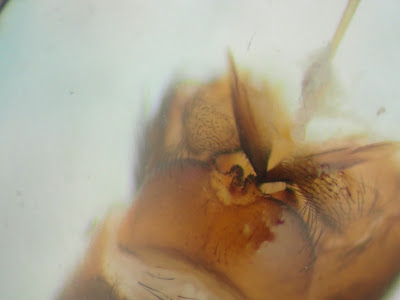
This cranefly has only ever been recorded three times and from one site - Sullington Warren. This small heathland is just the other side of Storrington to Wiggonholt, so it was certainly not out of the question. The book lists it as flying in June though, not late April. And lots of people have looked for it then and not found it. Could it have a much earlier flight period than people thought? I quickly got on to Alice Parfitt and told her all about it and she went and checked out Sullington (no joy) but did find it a third site - Hurston Warren. How amazing is this?! Especially as I just wrote a blog the night before about the importance of going out in April. Here are the rest of the microscope shots of this Endangered species.

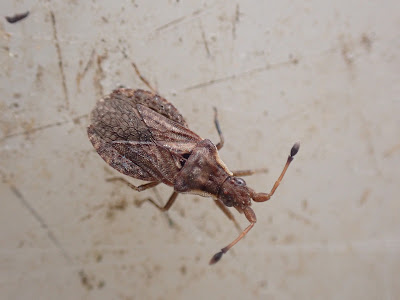
Other highlights included my first heathland Enoplognatha mordax (still it marches on inland into all habitats, I had one in woodland the other day - first photo), Cercidia prominens, Xerolycosa nemoralis, Sibianor aurocinctus and Hypsosinga albovittata. I had another lifer int he form of a scarce dung beetle, Euorodalus coenosus and I refound Spathocera dalmanii there (photo). I found a few Dieckmaniellus gracilis too, despite the lack of foodplant.
Day 2 I spent on the chalk with Kim Greaves. We did the morning at Malling Down and the afternoon at Seaford Head. We mopped up! Malling Down provided some really exciting records, but mainly things I had seen there before. The first sample generated an almost adult Phaeocedus braccatus (1st photo) in Bridgewick Pit. And a whole host of cool harvestmen, including Trogulus tricarinatus again and this awesome Megabunus diadema (2nd photo). I got a lifer on the way into Green Pits. This is a rather messed up looking specimen of Thimble Morel (3rd photo) which people tell me is having a good year.
Onto the Coombe and I found an adult Pancalia schwarzella at one of its few Sussex sites and Kim spotted this carabid, Lebia chlorocephala. This is only the third time I have seen this beetle in 13 years, the other two records being from Malling Down in 2010 and Southerham in 2017. The Horsehoe Vetch feeding pollen beetle, Meligethes erichsonii, was also a lifer.
To Seaford and a very casual twitch of the White-crowned Sparrow before mopping up on some Hope Gap specialities. Heath Snail, Moon Carrot, Lasaeola prona, Pyrausta ostrinalis (photo) and (possibly new to site) Astrapaeus ulmi. Oh and of course, loads of freshly emerged Anthophora retusa males. Amazingly we saw one male sitting on an Adder but I just couldn't get anywhere near it to get a photo. Picked up Whimbrel on call, when you do this you need to have one ear listening out all the time.
And I think these are my first Sussex Thick Top Shells (Phorcus lineatus) from the rockpools off Seaford Head. This seems about as far east as they come in the UK.
Day 3 and I spent it at work and made over 830 records to add to the set. Libby Morris accompanied me for about half of the day. Highlights included Bombus humilis and another Enoplognatha mordax. Oh and Aulacobaris lepidii which I see quite a lot on farms. But the best record was actually on what I believe to be Sussex University Campus land when I was trying to get back to my car. I saw that Martin Harvey had picked this up a few weeks earlier and I was gripped, can't believe I then went on to see this very odd yet charismatic sawfly, Sciapteryx soror. Yet another lifer.
And what must be the most Syntomus obscuroguttatus I have ever seen in one sample, this is just a fraction what was in the tray.
Day 4. I am broken after walking 27 miles in four days with 15 kg of gear. I spend most of the day entering records and identifying specimens. The weather is bad with some storms but Karen and I head out to Woods Mill to do some wetland invertebrate sampling in the afternoon and we do quite well. We find the ladybird Nephus quadrimaculatus, loads of new spiders in the meadow and finally Nightingale! Which was also Karen's first.
Here is my distribution over the four days, including some roadside botany. I am exhausted, 30% of the way through my field work for the year already and I have entered 8734 records in April alone. This challenge was immensely fun but talk about burning the candle at both ends.
Will it be enough to get us into top place for species again? I hope so. Here is the breakdown of the species recorded.
Before I found myself sucked into the inescapable gravitational pull of Black Hole at Burton Pond, I headed to Iping Common to MAX OUT ON MY SPIDER YEAR LIST! There, I've said it. I'm year-listing spiders again apparently. Anyway yesterday was awesome. From Iping and Burton I recorded 65 species of spider which from mid winter on a frosty day I think is pretty smart. I got TWO lifers out of it. Neither were from Iping. Iping was great for some big impressive spiders I would normally expect to see in autumn, such as an adult Ero tuberculata above (looks like another new record for January). This adult female Agroeca proxima.
Other charismatic mega fauna included Marpissa muscosa.
Nuctenea umbratica. I don't think I have ever noticed their weird eye arrangement before.
Clubiona corticalis with the above two on the same tree.
And a Cream-streaked Ladybird just to keep my eye in with the beetles.
I had collected tons of linys which it turned out were going to be mostly unexciting species. The Sphagnum areas at Iping were yielding nothing so by about 1.30 pm I found myself sucked into the Black Hole at Burton Pond.
A year on I was very much aware how much my spider field craft, especially with money spiders, had moved on. I was ticking off things such a Sintula corniger, Taranuncus setosus, even female Notioscopus sarcinatus (I did check these). In addition immature Theridiosoma gemmosum and Rugathodes instabilis. Black Hole really is a gem and recent work that Jane Willmott has done there is clearly having a great benefit to the site by keeping it more open. An an adult Platnickina tincta was a bit of a surprise too.
Oh and Demetrias monostigma. If you are finding this beetle, you are on a good site for spiders. And beetles. I only ever see it in old Greater Tussock-sedge and Marram tussocks.
It wasn't until I got home though that I realised I had found something rather good.
Here is Centromerus brevivulvatus. Last seen in the UK in West Sussex in 1998 by Dick Jones at Durford Heath. It's Endangered and Nationally Rare. Only ever known from seven 10 km squares, four of which are in Sussex. Interestingly one of these is Iping Common where it was last seen in 1969. This record though is an entirely new 10 km square making eight 10 km squares, five of which are in Sussex! Oddly only this week I assessed this species as a 'Sussex rare species' and thought to myself "I should get out there and have a look at Durford Heath."
Have a look at the SRS page for it
here. Here is the map. Look at all those 'x's.
The singularity that is the Black Hole opened up an Einstein-Rosen Bridge to 1998. What was I doing then? This:
I didn't know anything about spiders then, but I did look a lot more like a spider than I do now. I'd have been half way through my astrophysics degree at Sussex Uni at this point (that's not the name of a hipster ale by the way {hipsters didn't exist then} - in the above image I am halfway through a pint of Hoegaarden).
Anyway, back to Black Hole. One of the next spiders I looked at I only recently ticked off up north. I was amazed to find a male Aphileta misera. This seems to be a species new to West Sussex, the last Sussex record from Ashdown Forest was in 1970. So where was I in 1970? Well I was an unconstituted smear of matter across the Staffordshire landscape, with smaller clusters peppered around the world depending on where my mother's food would come from some seven years later. Some of my carbon might even have been sequestered by spiders at that point, probably the bits that would one day make up my neurons. We have all been there!
And also new for me was Diplocephalus permixtus. A species I was expecting to see up north. Turns out this is the first West Sussex record since 1944 and Sussex record since 1999.
Now I did quite a bit of recording at both these sites last year and it really does go to show how important repeat visits are. With just shy of 10% of the UK fauna seen in a single day I will not be doing any recording now until next weekend.
What road do you walk down?
October 1988: I made my first biological record aged ten (without really knowing what a record was) with the help of Ewart Gardner. It was a Goldeneye at Blithfield Reservoir.
September 1991: Steve Cooper showed me a moth trap for the first time on my school roof. Angleshades and Canary-shouldered Thorns blew me away.
October 1996: Partly through frustration at my A-level biology teachers ("that's not a rock-rose Graeme, it's a buttercup" - really? Is this what it's gonna be like if I do biology at university?) and partly for reasons that will forever remain a mystery, even to me, I started a degree and masters in astrophysics at Sussex University.
July 2001: I started my career in conservation at Dungeness RSPB.
May 2016: I returned to Sussex University to teach students from all over the UK about entomology.
I have just had one of the most rewarding weekends! Six month's ago Dr Alan Stewart of Sussex University asked me and a number of other specialists to come and help teach students in entomology at the campus as part of a BENHS event. For me, coming back to the university after all these years was very strange. Especially as I often used to look across from the maths and physics blocks up to the biology department thinking, "I really should be over there". I remember seeing the Biology Road sign all those years ago. So to go back and teach entomology, all be it just for a weekend, provided a great deal of catharsis for me. I gave talks on beetles, spiders and biological recording. The weirdest thing here was the lines and lines of calculus on the chalk boards, all very familiar but totally forgotten by me.

Anyway, the real stars of the show were the students. I was amazed at how keen they were, many of them turning up with reference collections and lots of equipment! On the first day we spent our time in the field by a dew pond on the campus (next to where twenty years ago Richard Attenborough gave us an introductory talk and I specifically remember him mentioning how important extra curricular activities are! - this could not be more true in the field of entomology) and the chalk-grassland at Stanmer Park. Alan and I had our petrol and electric suction-samplers respectively and this produced a wealth of material to show students. I was encouraging students to take carabid specimens to key out (the other half of the students split off with Mike Edwards to look at bees and flies).
I even managed ten new beetles with the help of Peter Hodge but it was back in the lab where the real work started walking students through keys for the first time. It was so great to see students get their first correct identification. One student picked up what I thought was a small Harapalus in the field which turned out be a male Ophonus. I helped really only by dissecting the aedeagus but the student managed to card the beetle and mount the aedeagus and we tentatively put the name Ophonus schaubergerianus which might even be new to East Sussex. I'm going to get a second opinion on this one. Sadly I didn't manage to get many photos of specimens or students. I did manage this photo of Chris Bentley and I at the microscopes.
On the second day we opened some moth traps. The highlight was the most well hidden Mullein, perfectly adapted to hiding on pegs.
We did more survey work on the campus and the highlight was finding yet another of the RDB1 Cassida denticollis. This area is clearly a hot-spot for this very rare beetle as we recorded it at Malling Down and Southerham last year. We picked it up (and two much commoner Cassida) in the suction-samplers. What was great was seeing students in the field come back with specimens they had caught such as Green Hairstreak, Rhinoceros Beetle, Andrena fulva, at least eight species of shieldbug and the saproxylic weevil Phloeophagus lignarius. The whole weekend was so exciting and I really felt like I helped make a difference. Well done to all the students and teachers alike, I hope this becomes a regular event!
Four years with my head in the stars seems like just a drop in the ocean now for me as I continue my life long journey down biology road.


 Posts
Posts


