An Alternative Natural History of Sussex.
This blog shows the highlights of my day to day findings as a naturalist and ecologist living and working in Sussex. Delivered with a pinch of nihilism, a dash of sarcasm and absolutely no tweeness, here is my attempt to show natural history as it really is: Brutal, beautiful, uncompromising and fascinating...and occasionally ridiculous.
I have been studying natural history for some thirty years, nineteen in a professional capacity. I currently work in Sussex as a freelance entomologist, ecologist and botanist and specialise in nature reserve and rewilding management advice based on the interpretation of the surveys I carry out. I also run a number of identification courses. An advocate of the pan-species listing approach. My main areas of interest are birds, plants and invertebrates and a lot of my spare time is spent in the field. I am the county recorder for spiders and bugs.
I finished an invertebrate survey at Holmwood Common today for the National Trust in Surrey. I was pleasantly surprised by how much stuff I found today but the lep. larvae were the highlights. This is the first time I have see a Purple Emperor larva, so you won't be surprised to see I took a LOT of photos of it. Enjoy!
What a cute little dude! Hard to believe next year this could become our biggest butterfly. If it's lucky!
Nearby I beat some gorse and got this remarkable looking lichen mimic moth larva. At first I thought Brussel's Lace, then a Light Emerald and thanks to Jeroen Voogd on the Caterpillars UK & EUROPE Facebook group he pointed me in the right direction. It's not a geometrid at all. It's Beautiful Hook-tip. A moth I have seen hundreds of times but another larva tick!
And then, a massive Pale Tussock! I couldn't get it to unfurl.
The black stuff on Pale Tussocks is like that Vantablack paint, it reflects no light at all. I was staring into that blackness when I was reminded of the Fast Show...
Or as I initially called this blog post: Passive sampling vs. active sampling.
I am a big fan of moth-trapping, don't get me wrong. It's a great way of racking up vast numbers of records for a site in a short space of time without leaving the comfort of your home but just how valuable are these records? The moth trap we run at Southerham picks up lots of moths off the chalk but it also gets lots of moths from the nearby Lewes Brooks wetland that are definitely not breeding on site. There was even a Pine Hawk-moth recently and there is very little pine nearby.
When I am doing surveys of invertebrates, I treat moths like any other taxa. You never catch a 100 species in a day, no way near that, but the moths that you get are almost always species that are breeding on a site. In the last month Glenn and I have been carrying out a vegetation survey of Malling Down and I have been constantly distracted by moths during these surveys. Although this site is extremely well recorded, we have added quite a few rare and scarce species.
First is Mecyna flavalis. This pRDB3 species is known really only from Deep Dean in Sussex, I went there with Michael Blencowe to look for it eight years ago and have not seen it since. It occasionally turns up in moth traps but this is the first record in the field of a specimen away from Deep Dean. Frustratingly I did only see one, which is a lot less significant than two, but the habitat was exactly the same. Extremely tightly grazed south facing chalk-grassland. This moth was not here by mistake and I would expect we will see this moth here again soon.
Yesterday we found the smart looking Moitrelia obductella (pRDB3). It would seem that this is the first record in Sussex that wasn't in a moth trap and it was also new to Malling Down.
Also yesterday were two Chalk Carpets (known from the site but I always get an eight-figure grid ref for these as they are on the real S41 list).
And the nationally scarce b Dingy White Plume which is common enough on the Downs where there is Marjoram, also new to the site.
Yet finding larvae in the field is even better. You're guaranteed it's breeding on site if you find larvae. Not rare but Glenn spotted this Small Elephant Hawk-moth in a plot last week, the first I have seen of this species. It really does look a bit like a Grass Snake! It lacks the spine at the back of Elephant Hawk-moth but also the eye spots are more detailed and a bit more like Peacock butterflies eye spots.
I would love to see more people finding larvae and adults in the field. And just so you know you don't need a trap to find rarities, here is a quick reminder of the Purple Marbled I found at Seaford Head a few weeks ago when I didn't even have my net to hand, just a tiny glass tube.
And out of county but last week I found a Vestal in a bog in the middle of nowhere.
And if you target a specific food plant for inverts that only eat that plant then you often turn up the goods. I beat a Crab Apple at asite in Surrey recently and this Argyresthia ivella came off it, the only time I have ever seen this Nb species. What was perhaps more unusual was the bare-footed man who appeared out of nowhere playing the theme tune to Lawrence of Arabia on a flute. I would like you to appear doing this whenever I get a lifer from now on please. It was magical.
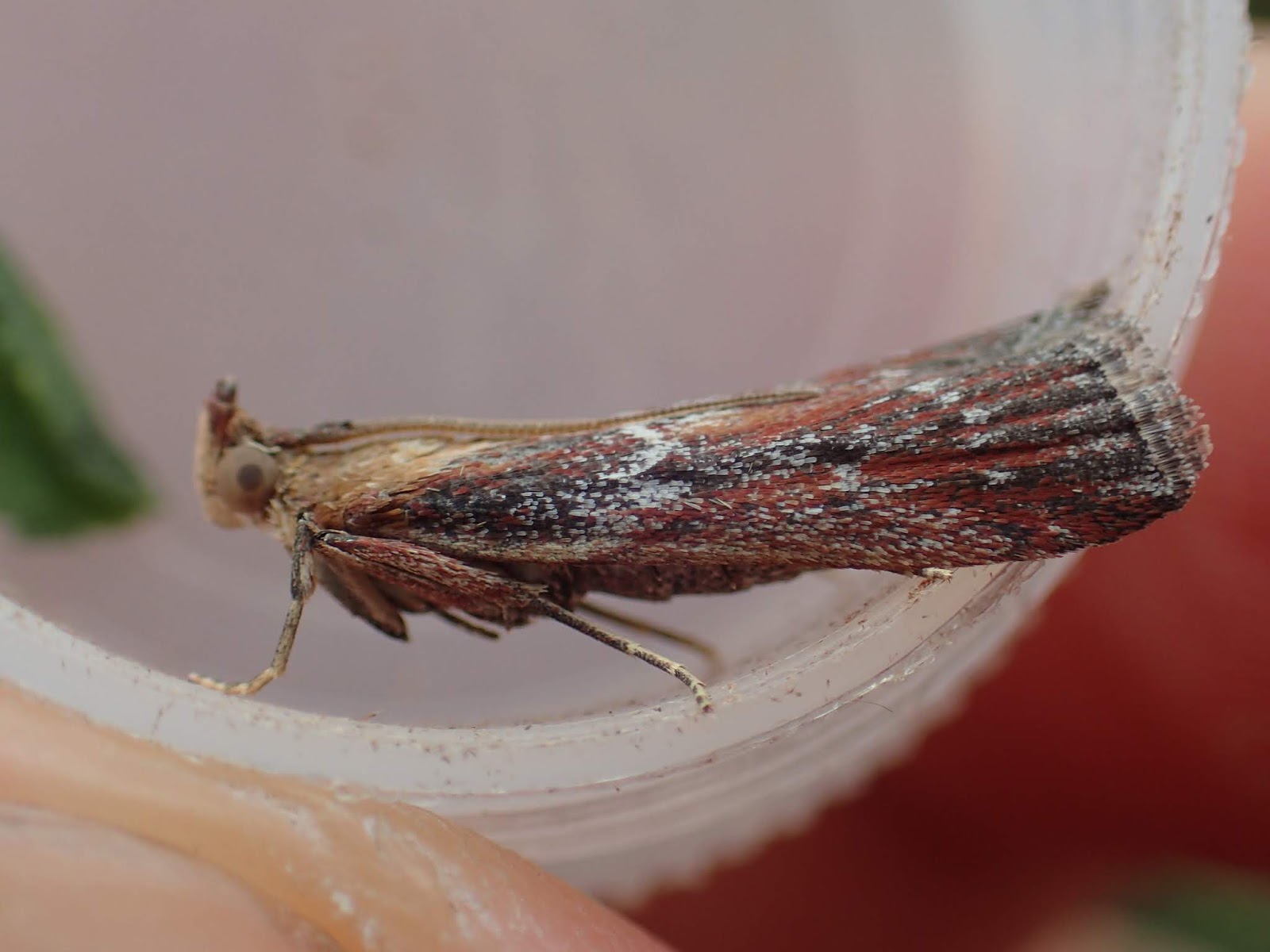
And I got a lifer in my own house yesterday morning whilst brushing my teeth. I looked up next to my dried Hops to see a little pyralid I didn't recognise. I had the back door open the night before so it must have come in that way. Or so I thought. On closer inspection it was an Indian Meal Moth Plodia interpunctella (it was neither spicy or filling I should add. Om nom nom). An adventive species, I think I found it right next to its food plant. They must be eating my dried Hops! It's quite a smart little beast though.
So you don't need a moth trap to find rare and unusual moths, but they will probably be mainly micros!
I've had a very enjoyable couple of days freelancing in Surrey and Kent and quite a few lifers. But first I finally caught up with my first adult Rambur's Pied Shieldbugs. My first reaction was how much blacker they were, in fact it looked more like a black bug with white bits on than a pied one. These were in Kent. This bug has yet to reach Sussex but look for it on Black Horehound in the north east of East Sussex, it's only a matter of time!
Back in Surrey we saw quite a few Raglius alboacuminatus, also on Black Horehound and also not yet in Sussex. This is a striking ground bug that I found mainly with the suction sampler by sampling in litter beneath or near to the foodplant.
Here are all the lifers from the last two days:
Raglius alboacuminatus Cheilosia soror Leopoldius strigatus Tapinopa longidens Creophilus maxillosus (at long last, what a beast!) Scymnus femoralis Stethorus punctillum (the UK's smallest ladybird at less than 1.5 mm!)
In fact, it was a great couple of days for ladybirds, the full list is here and includes the two lifers at the top. A total of 17 species not bad for two days. This is mostly down to using the suction sampler and picking up some of the smaller ones.
Yesterday morning, about 8.30 am I was getting to the end of a bird survey at Limpsfield Common in Surrey. No net, no pots. Just my binoculars and Weatherwriter, nothing else. And clothes obviously. When before me a golden orb of light appeared on a sunny ride. It wasn't a religious experience or a UFO, it was far more impressive than that. This hairy nugget of a hoverfly with magic wands for antennae got right up in my grill and I had an idea as to what it was but I needed to catch it to be sure. I stood motionless as the fly descended from eye level and landed in the eye cups of my binoculars! I had one chance and amazingly managed to grab it between my thumb and forefinger before transferring it to a pot. It was indeed the nationally scarce Callicera aurata and an impressive beast indeed.
I have wanted to see this for some time so it was a great way to end the survey. It actually flew off as I was taking this photo (after cooling down in the fridge) but amazingly I did it again, catching it between my little finger and palm. So when I caught a Syritta pipiens in the kitchen just now, I was feeling rather blase about my fly grabbing skills.
Too much natural history getting in the way of blogging at the moment! A crazy few weeks. Just a quick one of a new spider for me from a site in Surrey. The Nationally Rare Xysticus acerbus. The male is at the top and I also found a female (the bottom two photos). This is perhaps my favourite genus of spiders. In fact, there are now only two I haven't seen - robustus and luctator.
Other favourites of mine include Andrena, Chrysolina, Cryptocephalus and Ampedus. I am sure there are many more. What makes for a good genus? A decent number of species with a mix of bright and varied charismatic species identifiable in the field and some only at the microscope. A mix of common species and rare ones so that they are not too elusive. That sort of thing for me. So what's your favourite genus? Meanwhile enjoy some more Xysticus acerbus.
I gave a talk at the the Surrey recorders seminar yesterday, an updated version of a talk I gave to the Sussex recorders back in 2012. Half way through the talk I hijacked my own presentation with a short presentation called 'The Natural History of Pan-species Listers'. As the PSL community gave me the information to do this, I thought it only right to share it with everyone. Please bare in mind that this is only a subset of a maximum of 28 of the 51 listers that gave me their info. There have been some interesting changes in the last two years. First off. The number of people doing it! I couldn't get everyone onto a single slide for 2014! I imagine the website can't come soon enough for Mark at this rate!
The other interesting thing was the change in age classes. There has been a rapid increase in the number of twenty somethings which is really encouraging.
Here is the list size versus age graph which basically shows the rate at which you have seen what you have seen!
I find this really interesting. Jonty and Dave are clearly out at front. Mark, Richard, Scotty and I are all more or less lined up. There is the obvious cluster of the 'twenty somethings', another cluster in the 'forty somethings' a strange void in the 'thirty somethings' and beyond that not a lot of meaning at all. Another way of displaying this is...
But the balance between men and women needs a little working on!
I have the 2012 and the 2014 PSL atlases too but I just need to check if I can put them online.
Feedback was overwhelmingly positive. I had a few comments about the lack of mycological expertise expressed in the rankings. My answer to this was that they just haven't signed up yet. It seems to me that you can either go down a predominantly invertebrate route with this, or a predominantly fungi and lower plants route. As it's taken off with the former, I believe most of the people are drawn into it are currently more invertebrate focused. To have a few experts in mycology in the rankings with huge fungi lists would be great and would start to address this balance.
I also heard a sad story that a young lister was told it was a waist of time by their university lecturer! I think it was something along the lines of "all you would ever record are common species that nobody is interested in"! I believe this to be a very misinformed comment and I'm glad that who ever it was has stuck with it!
Another comment made seemed to think that most people could never tackle the keys out there with any competency and it would just produce lots of rubbish records. This goes totally against my approach to this and why I support PSL so much. My attitude is this, if someone else can do it, then I can do it and the only thing stopping me is not having the right equipment or literature. By being fearless with natural history and tackling new groups I have completely changed my approach. New taxa, keys and nomenclature are now something I thrive off not hide away from. Things are only hard when you don't know how to do them! I am not saying I haven't made a few mistakes along the way, but that's what county recorders and people further up the list are for!
A final point which I will be including in the website is the concept of PSL site rankings. This would be great way to engage nature reserve management staff in recording on their sites so if you have the ability to start putting a site list together (not just for a single person I should, a collective effort over time for a site) or already have one then please pass it on to me. It would be nice to have a few lists to kick start the website. Many people who are not interested in PSL have told me they would be interested in this. Rye Harbour for example must be up there as one of the most biodiverse sites in the UK.
Finally, as Scotty missed it. Here is the slide I put up to show that I am not in anyway competitive!
Thanks to a tip off by Steve Gale I was luck enough to catch up with yet another novelty alien fungus up in Surrey, the Red Cage Clathrus ruber. It was however already way beyond its best and was looking a little deflated by yesterday morning. Not all that different to the closely related actor Nicolas Cage Clathrus crapactor, also beyond his best, here he is expressing joy at discovering a rare leaf-miner on the set of the latest David Lynch film, 'Pan-species Listing: The Movie'. Early reviews suggest Cage's performance is lacklustre and that he wasn't even looking AT the leaf in this scene!
Anyway, I met up there with Seth Gibson and as we both had the day off work, we headed into the field to see all manor of interesting things. We went back to the Aseroe site, as Seth hadn't been over to look at the freaky Starfish Fungi of which we saw many, including this one that was just opening up. It didn't smell at all compared to the ones I saw last week. I agree that Anemone Fungi works better.
Whilst trying to identify a webcap (as if!), I stumbled upon a fungus which was a tick for both of us. The rather smart Earpick Fungus that grows out of decomposing pine cones. Once you get your eye in there are loads there.
Seth is really good on leaf miners, an area of natural history I am ashamed to say I have not really ventured into. Seth showed me this Stigmella tityrella mine on Beech. You can see the larvae still feeding at the end of the mine. I can't believe this is the first Stigmella I have ticked! With very little effort, I saw four new moths, all very common. This is a vast reservoir of species that I am now a little more inspired to access. Thanks Seth!
We also found lots of the alien Girdled Snail which was a new one for me.
And this common but distinctive millipede was also a tick being Nanogona polydesmoides.
I must do more of this sort of thing. So far Seth added 10 new species from the day and I added 11 which I guess is about even. I ended the day on 4559 species. It's good for making me aware of how much stuff I miss right under my nose! I'll happily host next time somewhere in Sussex anytime any of the listers fancy a day out and I'm free!
Less than 24 hours ago I saw these Roman Snails on Steve Gale's blog, north downs and beyond. They have been on my wish list for some time so I left a comment asking if I could have the gen. Before I knew it I had a text and had arranged to meet Steve this morning at Banstead Woods. I wasn't prepared for the four mega rare plant ticks I would also get thanks to Steve! I was surprised at how close these parts were to me in Brighton, being only 40 miles away and less than an hour's drive. It takes me much longer than that to get to many parts of Sussex, such as Ebernoe, Iping, Filsham or Rye Harbour!
Back to the snails though. What impressive beasts they are. They are surprisingly large and heavy. And disgusting. The shell is really tough, I doubt they have many natural predators apart from Humans...
Steve showed me a few areas where Greater Yellow Rattle grows and we found a small patch that were yet to open! The first rare plant of the day.
We then passed on to an area where Cut-leaved Germander and Ground Pine were possible. I was getting a wee bit excited by this point as I have always wanted to see Ground Pine and with 20 years of botanising behind me, it was about time 'n all. So, we entered the area of grassland known as Fames Rough and I spotted a tiny Cut-leaved Germander plant not yet in flower. I was pretty confident that was the plant after swatting up last night. A nice little Cryptocephalus moraei posed on the rare plant.
We found much more of the germander in an area that had clearly been managed for the plant. The chances of seeing Ground Pine were suddenly looking up.
After about ten minutes of searching, I found the Ground Pine! What a cool little plant. It certainly does not look like it belongs in this country and it is so unlike anything else. Awesome.
Steve then took me round to an area near Box Hill where Green Houndstongue grows right by the side of the road. It really is a very different plant to regular Houndstongue, the jizz is captured in the bottom photo. Four very rare plants and North Downs specialities. A massive thanks to Steve, I added five species today, all of them really good ones so I will have to return the favour at some point. In the meantime, for 24 hours only, my blog will be suffering from an identity crisis.


 Posts
Posts