An Alternative Natural History of Sussex.
This blog shows the highlights of my day to day findings as a naturalist and ecologist living and working in Sussex. Delivered with a pinch of nihilism, a dash of sarcasm and absolutely no tweeness, here is my attempt to show natural history as it really is: Brutal, beautiful, uncompromising and fascinating...and occasionally ridiculous.
I have been studying natural history for some thirty years, nineteen in a professional capacity. I currently work in Sussex as a freelance entomologist, ecologist and botanist and specialise in nature reserve and rewilding management advice based on the interpretation of the surveys I carry out. I also run a number of identification courses. An advocate of the pan-species listing approach. My main areas of interest are birds, plants and invertebrates and a lot of my spare time is spent in the field. I am the county recorder for spiders and bugs.
Yesterday, as well as four species of ladybird beaten from one branch of a Douglas Fir, there was also a sub adult male Araneus (either triguttatus or sturmi). Now sturmi usually favours evergreens and trigutattus deciduous trees according to the texts. So you would think that it's more likely to be sturmi. Being a young male though, it wasn't possible to tell. I fed him some springtails from the garden today to see if he would grow. An hour later I checked to see if he had eaten any of them and it appeared dead. No, wait, it's just started shedding its skin. So I dashed to the microscope and set up the camera and recorded it shedding its skin! So cool...
Turns out it is Araneus triguttatus which is much commoner in Sussex than sturmi. I have never seen one with this particular colour pattern as they are usually much more orange with a distinctive pattern, not these three pale dots. My 125th spider for the year and another new species for Burton Pond. I would have missed this if I had looked 10 minutes later, so feeling pretty lucky.
2014 was a great year of natural history for me. My database now stands at nearly 26,000 records, over 5000 added in 2014 so far. So here is my annual top ten highlights of the year in reverse order.
10) Spending some time in sand dunes
There isn't much good sand dune habitat in Sussex, so I had to go further afield.
Here is a selection being from top to bottom: Dalman's Leatherbug, Dune Waxcap, Marpissa nivoyi, Fallen's Leatherbug and Marram Grass Chelifer.
9) Flatropers Wood invertebrate survey
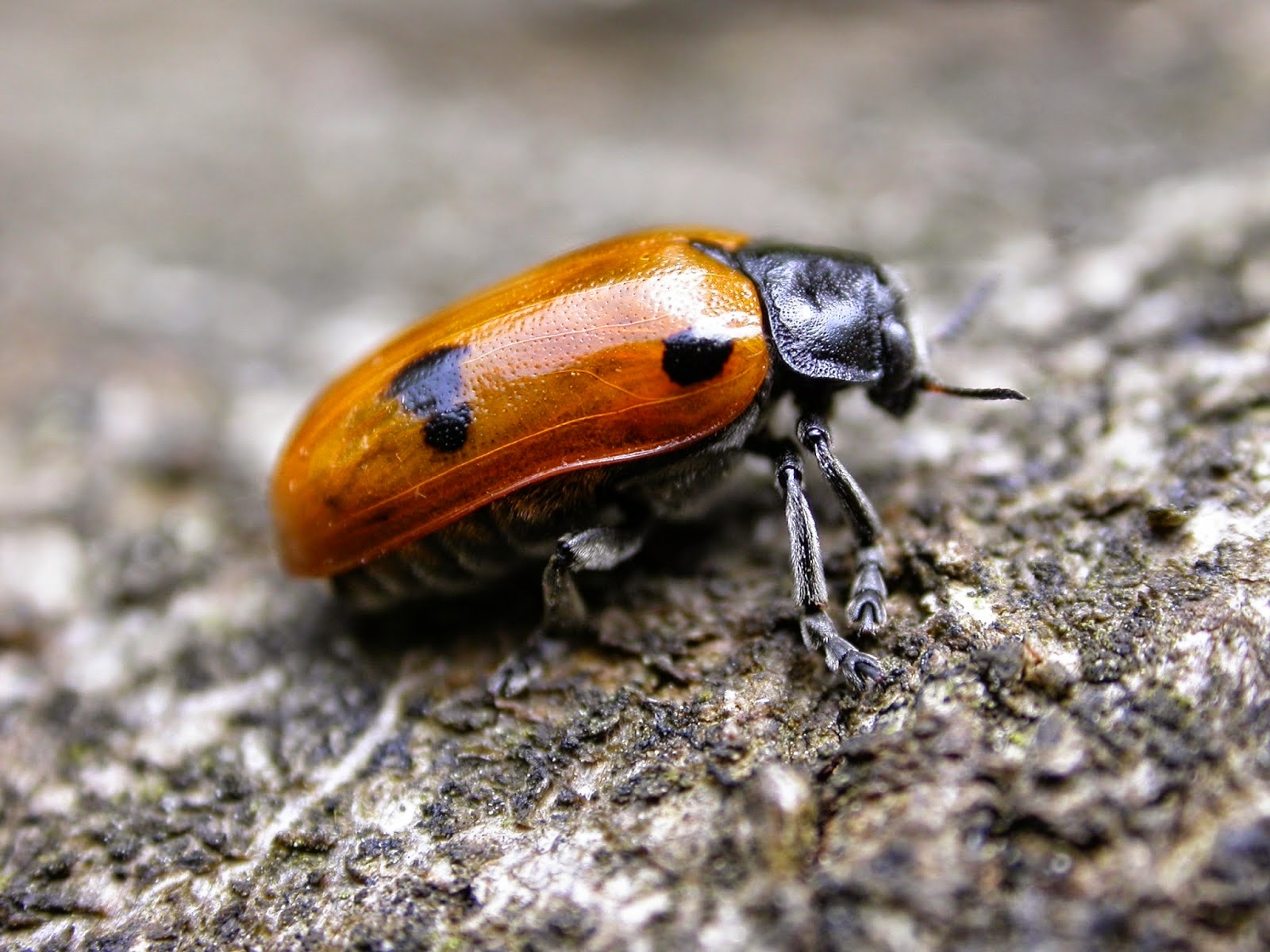
Flatropers isn't even an SNCI and it has shed loads of rare invertebrates. Here we have Xysticus bifasciatus and the two myrmecophiles: the Scarce Seven-spot Ladybird and Clytra quadripunctatus.
8) New Forest antics
I love finding lots of new species in a very small area. Micro-botanising overload.
7) If Darth Maul were a beetle...
Pilemostoma fastuosa. A very cool tortoise beetle from Knepp.
6) Gower power
Rock pooling on the Worm's Head produced this Green Sea Urchin among many other things.
5) Lappet
Always wanted to see one and one finally turned up in the moth trap.
4) Jurassic Carp
A trip with Seth and Tony to Kimmeridge Bay produced my first Cornish Sucker!
3) Burton Pond invertebrate survey
Here we have Xysticus audax, Alder Leaf Beetle (new to Sussex and found by Adrian Holloway) and the beetle Agapanthia villosoviridescens.
2) Creating the PSL website and article in British Wildlife
It has been a great year for pan-species listing and I'm pleased to have been able to contribute so much to the movement.
1) My first freelance invertebrate surveys struck gold!
Finding only the 7th known site for the rare Pondweed Leafhopper and also plenty of 13-spot Ladybirds was my highlight of the year. This cracking little private nature reserve just is a great example of what can be done to benefit wildlife.
So hopefully I will get back in the saddle in the new year but for the time being I'm still rather estranged from it. It's reminded me how much I love wildlife though writing this post so who knows.
After a slow start yesterday, the invertebrate survey at Burton Pond developed into a slow and steady trickle of large charismatic mega fauna and exciting rarities. Of greatest visual impact was this MASSIVE Agapanthia villosoviridescens. We actually saw six or more of these and all were sitting on Hemp-agrimony stems. This is one of only a few longhorn beetles which don't feed on wood as larvae and are known to feed in umbellifer stems. It's the first time I have seen one of these in four years and my first Sussex ones, glad to see them well established on on of our sites.
Mike noticed a nest of Lasius platythorax and said this would be a place for the hoverfly Microdon analis. As if by magic, a mating pair were spotted seconds later. In the afternoon I swept Microdon myrmicae from the the Black Hole which is the first time I have seen this species. I think both of these species are nationally scarce.
This HUGE Araneus angulatus (Nb) was only my third encounter with this species and the first one that was photographable. It's not even fully mature and is already a huge spider.
Strange things that I would not have expected to see included Bristly Millipede Polyxenus lagurus beaten off a dead tree at New Piece. Here is a photo I took of one at Rye Harbour.
And I swept a Donacia crassipes (Nb) off Alder.
Other highlights included the Ornate Brigadier Odontomyia ornata an IUCN Vulnerable species and perhaps the rarest find of the survey. Another exciting record was two Crambus uliginosellus netted in flight from Black Hole. This Nb micro moth is a bog specialist. According to Colin Pratt, this has not been seen in West Sussex since 1992 and this looks like a new site. Also in Black Hole was a cracking adult female Pirata piscatorius which I have only ever seen at Pevensey and might be a first for West Sussex! The only new beetle I saw all day was Abdera flexuosa which fell off a bracket fungi as I potted up a Dorcatma! I even saw four new species of spider but I haven't got time to go into them. Burton Pond is proving to be an exceptional site for invertebrates, what will we find their next?!
I found myself nearly waist deep in a stinking black bog today known ominously as the Black Hole, part of our Burton Pond reserve. It's a dangerous place but we had to have a good look around to discuss alder, willow and birch management there. It wasn't all bad though. I did a wee bit of sweeping on the edge of the bog and came up with this striking nationally scarce (Nb) spider, Araneus alsine. I have wanted to see this for years and was glad to finally chance upon it. There are only three records on SxBRC and the last in West Sussex was in the 1890s! Considering how distinctive this thing is, and apparently how hard it is to find, perhaps this is the first record since then! The only Araneus I have not seen now is Araneus marmoreus.
I also swept a carabid new to me, the nationally scarce Demetrias monostigma being my 4029th species. Here is a shot of Cranberry flowering in the bog, there is more there than I have seen anywhere else in Sussex.
Now this is the last post before I go to Ireland. See you on the flip side!
I was making a cup of tea at work yesterday and I saw a beetle fly past at eye level. Mr Miyagi style, I snatched it out of the air with my hand and carried it back to my bag of pots betwixt thumb and forefinger. I could see it was an Anthrenus but I thought it was going to be the Museum Beetle. It keyed out to Anthrenus fuscus (species 3865). Quite striking under the microscope.
I spotted this Large Red Damselfly at rest on a tree at Burton Mill Pond which made a nice subject.


 Posts
Posts


.JPG)