An Alternative Natural History of Sussex.
This blog shows the highlights of my day to day findings as a naturalist and ecologist living and working in Sussex. Delivered with a pinch of nihilism, a dash of sarcasm and absolutely no tweeness, here is my attempt to show natural history as it really is: Brutal, beautiful, uncompromising and fascinating...and occasionally ridiculous.
I have been studying natural history for some thirty years, nineteen in a professional capacity. I currently work in Sussex as a freelance entomologist, ecologist and botanist and specialise in nature reserve and rewilding management advice based on the interpretation of the surveys I carry out. I also run a number of identification courses. An advocate of the pan-species listing approach. My main areas of interest are birds, plants and invertebrates and a lot of my spare time is spent in the field. I am the county recorder for spiders and bugs.
Last summer I was fortunate to find three of these in a sweep net. This wasn't in Sussex though. Gargara genistae (above)is a local species that feeds on Broom, there is only one Sussex record. It was found in Rewell Wood in 1982 (I don't think it's been recorded in East Sussex) by Wilberforce Jones and E. C. M. Haes. Actually there was a second lifer in the net, the Broom Leaf BeetleGonioctena olivacea. Anther local species but not a particularly rare one (below). Broom just isn't that common in Sussex. When I say common, it's definitely widespread but if you want good populations of invertebrates that feed on a specific plant, you need lots of that plant in lots of places in the landscape. I rarely get to sweep Broom like this in Sussex. Flatropers has got a bit but it's isolated in woodland and rarely has anything on it.
Anyway back to the charming Gargara. It's one of only two tree hoppers we have. The other being the much commoner Centrotus cornutus. I think Gargara genistae is probably the closest insect in the UK to a cube in its proportions. Plea minutissima might give it a run for its money though. Is there anything else more cube-like out there?
I did a survey out in East Sussex today and Rachel came out for some invert training. We clocked up well over 150 species of invertebrate which was pretty impressive for the nature of the site. The highlight for me was beating an adult Ledra aurita from Hazel. I have only six records for this weird looking hopper, our largest species. I think it kinda looks like it has a dog's head in this photo. All but one of of my records have been nymphs, so it was great to see an adult again. It's not rare, I just don't seen the adults that often. I really remember finding a dead one when I as a kid at Sandringham whilst and identifying it myself.
So today when I placed it on top of a fence post for a photo shoot, I was excited to see it opening its wing cases ready to fly. I wasn't prepared for what happened next. It jumped almost vertically into the canopy and this seamlessly became flight. It was like watching a firework go off. Or Superman taking flight! If I had videoed this, it would have simply winked out of existence. What an amazingly efficient and fast way to find your way back to the canopy if you get beaten out of a tree by an entomologist or blown out in a storm!
Other highlights included this Dotted Fan-foot that Rachel caught and several Adelphocoris ticinensis. We also had two new bugs for the 10 km square on the atlas, being Box Bog and Stictopleurus punctanervosa.
2014 was a great year of natural history for me. My database now stands at nearly 26,000 records, over 5000 added in 2014 so far. So here is my annual top ten highlights of the year in reverse order.
10) Spending some time in sand dunes
There isn't much good sand dune habitat in Sussex, so I had to go further afield.
Here is a selection being from top to bottom: Dalman's Leatherbug, Dune Waxcap, Marpissa nivoyi, Fallen's Leatherbug and Marram Grass Chelifer.
9) Flatropers Wood invertebrate survey
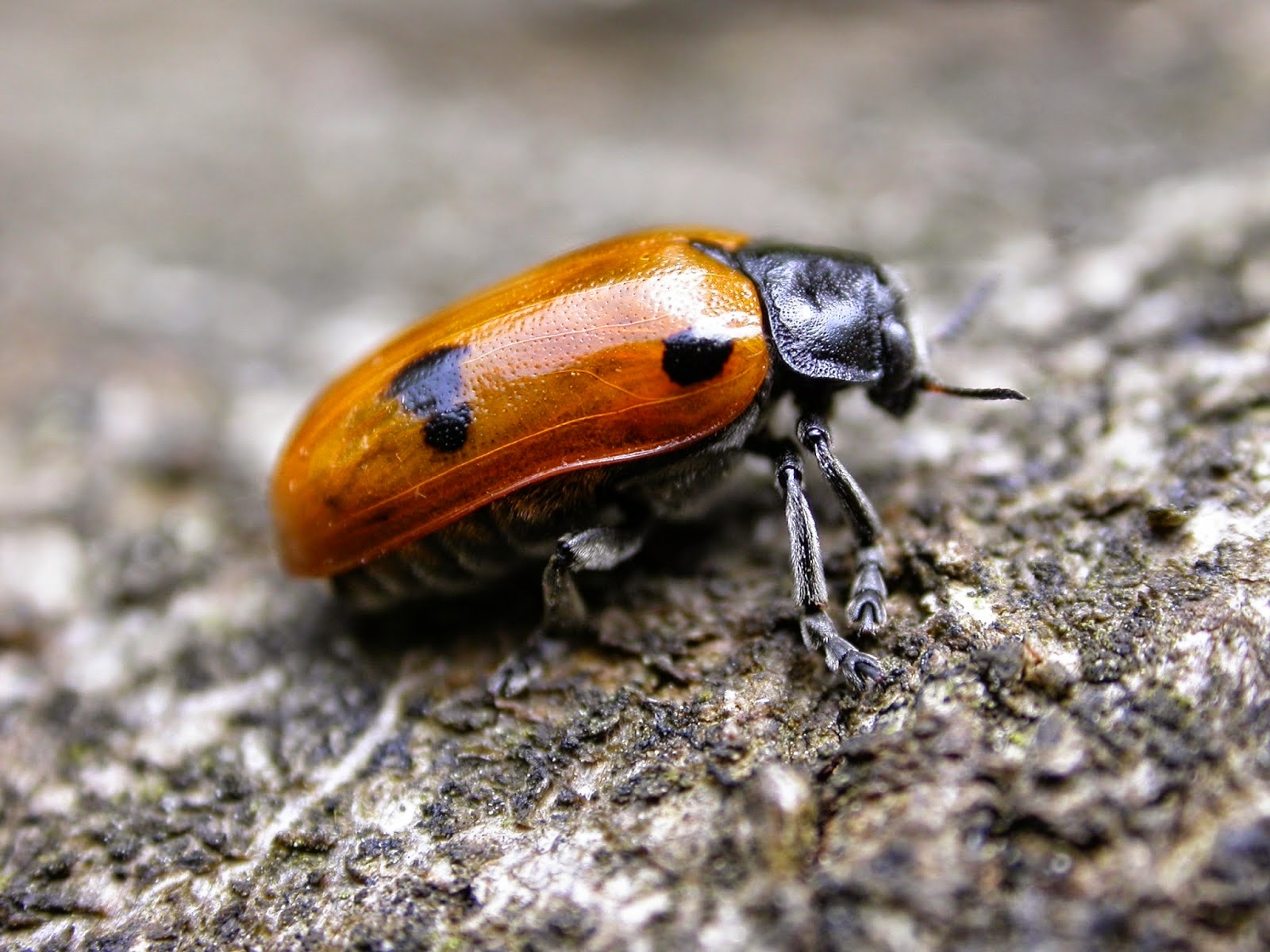
Flatropers isn't even an SNCI and it has shed loads of rare invertebrates. Here we have Xysticus bifasciatus and the two myrmecophiles: the Scarce Seven-spot Ladybird and Clytra quadripunctatus.
8) New Forest antics
I love finding lots of new species in a very small area. Micro-botanising overload.
7) If Darth Maul were a beetle...
Pilemostoma fastuosa. A very cool tortoise beetle from Knepp.
6) Gower power
Rock pooling on the Worm's Head produced this Green Sea Urchin among many other things.
5) Lappet
Always wanted to see one and one finally turned up in the moth trap.
4) Jurassic Carp
A trip with Seth and Tony to Kimmeridge Bay produced my first Cornish Sucker!
3) Burton Pond invertebrate survey
Here we have Xysticus audax, Alder Leaf Beetle (new to Sussex and found by Adrian Holloway) and the beetle Agapanthia villosoviridescens.
2) Creating the PSL website and article in British Wildlife
It has been a great year for pan-species listing and I'm pleased to have been able to contribute so much to the movement.
1) My first freelance invertebrate surveys struck gold!
Finding only the 7th known site for the rare Pondweed Leafhopper and also plenty of 13-spot Ladybirds was my highlight of the year. This cracking little private nature reserve just is a great example of what can be done to benefit wildlife.
So hopefully I will get back in the saddle in the new year but for the time being I'm still rather estranged from it. It's reminded me how much I love wildlife though writing this post so who knows.
This is the the very rare Pondweed LeafhopperMacrosteles cyane and this is the story of why you should never cry wolf. First off, read this. With particular reference to the last line of the second paragraph.
Yesterday, on the pool behind where Seth made his little joke last month (when I say behind, I'm talking 5 metres behind) I spotted HUNDREDS of the this very rare leafhopper sitting on the leaves of Broad-leaved Pondweed. What a fantastic result! This is a really rare species found at only a handful of ponds in the UK. Read here for more info. There were so many there that I must have overlooked them last time. Which means Seth, they were right behind you all along!
Should I mention the three Thirteen-spot Ladybirds?
There are four pirate spiders in the UK in the genus Ero. They are smart looking, have a very cool ecology and of course are blessed with a rather silly name that lends itself to many bad puns. I encountered my first Ero at Stedham Common, the Nb Ero tuberculata. The second species of Ero I saw was in my garden in Brighton last year being Ero furcata. Yesterday, at my secret site just north of Brighton I went and started an invertebrate survey I am doing there for fun this year. I am treating it seriously though using a standardised methodology and after some sweeping in the meadow (where I spotted my first Brimstone of the year) I spied an old pile of grass cuttings. A little sieving produced a lot of invertebrates but best of all was my third Ero, Ero cambridgei (photo). That leaves me just the one Ero now, which Mark has found on his bedroom wall! Pirate spiders are so called because they predate other spiders, pretending to be prey in other spider's webs they then attack the spiders and suck them dry through a hole in the leg!
Other highlights from same patch of cuttings yesterday included Sepedophilus littoreus and Ozyptila simplex. In the nearby wood I also saw a new saproxylic beetle, Orchesia micans, a Nb species that I beat from fallen Ivy. At least eight species I hadn't seen before from just two hours in the field including two new spiders was not bad at all!
So where is the most likely place to see my missing Ero (apahana)? Once confined to heaths it now seems to be easier to find it on bedroom walls or gents toilets! I'm sure it's nothing that a broad sword or a 'pass through rock' spell can't sort out though...
I received a request to go and have a look at a site just north of Brighton last week, which fitted in really well as I was looking for somewhere new to go this Saturday. Seth Gibson came along too and I managed to clock up ten new species! The highlight actually occurred as we were leaving the site. Seth mentioned that it was worth looking on Greater Stitchwort as there is a couple of Coleophora moths on the plant. I bent down, picked up the nearest bit of Greater Sticthwort and said, "are these them?". It was indeed the Nb Coleophora solitariella. The Sussex Moth Group website states the only 'recent' Sussex record occurred in the Chichester area in 1980! Tony Davis mentioned that he has found it very infrequently despite looking for it many times, so were we just lucky?!
Other highlights included the Nb Scaphisoma boleti, a very cool staph called Bolitobius cingulatus and a money spider with a very strange epigyne (my 212th spider!) being Diplostyla concolor. I recorded over 50 invertebrates myself (I still have Seth's identifications to add to the list) which isn't bad for a day in February. I even managed a bit of sweeping in a rough meadow which proved really productive. It almost felt like summer. I ended the day on 4838 species and look forwarded to making this site my patch over 2014.
So we all have are weak points, right? The one area that I have not been fastidious in keeping up to date and accurate with has been Hemiptera. That is until today. Last week I took on the role of county recorder for Heteroptera. Now for those out there that are not familiar wit the taxonomy of insects, bugs (or true bugs) are collectively known as Hemiptera. This order is split into a number of suborders. The classic bugs, such as shield bugs and ground bugs, fall into the order Heteroptera (this is what I will be covering). The hoppers used to be in the sub order Homoptera but this now has the awfully unpronounceable name of Auchenorrhyncha. Alan Stewart will continue to be the county recorder for these. Then you have psyllids (Sternorrhyncha) which I haven't done anything with yet.
On my list I have previously just treated them to order with a total of 137 species of Hemiptera as of first thing this morning. For this group I have been keeping a paper checklist that I update as a I see new species but today I finally got around to updating this digitally and pulling everything together. I'm glad that I actually came out with 149 Hemiptera, in total being 132 Heteroptera and 17 Auchenorrhyncha, that from now on, on my list I will call true bugs and hoppers respectively. So I end the day on 4798 species, 12 species up. I'm glad to find that I was under-recording rather than over-recording! All the gaps are filled in and the missing species added to Recorder.
Of the 583 species of Heteroptera on the systematic list on British Bugs, I have seen only 132, just 22.6% of the fauna. Plenty of room to for improvement which is great as far as I am concerned. I searched my photo archive for a species that had slipped through the net and this was all I could find. It's the Nb Dicranocephalus medius, a bug that feeds on Wood Spurge that I saw at Rewell Wood in 2009 but have not seen since. So the first thing I need to do as county recorder now I have sorted my own bug business, is do the same for East and West Sussex and find out what the county list is, then I'll be in a better position to write an article about it for next year's Adastra and start doing some of the more fun stuff! Like trying to fill in the gaps and promoting bug recording. That leaves me with just one question that is best asked by Hudson from Aliens:
"Is this gonna be stand up fight, sir, or another bug hunt?"


 Posts
Posts


.JPG)