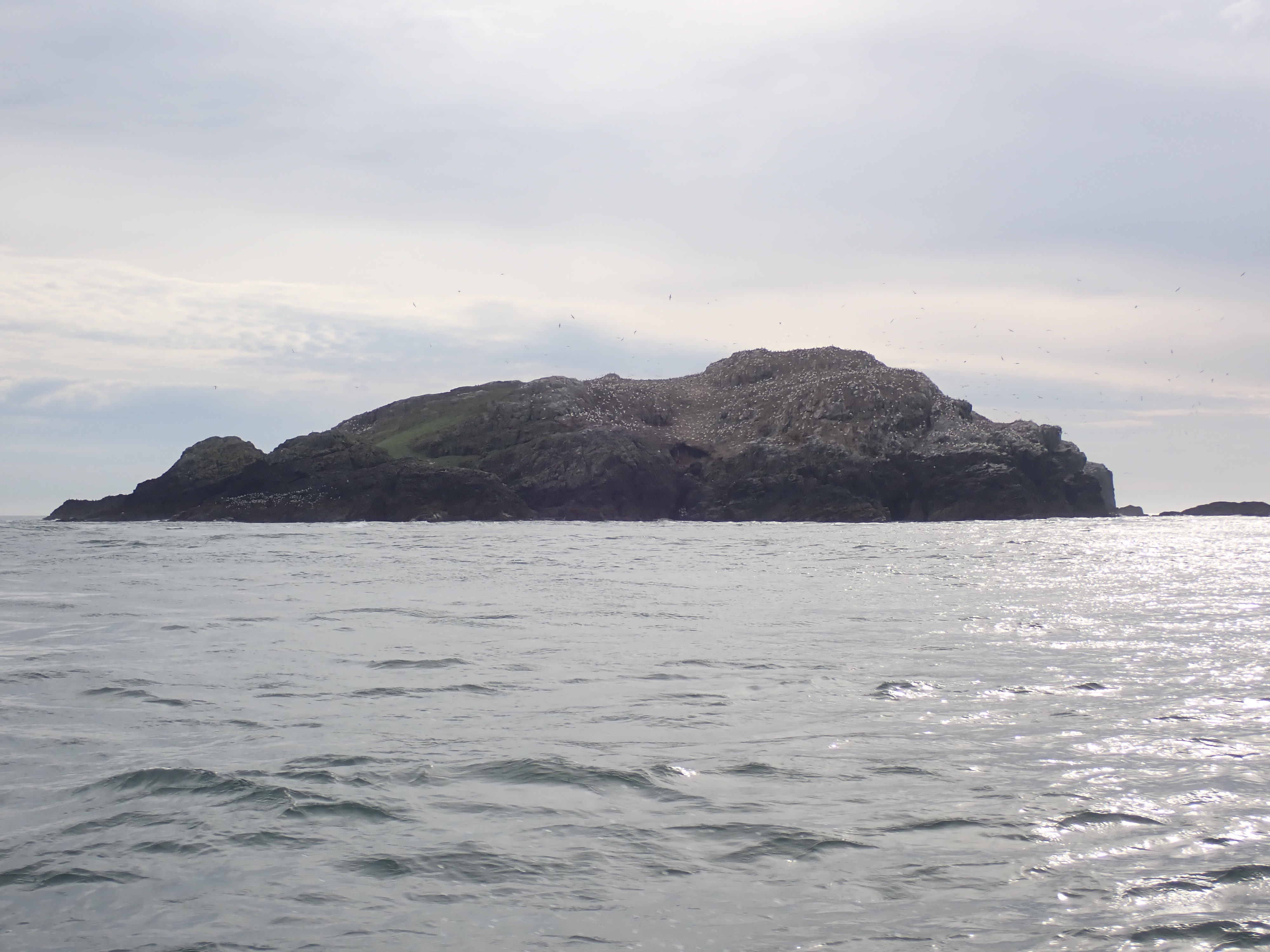
Grassholm. The furthest west in Wales I've ever been. Actually, it's the first time that I have ever been to Pembrokeshire. It was my first real holiday in five years and the first time Karen and I have been away together for more than two days. And my first blog in over six months. A lot of firsts. We absolutely loved it. I tried not to make it too nature-based but it just kinda happens that way anyway with such a wild coast. Day one and we headed out on two boat trips with Voyages of Discovery. The second one here saw us head out firstly to Grassholm, where thousands of Gannets are getting ready to leave. This island is around 11 miles off the coast and the half of it where they breed, appears white even at this distance.
Such wonderful birds. Even more tragic to see this less than a week after I found this sick bird on the South Downs north of Brighton. Bird flu. This is the price of cheap chicken. Anyways, back to the holiday.
A little further out to some reefs (looking back to Grassholm) and we saw lots of feeding birds including these Kittiwakes being harassed by Arctic Skuas. It's 20 years ago this summer that I did the RSPB contract at Rhosneigr, looking after the tern colony there. So when we stopped at one reef and heard the distinctive call of a Roseate Tern, it was just so exciting. I couldn't get a photo though, the sea was very mobile.
Earlier, on the way out, we saw a group of four Harbour Porpoise, about as close as I have ever been to them. That's Ramsey Island. Ramsey Sound was incredible with these eerie, glass-like patches of up-welling water, interspersed with some ferocious rapids and broiling seas around the hidden rocks.
One such area known as the Bitches has a cruel history. Shags seem to like the Bitches.
We saw plenty of Grey Seals too but my photos were pretty awful. The skipper nosed the dinghy into a sea cave, which was well cool!
Before we got to Pembrokeshire, a brief visit to the Worm's Head on the Gower produced the first of the daily Chough action, their calls rapidly becoming a common feature in the local sound-scape. A quick bit of rock-pooling produced what I think is a Daisy Anemone.
EDIT 20/09/22 - Thanks Evan, Daisy Anemone looks nothing like this, of course this is the Elegant Anemone.
With help of some locals, I spotted a HUGE Sea Bass in a deep gully (the tides were great, both big tides and easy tides - really great considering I did zero prep). I didn't manage a photo but the young fisherman who was looking for bait, was almost crying because he didn't think to lunge at it with his big net.
It was wicked to see a Spotted Cowrie with it's mantle out all over the shell. We never saw these again after this.And the first of many netted fish. The obligatory Rock Goby.
Green Sea Urchins were also not seen again on the trip after the Gower. That's one way to get mussels quickly!
Oh yeah, Bloody-nosed Beetle is EVERYWHERE in South Wales. Here was a four way, the filthy buggers.
Sorry, five way! This pervert was late to the party.
Day two. I had ONE target for the WHOLE trip. The only thing I vaguely researched was Scaly Cricket. I knew it was at Marloes Sands but it was a slim chance being mainly nocturnal. But there were rockpools there too. And they were full of Montagu's Blenny, hugely distracting. I could look at these goofy little twerps all day. 

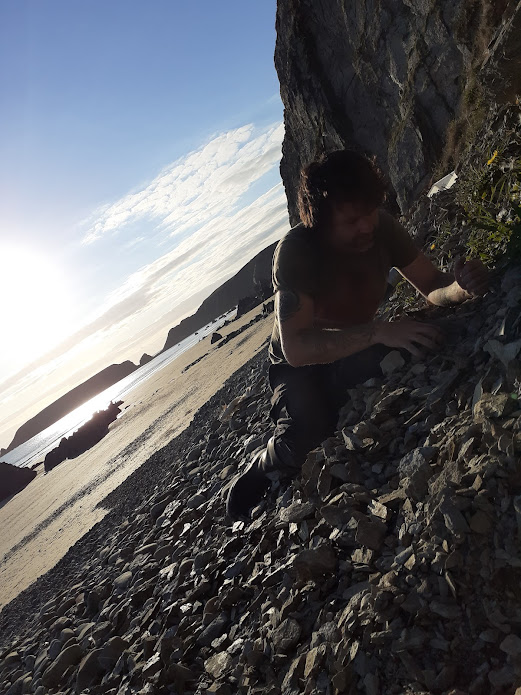
We spent an hour in an area that looked good for what I imagined Scaly Cricket would like. Turned out we were in the right area but just unlucky. Well, if you can call it unlucky. I saw a large black gnaphosid but I lost sight of it in the scree. I searched, saw it again but it went under the shingle never to be seen again. The tide was coming in and I didn't want us to get cut off and walk up the steep steps (this was a 47 miles in six days kinda holiday) when I saw a small spider with four small spots. It was unmistakable. It was clearly Callilepis nocturna. I am at the base of a cliff without signal and my camera is 20m away in my coat pocket and this thing looks like it's going to run into the shingle. It froze long enough for Karen to grab my camera then jumped onto my hand and started doing circuits. I looked like David Bowie in Labyrinth messing about with his balls. I got it in the tray. Behold!

I was rather stoked. Thinking I had a first for Wales, we headed up the cliffs for food and signal. Only to find that it was discovered on the exact same beach 'recently'. This is where it gets really weird. It was found there 20 years ago by another Brightonian, and a chap I know well. Dave Bangs. I might not have got a first for Wales but I did get all the excitement of one and I also stumbled on one of the rarest UK spiders (it's still only at three sites). That's my 518th UK spider. Totally beats that stupid cricket. We went back on day four as that beach was just so beautiful. Here she is in all her glory. What a beauty!
I took the sucker this time but hardly used it. We found 16 more but 14 of these were from hand searching.
The habitat shot.


Whilst I poked around here for a little while, Karen did some reading and then told me about a place which is pretty good for Otters! Now, Otter is my biggest bogey species. That's day five sorted then! I did get one other rare spider here. A new site for Porrhoclubiona genevensis. It's known from the hectad but last seen there on Skokholm in 1934 by Bristowe! An important record then, not bad considering I only turned it on four times in the whole trip.
UPDATE 20/09/22 - It turns out Richard Gallon had both species from near there on a job in 2021! Oh well! But the main group I found appears to be in a slightly different area, so that's good.
But before day five. It's day three. And after a visit to Tenby in the morning which was lush, we headed to Wiseman's Bridge. The rockpooling was a let down. So I suggested walking along the beach to Saundersfoot where I could see an interesting looking rocky outcrop. A single large rockpool there, produced three fish that we didn't see anywhere else. First off though, probably the best underwater shot of the trip was of this Shanny. The Meadow Pipit of the rook pool. They get boring quickly. My TG-6 has been working hard under water of late.

First dip in this rock pool produced a lifer for me. I pushed a shoal of largish-looking fish into a blind corner and lunged with the net. I caught two but one jumped straight out of my empty Ferrero Rocher container. Took some figuring out this one but it's clearly Horse Mackerel. A fish of the open sea and not really a rock pool fish at all! Check out that dog leg in the lateral line and those weird ridges. Quite a strange fish. Nice to say that literally for once.

The second dip produced a single Long-spined Sea-scorpion. Common enough but the only one we saw and Karen was quite taken with its grumpy face and eyelashes.
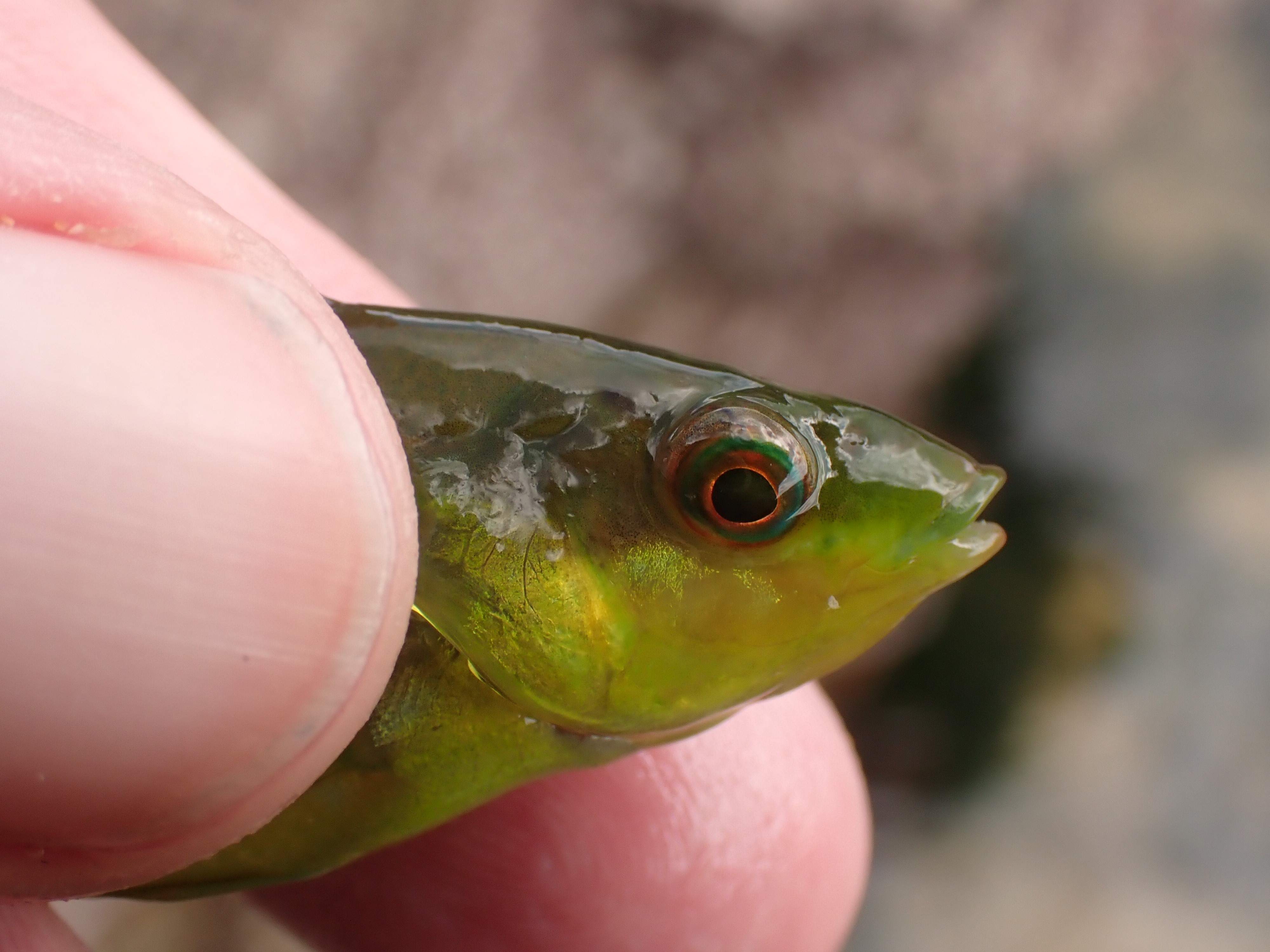
But it was the third dip of the net that got me really excited. Initially, at the bottom of the net I thought this was a pipe fish but I soon realised it was an adult Fifteen-spined (or Sea) Stickleback!!! Just wow. This is a fish that I saw once, on Anglesey some 20 years ago and it was nothing like this. An absolute stunner.


I think we saw over ten species of fish on the trip. I think I got more into fish than spiders, which is a weird thing for any grown man to say but especially me.
But who knew how many spiders were lurking above them on that foot path/tunnel through the rock between Saundersfoot and Wiseman's Bridge? Loads of Meta menardi, Metellina merianae and a new hectad for Nesticus cellulanus. Herald and Small Tortoiseshell too. Plus these early Humans.
Earlier that morning we went on a long walk around the coast. Here is a flock of 30 Chough! Incredible. What's more incredible is that in the five minutes we walked past this flock, they were disturbed by two different dogs that were off the lead and by the second time, they left the field altogether. Imagine this stress, day after day after day. Put your choughing dog on a lead if you can't control it! There are enough pressures on nature beyond your delinquent dogs. It's a serious problem that dog owners, who are often nature lovers, have no perspective on. I don't think they see it as serious, or lack the long term thinking to recognise that this time, the time their dog does this, might just be the time that makes these animals leave the area altogether. Or worse. We never saw as many Choughs as we did this day (at least a group of 21 and another group of c36) but we did see or hear Choughs every day of the trip.

Right, nearly there. Day five. An early start to Bosherston Lily Ponds see the Otters was starting to feel like we were going to dip out. Some Common Calamint was nice to see though.
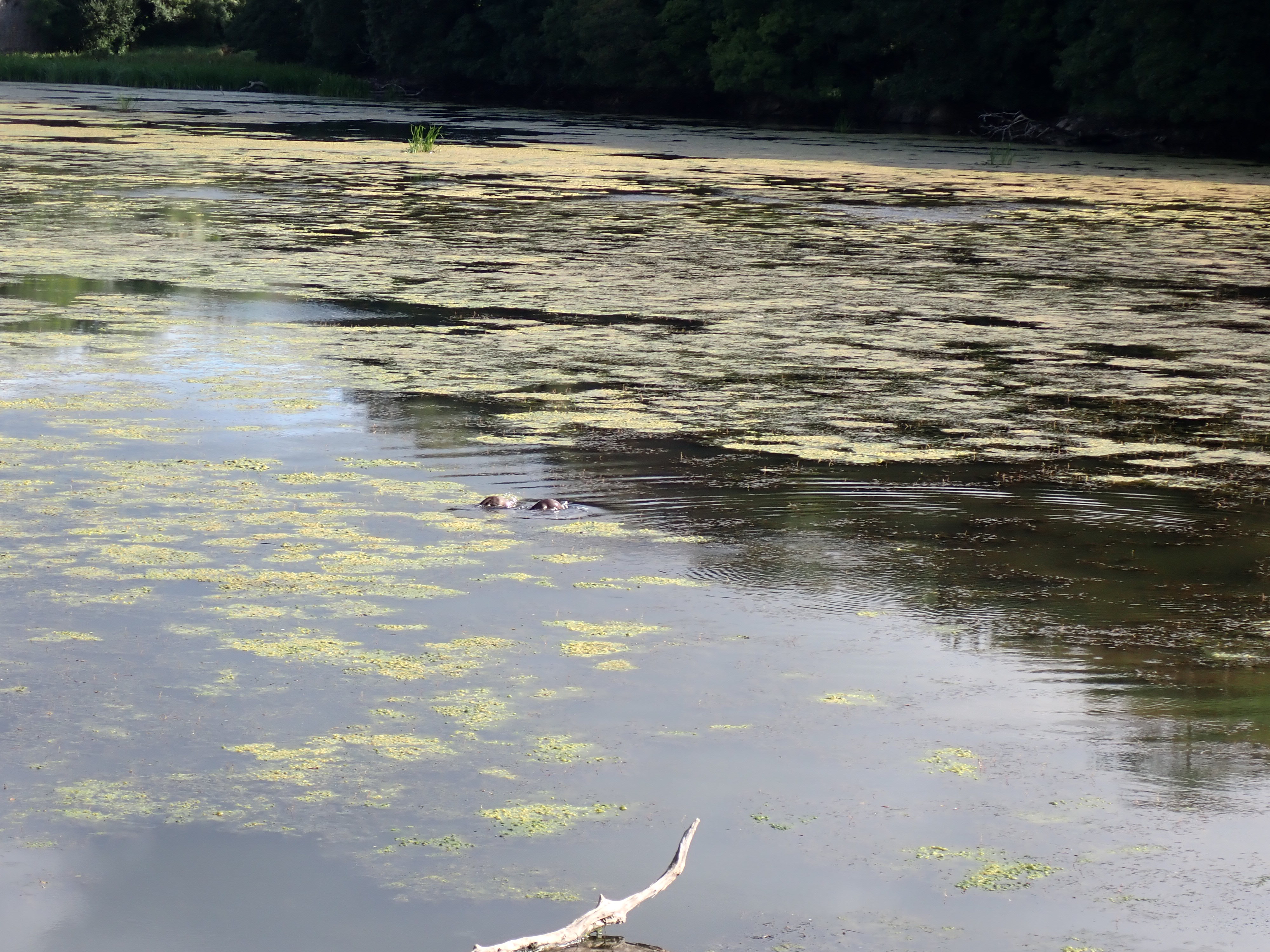
Then a chap said, "There's a family of Otters up there!" We started running and we got there just in time! All those years electrofishing with the RSPB and nothing. Hours put in at the crack of dawn searching across the UK in the cold, nothing. And then there they were, not giving a monkeys about the hoards of people walking past, or their dogs. Amazing to watch this family of four with their synchronised diving. They reminded me of Studio Ghibli dragons but in the water instead of the air. A continuously rolling, relentlessly restless, wet, muscly and hairy sine wave of reconstituted fish. Sublime.
One final trip after a chap told us about Freshwater West, a nice west facing beach at the end of the peninsula. A bit of rockpooling there produced this lovely young Ballan Wrasse.
A nice under water shot of a Beadlet Anemone.
But the highlight here was walking down to the beach. I was distracted suddenly by lots of white snails, which of course were actually White Snails (Theba pisina). Another reason to use capitals to distinguish between a species and just a white snail, of which we have many (White Snail being one of them). Then Karen said; "What's that?"
It's only a nymph of the Boat Bug (Enoplpops scapha). One of my most wanted species and the last UK squash bug I needed to complete the set! Result.
It was an awesome trip and another important reason for this trip was to give myself time to start writing again. Getting back into writing this blog (and other side projects that I have struggled to find creative energy for this year) being one thing but the main reason was to kick start the book I am writing on pan-species listing, now that the field season has almost finished. And that has worked a treat, with an hour a day producing a lot of words and the flood gates are now open. This holiday might have only had four lifers in it (Callilepis nocturna, Horse Mackerel, Otter and Boat Bug) but boy, what an eclectic mix they were. A pan-lister's dream holiday, with such a cornucopia of different taxonomic delights. We will definitely go back to this part of the world! Thanks to Karen for putting up with me, I see a rockpool and I am just a giant toddler and for her photos. And a huge thanks to the hosts at Pantier near Roch too, a really lovely place to stay. Hopefully I will try and blog a bit more frequently now, too.

Last year I wrote this post. It is by far the most viewed post I have ever written on this blog in 12 years of blogging, with over 3000 views! So I thought we needed to put a little more momentum into it.
So, if you agree with the following statement, why not put your name to it and ideally, let me know who you work for OR say 'rather not say'. Either comment or message me directly. And please share this post like mad so we can get a big list of names going. Yes, some big organisations are doing it wrong but some are getting right, like Butterfly Conservation, BTO and (now) Sussex Wildlife Trust. And publications like British Wildlife and Adastra also get it bang on. If you can think of anymore, please feel free to comment too.
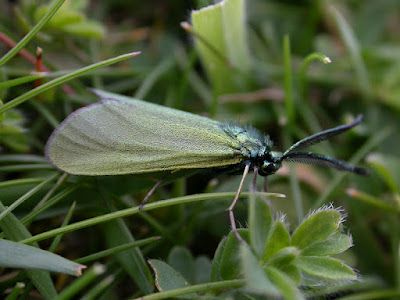
"English names of species should be correctly capitalised and hyphenated, effectively treated as 'proper names'. This should be mandatory and standardised, as is the format for scientific names. There are many different reasons to do this explained more fully in the above mentioned post but perhaps none are more troublesome than the fact that lower case should be reserved for the generic sense, i.e., we have three species of forester in the UK, one of which is the Forester (above). Without the species being correctly capitalised, there is no way to distinguish species from genus. And there are a many different ways this can go wrong, from Small Blue becoming small blue to Little Ringed Plover becoming little ringed plover. The excuse that "capitals look bad on the page" is not a valid excuse. If you are writing primarily about species, they should be written with capitals.
- Little Ringed Plover NOT little ringed plover
- Mediterranean Gull NOT Mediterranean gull
- Silver-washed Fritillary NOT silver washed fritillary
- Forester (or The Forester) NOT forester (or the forester)
The argument that species should be treated as 'proper names' is important. Yes, each species might be comprised of countless millions of individuals but by definition, they are distinct at the genetic level. There is (roughly speaking) one distinct set of code per species. It is this that should be treated as a proper noun/name. If we can be bothered to capitalise the names of man-made dog breeds and models of cars, we owe it to the natural world too."
Organisations, publications and projects that get it right.
- RSPB (changed with help from this campaign)
- BUBO
- IUCN Red List
- UK Species Inventory
- Herts & Middlesex Wildlife Trust
- Sussex Ornithological Society
- Botanical Society of Britain and Ireland
- The Species Recovery Trust
- Wild Ken Hill
- Buglife (changed due to this campaign)
- Pelagic Publishing (changed due to this campaign)
- Butterfly Conservation (BC)
- British Trust for Ornithology (BTO)
- Sussex Wildlife Trust (changed due to this campaign)
- British Wildlife
- NBN
- iRecord
- Recorder 6
- British Birds
- British Ornithologists' Union (BOU)
- State of Nature
- Back from the Brink
- Adastra (Sussex Biodiversity Record Centre annual publication)
- iNaturalist
1). Graeme Lyons Freelance entomologist and ecologist
2). Tony Davis Senior Ecologist, Butterfly Conservation
3). Michael Pannell
4). Graeme Davis Environmental Correspondent at Love Andover Observer
5). Simon Edwards Self employed
6). Daniel Blyton Amateur entomologist
7). Mark Whittaker Animal Welfare Assistant
8). Adrian Knowles Self-employed Ecologist
9). Martin Bell Amateur naturalist
10). Mark G. Telfer Entomological Consultant
11). Marilyn Abdulla Amateur naturalist & wildlife recorder
12). Malcom Storey Naturalist and wildlife recorder
13). Louis Parkerson Amateur naturalist
14). Julian Small Peatland Restoration Advisor
15). John Pilgrim Ecological Consultant
16). Su Reed Naturalist and wildlife recorder
17). Mike Wall County Moth Recorder for Hampshire
18). Terry Crow Amateur naturalist & wildlife recorder
19). Rachel Bicker Airport Biodiversity Consultant
20). Matthew Oates Field Naturalist and Nature Writer
21). Ralph Hobbs County Recorder for Orthoptera, Sussex
22). David Green Trustee of conservation organisation & Ecologist
23). Rich Billington Associate Professor of Biology and amateur naturalist, University of Plymouth
24). Darren Matthews Former wildlife ranger
25). John Lyden Biology teacher and amateur naturalist
26). Mariska Hattenburger Amateur wildlife recorder
27). Jim Ormerod Amateur birder & naturalist
28). Lloyd Davies Amateur wildlife recorder
29). Judy Staines Amateur naturalist & wildlife recorder
30). Neil Fletcher Environment Support Officer, Buckinghamshire & Milton Keynes Environmental Record Centre.
31). Andy Musgrove Ecological Consultant
32). Bill Urwin Naturalist, Marauder, Educationalist (retired)
33). Ai-Lin Kee Amateur Naturalist
34). Kevin Rylands Conservation Adviser Fair to Nature & RSPB
35). John Martin Retired National Vascular Plant Specialist at Natural England
36). Marcus Lawson Ex Dorset Bird Recorder & Dorset Bird Club Chairman
37). Mark Skevington Amateur naturalist, pan-species lister and Naturespot verifier
38). Roman Soroka Armchair naturalist
39). Natasha Clark Amateur naturalist & wildlife recorder
40). Paul French Senior Ornithologist, HiDef aerial surveying
41). Les Evans-Hill Butterfly Conservation Senior Data Officer
42). Dr Barry Yates Ecologist, land manager, studied Zoology at Imperial College in 1970s
43). Clive McKay Ecologist
44). Piers Vigus Management Consultant
45). Dave Gould Amateur naturalist and biological recorder
46). Marc Taylor County Recorder of Diptera, entomological field surveyor and trainer
47). Leon Truscott Cornwall County Moth Recorder
48). Dave Appleton Birder, entomologist, all-round naturalist and wildlife recorder. County recorder for Neuroptera and allies
49). Paul Griggs
50). Alastair Rae
51). Alan Miller Wildlife tour leader
52). Jon Dunn Nature write, wildlife photographer and tour leader
53). Iain Downie eBird Developer, Arachnologist
54). Liam Crowlie Postdoctoral researcher, University of Oxford
55). Edward Pollard Technical Director, the Biodiversity Consultancy
56). Steven Falk Associate Stickler
57). Chris Gibson Freelance naturalist, author, speaker and tour leader
58). Gino Brignoli FSC BioLinks Project Officer
59). Dave Smallshire Retired policy advisor with Defra/NE & retired Naturetrek tour leader
60). Steve Preddy Co-author, Ornithological Society of the Middle East regional bird list, County Dragonfly Recorder, Monmouthshire
61). James Emerson Amateur naturalist
62). Adrian Dutton Entomologist
63). Monty Larkin Writer, retired conservation adviser and founder of Sussex Pony Grazing & Conservation Trust
64). Sean Browne Amateur naturalist
65). Seth Gibson Amateur naturalist on a mission
66). Bill Sutherland Professor of Conservation Biology, University of Cambridge
67). Tristan Bantock Entomologist
68). Alex Prendergast Vascular Plants Senior Specialist, Natural England
69). Adam Rowe LERC Manager
70). Nigel Wheatley Author of books on birds
71). Carey Lodge Amateur recorder
72). Hawk Honey Visitor Officer, Suffolk Wildlife Trust, amateur Hymenopterist
73). Elizabeth Jude
74). Pete Holdaway
75). Vince Smith
76). Jeremy Dagley
77). Finley Hutchinson Amateur entomologist
78). Paul Tout Naturalist, translator
79). Dan Asaw BioLinks Courses
80). Ian Carter Naturalist and author
81). Graham White Ecologist
82). Dawn Balmer Ornithologist
83). Mike Hoit Ornithologist and field ecologist
84). Richard Mabbut Amateur botanist recording in VC55
85). Tim Inskipp Naturalist and author
86). Dawn Nelson Botanist
87). Alistair Shuttleworth Amateur naturalist
88). Hillary Melton-Butcher
89). Jeremy Lindsell Director of Science and Conservation, A Rocha International
90). Linda Robinson VC65 (Botanical) Recorder
91). Thomas Curculio Author and amateur entomologist
92). Audrey E. Turner Butterfly recorder for VC95/Moray
93). Sarah Whild Botanist and biological recorder
94). Alyson Freeman VC32 Botanical recorder
95). Peter Llewellyn Botanist
96). Richard Goldlfinch Amateur naturalist
97). Ian Bennallick BSBI recorder for East Cornwall
98). Mike Crewe Tour guide, environmentalist and editor
99). Chris Vincent Amateur naturalist and moth recorder
100). Jayne Chapman Estate and Conservation Manager, Hampshire & Isle of Wight Wildlife Trust
101). Rebecca Jones Marine Ornithologist, Natural England
102). Jason Steel Amateur wildlife photographer
103). Owen Beckett Entomologist
104). Sam Buckton Yorkshire Naturalists Union/British Plant Gall Society
105). Sam Stripp Amateur naturalist
106). Paul Hopkins Amateur naturalist
107). Mark Lawlor Guernsey bird recorder and naturalist
108). Steve Smith Dorset birder
109). Andy Butler Derbyshire birder
110). Kevin Clements Naturalist and Green Space Manager
111). Diana Spencer Bats in Churches
112). Neil Hulme Freelance ecologist and wildlife guide
113). Robin Knill-Jones Retired academic and Lepidoptera recorder
114). Paul Tinsley-Marshall Conservation Evidence Manager, Kent Wildlife Trust
115). Matt Phelps Conservationist and write
116). Savanna van Mesdag PhD student
117). Chris Glanfield Amateur naturalist
118). Denise Wawman Amateur naturalist, Hippobosciade recorder and bird ringer
119). Sam Bayley Consultant Ecologist/Ornithologist
120). Rob Grimmond
121). Tylan Berry County recorder for spiders in Cornwall
122). Ian Hartley Editor Bird Study, Senior Lecturer , Lancaster University
123). Paul Dolman Professor of Conservation Ecology at University of East Anglia
124). Mike Mullis Naturalist
125). Tom Simon Senior Countryside Officer, Epping Forest District Council
126). Liz Palmer Birdwatcher
127). Richard Moore
128). Steph Holt Ecologist
127). Bill Honeywell
128). Chris Raper Manager of the UK Species Inventory, The Natural History Museum
129). Andy Marquis Amateur naturalist
130). Rosemary Parslow BSBI Recorder, Isles of Scilly
131). Rob Large Field Ecologist
132). Steve Dudley COO, British Ornithologists' Union
133). George McGavin Zoologist, entomologist, broadcaster and President of Dorset Wildlife Trust
134). Jake Everitt Countryside and Ecology Manager
135). Robbie Still Digital Transformation Officer at Kent Wildlife Trust
136). Tom Gittings Ecological Consultant
137). Lee Dingain Naturalist, ecological consultant, nature writer, conservationist
138). Julian Hughes Editor of the Welsh Bird Report
139). Tim Thomas Environmental Consultant
140). Steve Elcoate
141). Tony Perry
142). Steve Lister Lifelong birder/naturalist, retired county bird recorder and & annual report write, eBird regional reviewer
143). David @the Hall of Einer Wildlife and nature blogger
144). Warren Maguire Marine Isopod Recording Scheme and linguist
145). Cath Hodsman Insect Artist
146). Libby Morris Amateur naturalist, student and wildlife artist
147). Joe Beale Naturalist
148). Josie Hewitt Amateur naturalist
149). Bob Vaughan
150). Kelly Thomas Senior Ecologist
151). Howard Vaughan All round naturalist, RSPB
152). Jane Thomas Amateur naturalist
153). Lee Hurell Lepidopterist and English teacher
154). Steve J. McWilliam
155). Tim Jonas Amateur naturalist and photographer
156). Philip Amies Retired estate land manager and ecological consultant
157). Dr Phil Saunders Ecologist/ornithologist
158). Ben Lewis Conservation warden, bird charity
159). Bob Foreman Biodiversity Data Lead, Sussex Biodiversity Record Centre
160). Mary Atkinson Field naturalist
161). Harry Hussey Consultant ornithologist
162). Sue Loader Amateur naturalist and recorder
163). Ian Lewis Retired Biochemical Scientist
164). Tom Derutter
165). Martin Roberts County Dragonfly Recorder and amateur naturalist
166). Dan Brown
167). James Lowen Naturalist and author
168). Mark Duffell Botanist, botanical lecturer and surveyor
169). Paul Doherty York birder and producer of wildlife videos
170). John Moon
171). Samantha Batty Horticulturalist and wildlife recorder
172). Brigit Strawbridge Amateur naturalist and author
173). Graham Madge
174). Shaun Pryor Ecological consultant
175). Robert Edgar Retired English Nature Conservation Officer
176). Tony Stones
177). Dan Chaney Birder
178). Ottavio Janner Birder and translator
179). Vanna Bartlett
180). Robin Harris Amateur naturalist
181). Penny Green Ecologist
182). Joshua Styles Botanical Specialist
183). Glenn Norris Ecologist, Sussex Wildlife Trust
184). Simon Hedges Conservationist
185). John Hancox
186). Andy Brown Principal Specialist, Species Conversation
187). James Lowther Molecular Biologist
188). Phil T Lifelong birder
189). Lee Walther National Trust Ranger
190). Dr Clive McKay Ecologist
191). Dr Roger Kendrick Director, C & R Wildlife, Hong Kong. Founder: Asian Lepidoptera Conservation Symposium series.
192). Chloe Edwards Director of Nature Recovery, Herts & Middlesex Wildlife Trust
193). John Burnham Amateur entomologist and photographer
194). Tim Dixon
195). Mariko Whyte Conservation Officer, Dorset Wildlife Trust
196). Ian Ellis Consultant Ecologist
197). Richard Lewington Wildlife Illustrator
198). Suzy White
199). James Langiewicz Amateur naturalist
200). Dawn Langiewicz Amateur naturalist
201). Liam Olds Entomologist and organiser of the National Oil Beetle Recording Scheme
202). Stephen Wadsworth Ornithologist and Naturalist
203). Brian Clews
204). Wil J. Heaney Ecologist/entomologist
205). Alastair Forsyth Retired ecology technician and teacher, now amateur entomologist
206). Alison Cobbing Amateur naturalist
207). Toby Collett Warden
208). Frances Abraham Sussex Botanical Recording Society
209). Mike Edwards Entomologist
210). John Boback American naturalist
211). Clare Blencowe Head of Sussex Biological Records Centre
212). Dom Price Director, the Species Recovery Trust
213). Stewart Sexton Amateur naturalist
214). Libby Ralph
215). Anne Donnelly Data Officer at ERIC NE
216). Nigel Jennings Volunteer Group Leader, Kent Wildlife Trust
217). Dr Gordon McGlone OBE Conservationist and campaigner
218). Ian Boyd Ecologist
219). Derek Crawley
220). Talya S. Davies
221). Keiron Derek Brown National recorder for earthworms
222). Stepehen Welch Lothian SOC bird recorder
223). Lindsay Morris Amateur naturalist
224). Rich Black Sussex based birder, Sussex Wildlife Trust
225). Dick Alder West Weald Fungi Recording Group
226). Max Barclay Curator of Coleoptera at NHM
227). Mike Prince Natural England, Biodiversity Data Engagement Lead
228).


 Posts
Posts