Yesterday started off very frustrating but ended up being pretty awesome. I started work late as the Sun was meant to appear about midday. On the Cuckmere I did find an area with Divided Sedge, Marsh/Golden Dock (I've never seen either in Sussex and will go back to confirm which species) and a Spotted Redshank flew overhead calling in the sea fog. But by midday, the forecast said about 4.00 pm. Without sun, the farm vegetation I was working on was going to remain sodden. So I went recording to Seaford Head. My target was linys on the saltmarsh and Lasaeola prona at its only known Sussex site.
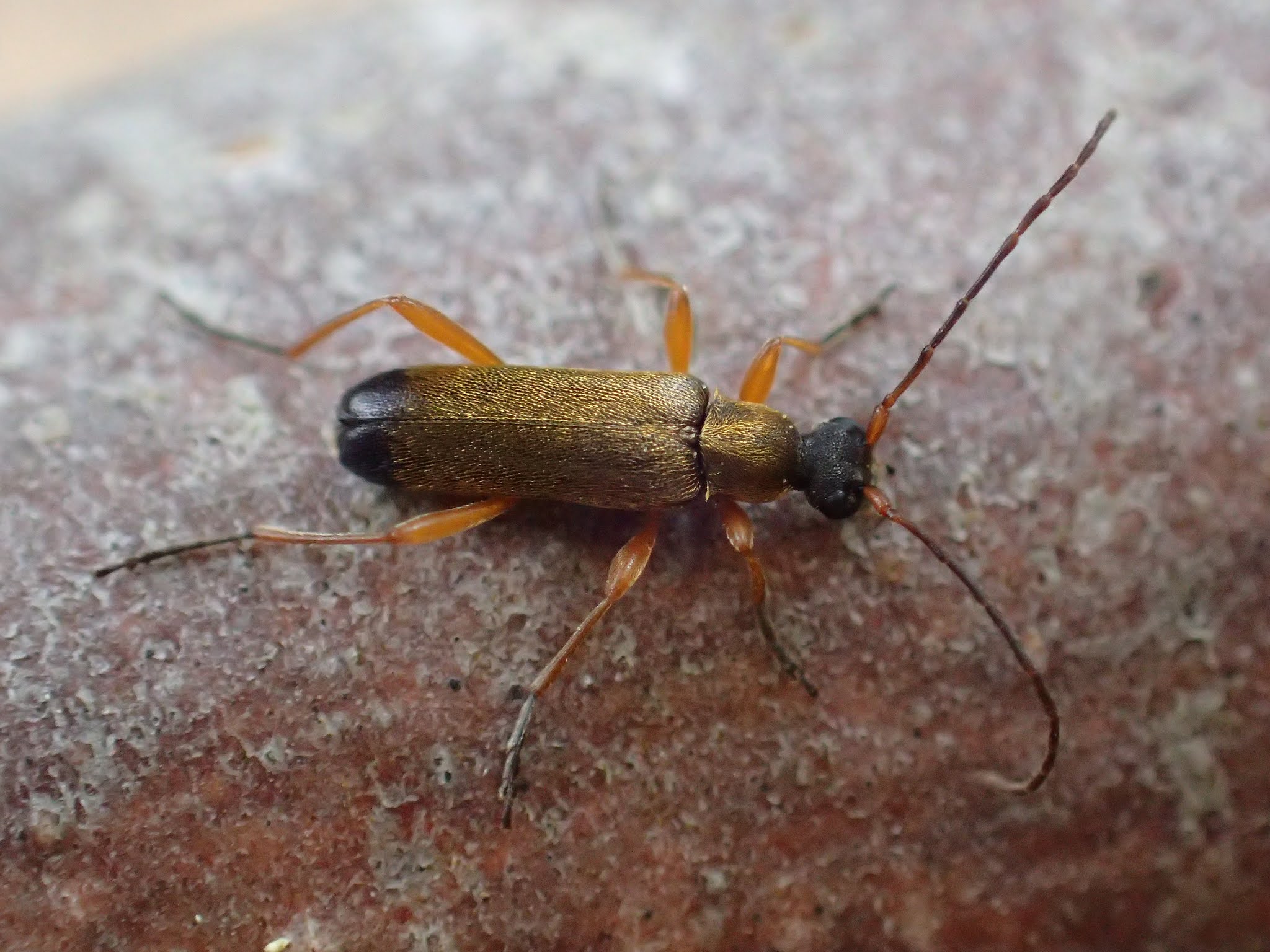
The little saltmarsh at Seaford was hard work. It started raining as I got there and the sea fog was frustratingly stubborn. But then I saw a beetle flying over head, it looked like a longhorn in flight so I netted it. I looked in the bottom of the net and was about to dismiss it as Rhagonycha fulva when I realised it was a Wharf-borer (Nacerdes melanura). I have only seen one of these before at Rye Harbour. That's the 1st species I had new to the reserve.
I tried the suction sampler on the black litter that builds up at the base of Yellow Horned-poppies and got a spider new to the site and new for the year for me, Argenna patula! A nationally scarce saltmarsh species. It made up for the lack of linys. I did find Sitticus inexpectus immatures though but I already have that this this year, from Rye Harbour.

I walked along the cliff top and kicked up a surprise, Palpita vitrealis. It flew off into some bushes but I got a good look at it although couldn't get a photo. That's three new to the reserve! I tried some suction sampling along here and got this nationally scarce tortoise beetle. Cassida prasina is amazingly new to the reserve network! Also around here was Formica cunicularia, again new to the site. It's amazing how you can work a site really hard for years and still find things, in numbers, that are new. There are lots of reasons for this.

- Many inverts occur at low densities, so luck is a huge factor. Especially for the things you only ever find one of.
- Sites are changing all the time, through succession or better/worse management. This can have a big impact in a short pace of time.
- Climate is changing things too, from migrant moths to colonising insects from the continent. Plus we have an ever increasing proportion of non-natives. A wet year like this with a lot of growth is going to be very different to a summer drought year like last year.
- I've changed. We all have. I am definitely better at finding things than I was five years ago and probably will be again in another five years time. I'm also faster and more efficient but I think this has plateaued.
So, the idea you can do one invert survey over one year (even with lots of visits) and expect to find everything is bobbins. That's why I created the Species on Reserves list in the first place for the Sussex Wildlife Trust reserves. Long-term effort is a great way to accumulate all these records together, so I am very glad that Glenn is keeping it going! I also like to accumulate survey data from repeat surveys I am carrying out as a way of edging closer (but never ever getting there) to a site's true fauna. Anyway, I'm currently five up for the reserve.
Then I got to Hope Gap and in one suction sample I got two new to the site, including another new to the reserve network. One was the myrmecophile ladybird Platynaspis luteorubra (a Na species that is spreading) and the other was a new shieldbug. The Sand-runner Sciocoris cursitans. This really is a small shieldbug (5 mm) but until now, the only site I have seen it in Sussex is the Crumbles. Another nationally scarce species but you would be lucky to find this without suction.
And then after about ten fruitless suction samples, I found FOUR Lasaeola prona in one sample! Here's a sub-adult male.
I also added new for the year Ozpytila claveata (known from the site). Which leaves me on 290 for the year! I am going for the 400 this year by the way, but that's another story. So, in a three hour period wandering around I added all these new to the site:
Nacerdes melanura
Drassodes lapidosus
Meioneta simplicitarsis (Nationally Scarce)
Argenna patula (Nationally Scarce)
Drassyllus pusillus
Palpita vitrealis
Cassida prasina (Nationally Scarce and new to network)
Sciocoris cursitans (Nationally Scarce and new to network)
Teniuphantes flavipes
Formica cunicularia
So ten species! Four with status and two never recorded on a Sussex Wildlife Trust reserve before. I had forgot how much I enjoy that spreadsheet. Pleased to have made a contribution with a few hours to kill. The sun came out about 3.00 pm so I dashed back to the farm I was working on and got Andrena hattorfiana and Atylotus rusticus before the thunder started. It was very strange to see cloud come in from the north at the same time as a sea fog slid in rapidly up the valley from the south.
By working like mad through the heatwave, I've bought myself a tiny amount of free time at the end of June. So that's why I have been hitting the SWT reserves when I could. Also new to the reserve network this week is the smart woodlouse Armadillidium pulchellum from Graffham Common, appears to be a county first.
And the Dark Giant Horsefly (Tabanus sudeticus) from Black Hole, Burton Pond!
So, if you think spider year-listing is just about ticking things off a list you couldn't be further from the truth. As well as getting better at spiders, it has a direct benefit to spider recording that in turn, spills out into a wide range of other taxa! So what are you waiting for!? I still want to try year-listing Heteroptera one year but I am yet to find anyone to play with :(
I have rarely had such a good day out in the field as I did last Sunday at Blean. By 08:59, I was looking at a very immature Pistius truncatus (have a look here for more info). A Critically Rare arboreal crab spider, something of a mega in the spider world. Not seen in the UK for 20 years and only ever known from the East Blean Woods complex (and old records in the New Forest). This was therefore a new location for the spider on the KWT managed land. It was also at the very far west of this area, about as far from East Blean Woods as it could possibly be. I picked this up on the second out of 24 plots I am surveying this year, so I expected I might see some more. I did not. I do still have three rounds of visits to go though. It's a gorgeous little spider, appearing to have no hind legs to the naked eye. They're a translucent yellow, next to the greeny/brown body. Very similar in build and shape to Thomisus onustus. Here is my first view of it in the tray.

The spider list is epic. With Walckenaeria mitrata found in a conifer plantation last month, the total number of spiders with conservation status stands at 20 already! That's 20 out of the 127 spiders I have recorded so far. New this month was Salticus zebraneus and a stonking adult male Philodromus longipalpis. This really is clearly bigger than the other Philodromus in that group.
But it's not just the spiders. Across the board, rare species are turning up in droves. In fact, so far 46 of the 378 species recorded have some form of conservation status. I had four new beetles that day. First up being a real surprise for me that took a little while to digest. Lagria atripes was listed as Regionally Extinct in the 2014 review but it was widespread at Blean. I recorded 10 animals across six of the 24 compartments. It seems it has been turning up in a few places in Kent though, so is not that much of a surprise.
Then I had a "WTF?!" moment. I love that there are so many beetles in the UK that you can keep encountering ones that you have never even seen a photo of before. This is the Nationally Rare melandryid, Hypulus quercinus. Phwoar!!!
And quite a surprise was the recent addition to our longhorn fauna, Agapanthia cardui. Swept from a cleared area in the wood. I expect this will be all over the south east in a few years.
The fourth beetle was one that I am surprised it has took me this long to find, Pityophagus ferrugineus (not photographed). Additionally to all these lifers, there were loads of nice beetles I have only ever encountered once or twice before. First up the myrmecophile, Clytra quadripunctata. Found so far on three out of 24 plots. A stonking Nationally Scarce species. Not a surprise with all the Formica rufa there. Oh and I had a new ant, Guest Ant!
Two Anthribus fasciatus (Na) from one plot. Only the 2nd and 3rd examples of this I have ever seen. The last being Knepp in 2015.
Four Tritoma bipustulata (Na) on brackets on a recently fallen, rotten oak limb. I have only ever seen this at Levin Down in West Sussex.
Trogulus tricarinatus. Not sure why this isn't nationally scarce. This rather large and bizarre looking harvestman was found by suction sampling vegetated leaf litter (which is especially rich at Blean - the best leaf litter I have ever sampled).
A stonking Didea fasciata was a new hoverfly for me.
Always nice to see Lapidary Snail too.
And a long overdue lifer. Although try as I might I cannot find this in any of the 24 plots. I walked passed a sunny bank of Cow-wheat and thought to myself, "if this isn't there, it can't be here at all". I found it in 30 seconds. The Cow-wheat Shieldbug Adomerus biguttatus. It must like plants growing on sunny rides and not under the canopy, not surprising really.
And of course, Heath Fritillary is the commonest butterfly there at the moment. What a beauty.
All this is baseline monitoring/research is driven by the application of the bison to the site. But it's important recording in its own right, with this area of Blean receiving relatively little invertebrate monitoring compared to East Blean Woods and the RSPB reserve. Monitoring like this is vital for nature reserves and rewilding projects alike, as it shows not only what is working but what isn't. So the management of sites can be adjusted accordingly. It's part of a whole package across a wide range of taxa that KWT are carrying out this year.
Definitely one of the best days I have ever had in the field and also, possibly the best survey I have ever done, for the sheer number of rare species and lifers. What makes it so good? Well, along with sites like the Surrey Heaths, it's the landscape scale effect I am sure. It's big enough to cope with small scale extinctions that can easily recolonise from other areas of the wood. Small, isolated sites can't cope with this. Continuity of management is always vital for good sites and it's also in the south east too, to be fair. I can't wait until July!
I have had a bit of a break from blogging recently. Not natural history though, I am already 36 field days into my field season, with over a quarter of the work complete for the year already. One of the most exciting projects I am working on this year is the #WilderBlean invertebrate baseline survey. Kent Wildlife Trust are going to put bison into part of Blean Woods, well West Blean Woods in fact. It's all being monitored heavily before hand, which is great. This includes a solid baseline, with controls and proxy grazers. So using my methodology for monitoring invertebrates on rewilding projects, but scaled up to take in the three different treatments, I will be heading to Blean monthly between April and September. You can read more about the project
here.
It turns out Blean is one of the best woods for spiders in the south east, well the UK even, but this bit of Blean hasn't ever been as well recorded as say the RSPB part or East Blean Woods. So, after the second round of visits, I am up to 105 species of spider already, 15 of these have status (that's really good for a wood!) and quite a few of these are Blean specialists. One such species though I was NEVER expecting to find.
Walckenaeria mitrata has only ever been recorded from two sites on the western most part of Blean.
Have a look at the SRS page for the species here. Here are some more shots, a difficult spider to photograph well but as with most
Walckenaeria, the head in the male is produced up into a bizarre 'bed knob' structure (with a pair of eyes on), held back at a jaunty angle. Here are some more shots.


Only nine specimens have been recorded, in 1967 & 1971 on the RSPB Reserve and then again in 2004 at Church Wood. So when I found a male in the suction sampler, I was rather excited, as this is only the third site for this nationally rare/vulnerable spider, ALL in Blean Woods. Interestingly, all the old records were from Sweet Chestnut coppice but this one was from a...conifer plantation!
Which just shows it's probably not as picky as we think. Or that it's at very low densities. Or both. It was strange that I looked at so many other compartments that were nicer habitat than this. It's certainly one of the least interesting of the 24 compartments I am looking at.
I wasn't going to year list spiders this year but it sort of happened. I couldn't help looking in the database and seeing what I have recorded so far. I was desk bound until 30th March though. That hasn't stopped me making over 1900 spider records in six weeks though, and 205 species already. I've had an incredible nine species new this year too, five of which are from Blean.
The leaf litter there is exceptional, sometimes I will find up to four nationally scarce species from sieving a couple of handfuls of litter. New to me (and so far the most widespread of all the spiders with conservation status in the wood - occurring in 15/24 samples) is Phrurolithus minimus. It's incredibly distinctive, appearing very red in the field. It's quite unlike the much commoner and more widespread Phrurolithus festivus.
Scotina celans is also extremely common throughout the litter, recorded in half the plots so far and very many adult females still present in April and May.
Entirely new for the whole of Blean is Euryopis flavomaculata. I have now recorded this in 7/24 plots and it has been recorded in every habitat type except high forest. It's a distinctive spider, even as an immature, and is readily collected by pitfalls. So I think this is most likely a recent colonist rather than something that was overlooked. It could be that it's only found on this bit of woodland and not East Blean and the RSPB reserve but this seems unlikely. I can't see that it has been missed. Also new to Blean in one very open compartment, is the ever expanding Sibianor aurocinctus.
Also common in the litter is Halpodrassus silvestris. So far found in 7/24 compartments.
Another one new for me is the tiny Tapinocyba insecta. So far, only recorded from two plots. A tiny spider of the the leaf litter. I have not seen this anywhere else.
The recent addition to our fauna, Nigma flavescens, was recorded at three sites in early May. I expect I will pick this up more when leaf burst actually completes. It's really taking it's time this year!
It's certainly not all spiders there. This Na Tychius parallelus, a large and stripy Tychius that feeds on Broom, is the only non-Dungeness Kent record! A new one for me. It appears to be spreading though, as the very next day, Scotty had it in Surrey. A rubbish photo but you get the idea.
With lots more visits this year, I can't wait to see what else I will find! Could it involve Pistius truncatus? Now THAT would be something!
It's been a while. This is the longest period, over three months, that I have gone without writing a post since I started this blog back in 2010. The last three months have been difficult for several different reasons but it's time to get back in the saddle. I've stopped and started writing several times over the last few months but my confidence with it had gone. The sudden death of my father, Roger Lyons, has been hard to process and come to terms with. He might never have read this blog in the decade I've been writing it (he wasn't the computer type), but it's at least forever got his name on it. So here's to another ten years plastering his and my name over the Internet with wildlife sightings. Your name lives on here, Dad.
And what a year to go fully freelance? I was fully booked by January, lost half my work by March but then by late summer, was back to being fully booked up again. Many of the new jobs were really close to home too and included some really lovely projects. This year was probably about 4/5 entomology and about 1/5 botany and other taxa. It's been AMAZING for wildlife. I have very little time still, even over the winter but that's down to several months of being less than my usual productive self.
It was a particularly 'beetle heavy' year for me. As I approach 1500 species of beetle, I thought I would start with my first post hiatus post with the beetle highlights of 2020. In no particular order, other than my favourite one is first. I should add, this is just the big showy stuff that I have photos of!
First up was the stunningly smart Grammoptera ustulata from a Surrey Heath (above). It appears to be a new 10 km square for this national rarity and a significant range expansion to the south. Might it make it's way to Sussex soon? I hope so as it is far better looking in reality than I ever thought. Look how shiny it is!
In Hampshire, in a field I visited three times in 2019, I found dozens of Cassida murraea in the first sweep. In fact, I visited that field six times over the last two years and only on one occasion did I find this beetle, and then it was in super abundant numbers, being the commonest beetle in the field. Incredible! No status but a smart beast that is much commoner in the west than it is down here.
At the same site in Hampshire in April, I suction sampled Baris analis! Certainly started the field season with a bang. A vulnerable species, this being a significant new inland record for this species.
I saw Stenostola dubia (nationally scarce) twice in 2020, my first since my only other record in 2009. The first one was beaten from an old lime at Knepp where I thought to myself, "I wonder if this is how you get Stenostola". It flew off before I got a decent photo though. Then, at a farm in East Sussex during one of those days where loads of Cantharis rustica and fusca are just bombing it around all day long, something flew over head and caught my eye. It was high, so I had to sprint and jump for it. It was another Stenostola dubia! Here it is.
At sites in East Sussex and in Wiltshire, I recorded Triplax lacordairii. The latter was a new county record.
On a farm in East Sussex, I stumbled across the first county record of Pseudeuparius sepicola! What a gorgeous weevil. I then beat two from a dead branch at Knepp, the first record for West Sussex in about 50 years.
At midnight at Knepp, Dave Green spotted this Opilo mollis. I have never seen one up close, my only other records were of a single elytron and a beetle 12 foot up a tree (also in the moddle of a night). Such an unusual beetle and so unlike any other. Not the scarcest but always nice when you see something well for the first time.
Not the cleanest specimen but this is the only time I have seen the Nb weevil, Tropiphorus elevatus. East Sussex and Kent being a stronghold for this species. The specimen was picked up early in the year and was found in an an area that had experienced significant winter flooding, hence it is covered in crud.
Also Knepp whilst helping a film crew find invertebrates, I picked up Sphinginus lobatus new to West Sussex. This certainly seems to be spreading.
Another lifer for me, just inside the M25 and less than an hour from where I live was the Bryony Ladybird Henosepilachna argus. It's amazing that this isn't all over Sussex, it's so close. It may well be about in the north of the county where I spend very little time.
Thanks to Steve Gale (and the original finder Tristan Bantock), I was able to go and have a look at the awesome Lixus iridis in Surrey! What a beauty!
And thanks to Steve Teale, I was able to go and have a look at our newest chafer down in Newhaven! The delightful Rhizotrogus aestivus!
I suction sampled two Rhyssemus germanus from a site in West Sussex and I think this is also a county first. A lovely little wrinkly dung beetle.
This was a new one for me, the unpronounceable Phloiotrya vaudoueri (with a name that looks like two of the worst racks of Scrabble letters you could get), a nationally scarce saproxylic species that I found in Wiltshire. I hate names like this, my brain struggles to put the letters in the right order.
From an arable margin in West Sussex, only the second time I have seen Trichosirocalus horridus. A lovely weevil (Na) that feeds on thistles, makes you wonder why it is so scarce.
And nice to see plenty of
Thymalus limbatus in Wiltshire/New Forest. Not all that scarce as you head west but really uncommon in Sussex, with very few records.
Oh, and I finally caught up with Agrilus sinuatus! What a looker.
And the latest find for me was
Cryptocephalus punctiger that I picked up on a Surrey heath! Love this genus.
What will 2021 bring? Lots more beetles I hope. I'm taking booking for 2022 now, and will be travelling a little further afield too. I am having a year off year-listing any taxa this year though. But PSL ticks on as ever. I'll be listing to the grave. One day, my PSL list will have 'the late Graeme Lyons' next to it, (for someone HATES being late, this sucks). Not for a while yet though.
And finally, any rumours that I am responsible for that stupid LEGO man I keep seeing plastered all over the Internet are totally unfounded, I am a serious naturalist. I don't know why someone would design it to look like me (arguably!) but I find that very offensive. It's not even funny.


 Posts
Posts