I have had a bit of a break from blogging recently. Not natural history though, I am already 36 field days into my field season, with over a quarter of the work complete for the year already. One of the most exciting projects I am working on this year is the #WilderBlean invertebrate baseline survey. Kent Wildlife Trust are going to put bison into part of Blean Woods, well West Blean Woods in fact. It's all being monitored heavily before hand, which is great. This includes a solid baseline, with controls and proxy grazers. So using my methodology for monitoring invertebrates on rewilding projects, but scaled up to take in the three different treatments, I will be heading to Blean monthly between April and September. You can read more about the project
here.
It turns out Blean is one of the best woods for spiders in the south east, well the UK even, but this bit of Blean hasn't ever been as well recorded as say the RSPB part or East Blean Woods. So, after the second round of visits, I am up to 105 species of spider already, 15 of these have status (that's really good for a wood!) and quite a few of these are Blean specialists. One such species though I was NEVER expecting to find.
Walckenaeria mitrata has only ever been recorded from two sites on the western most part of Blean.
Have a look at the SRS page for the species here. Here are some more shots, a difficult spider to photograph well but as with most
Walckenaeria, the head in the male is produced up into a bizarre 'bed knob' structure (with a pair of eyes on), held back at a jaunty angle. Here are some more shots.


Only nine specimens have been recorded, in 1967 & 1971 on the RSPB Reserve and then again in 2004 at Church Wood. So when I found a male in the suction sampler, I was rather excited, as this is only the third site for this nationally rare/vulnerable spider, ALL in Blean Woods. Interestingly, all the old records were from Sweet Chestnut coppice but this one was from a...conifer plantation!
Which just shows it's probably not as picky as we think. Or that it's at very low densities. Or both. It was strange that I looked at so many other compartments that were nicer habitat than this. It's certainly one of the least interesting of the 24 compartments I am looking at.
I wasn't going to year list spiders this year but it sort of happened. I couldn't help looking in the database and seeing what I have recorded so far. I was desk bound until 30th March though. That hasn't stopped me making over 1900 spider records in six weeks though, and 205 species already. I've had an incredible nine species new this year too, five of which are from Blean.
The leaf litter there is exceptional, sometimes I will find up to four nationally scarce species from sieving a couple of handfuls of litter. New to me (and so far the most widespread of all the spiders with conservation status in the wood - occurring in 15/24 samples) is Phrurolithus minimus. It's incredibly distinctive, appearing very red in the field. It's quite unlike the much commoner and more widespread Phrurolithus festivus.
Scotina celans is also extremely common throughout the litter, recorded in half the plots so far and very many adult females still present in April and May.
Entirely new for the whole of Blean is Euryopis flavomaculata. I have now recorded this in 7/24 plots and it has been recorded in every habitat type except high forest. It's a distinctive spider, even as an immature, and is readily collected by pitfalls. So I think this is most likely a recent colonist rather than something that was overlooked. It could be that it's only found on this bit of woodland and not East Blean and the RSPB reserve but this seems unlikely. I can't see that it has been missed. Also new to Blean in one very open compartment, is the ever expanding Sibianor aurocinctus.
Also common in the litter is Halpodrassus silvestris. So far found in 7/24 compartments.
Another one new for me is the tiny Tapinocyba insecta. So far, only recorded from two plots. A tiny spider of the the leaf litter. I have not seen this anywhere else.
The recent addition to our fauna, Nigma flavescens, was recorded at three sites in early May. I expect I will pick this up more when leaf burst actually completes. It's really taking it's time this year!
It's certainly not all spiders there. This Na Tychius parallelus, a large and stripy Tychius that feeds on Broom, is the only non-Dungeness Kent record! A new one for me. It appears to be spreading though, as the very next day, Scotty had it in Surrey. A rubbish photo but you get the idea.
With lots more visits this year, I can't wait to see what else I will find! Could it involve Pistius truncatus? Now THAT would be something!
It's been a while. This is the longest period, over three months, that I have gone without writing a post since I started this blog back in 2010. The last three months have been difficult for several different reasons but it's time to get back in the saddle. I've stopped and started writing several times over the last few months but my confidence with it had gone. The sudden death of my father, Roger Lyons, has been hard to process and come to terms with. He might never have read this blog in the decade I've been writing it (he wasn't the computer type), but it's at least forever got his name on it. So here's to another ten years plastering his and my name over the Internet with wildlife sightings. Your name lives on here, Dad.
And what a year to go fully freelance? I was fully booked by January, lost half my work by March but then by late summer, was back to being fully booked up again. Many of the new jobs were really close to home too and included some really lovely projects. This year was probably about 4/5 entomology and about 1/5 botany and other taxa. It's been AMAZING for wildlife. I have very little time still, even over the winter but that's down to several months of being less than my usual productive self.
It was a particularly 'beetle heavy' year for me. As I approach 1500 species of beetle, I thought I would start with my first post hiatus post with the beetle highlights of 2020. In no particular order, other than my favourite one is first. I should add, this is just the big showy stuff that I have photos of!
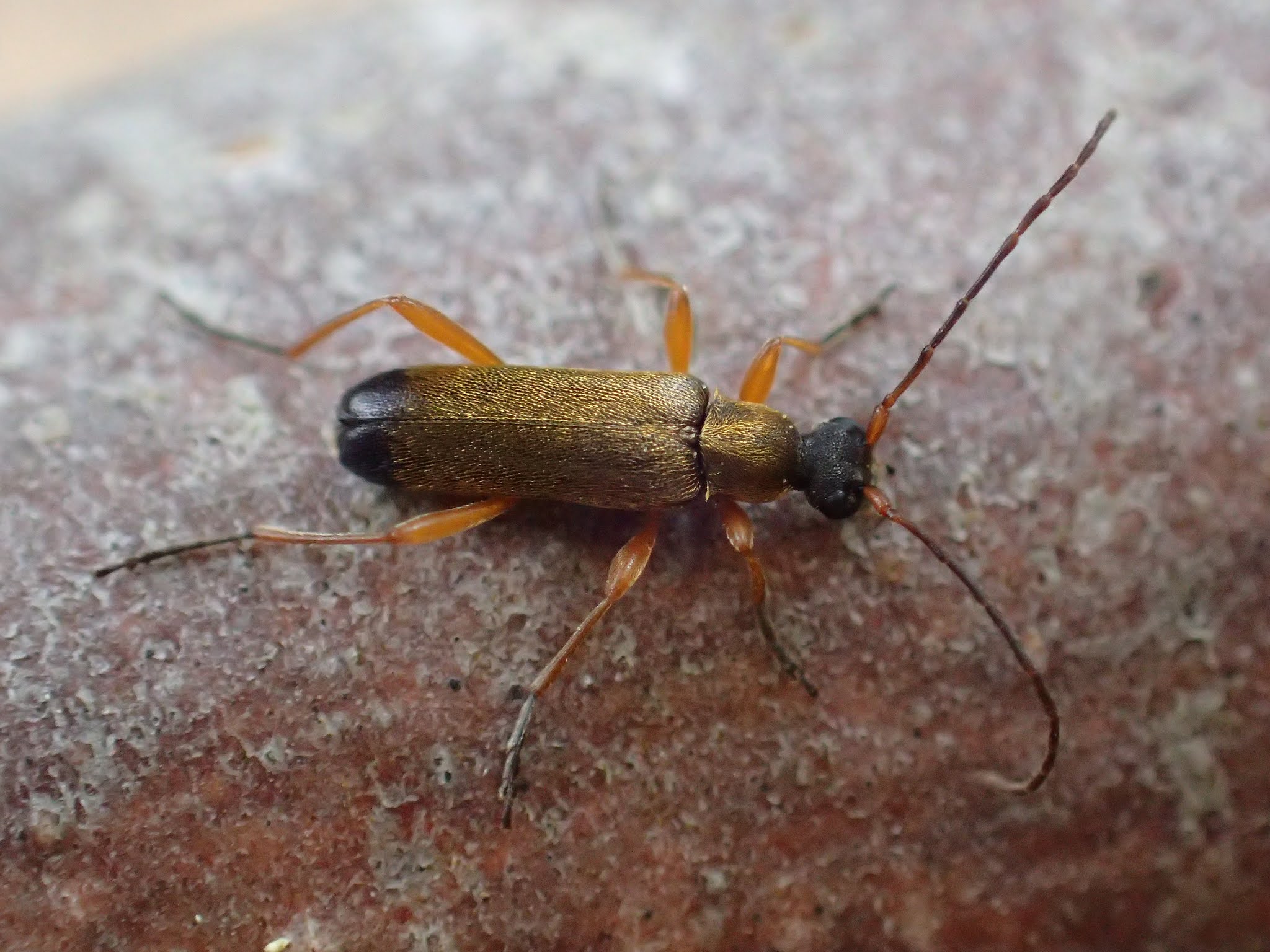
First up was the stunningly smart Grammoptera ustulata from a Surrey Heath (above). It appears to be a new 10 km square for this national rarity and a significant range expansion to the south. Might it make it's way to Sussex soon? I hope so as it is far better looking in reality than I ever thought. Look how shiny it is!
In Hampshire, in a field I visited three times in 2019, I found dozens of Cassida murraea in the first sweep. In fact, I visited that field six times over the last two years and only on one occasion did I find this beetle, and then it was in super abundant numbers, being the commonest beetle in the field. Incredible! No status but a smart beast that is much commoner in the west than it is down here.
At the same site in Hampshire in April, I suction sampled Baris analis! Certainly started the field season with a bang. A vulnerable species, this being a significant new inland record for this species.
I saw Stenostola dubia (nationally scarce) twice in 2020, my first since my only other record in 2009. The first one was beaten from an old lime at Knepp where I thought to myself, "I wonder if this is how you get Stenostola". It flew off before I got a decent photo though. Then, at a farm in East Sussex during one of those days where loads of Cantharis rustica and fusca are just bombing it around all day long, something flew over head and caught my eye. It was high, so I had to sprint and jump for it. It was another Stenostola dubia! Here it is.
At sites in East Sussex and in Wiltshire, I recorded Triplax lacordairii. The latter was a new county record.
On a farm in East Sussex, I stumbled across the first county record of Pseudeuparius sepicola! What a gorgeous weevil. I then beat two from a dead branch at Knepp, the first record for West Sussex in about 50 years.
At midnight at Knepp, Dave Green spotted this Opilo mollis. I have never seen one up close, my only other records were of a single elytron and a beetle 12 foot up a tree (also in the moddle of a night). Such an unusual beetle and so unlike any other. Not the scarcest but always nice when you see something well for the first time.
Not the cleanest specimen but this is the only time I have seen the Nb weevil, Tropiphorus elevatus. East Sussex and Kent being a stronghold for this species. The specimen was picked up early in the year and was found in an an area that had experienced significant winter flooding, hence it is covered in crud.
Also Knepp whilst helping a film crew find invertebrates, I picked up Sphinginus lobatus new to West Sussex. This certainly seems to be spreading.
Another lifer for me, just inside the M25 and less than an hour from where I live was the Bryony Ladybird Henosepilachna argus. It's amazing that this isn't all over Sussex, it's so close. It may well be about in the north of the county where I spend very little time.
Thanks to Steve Gale (and the original finder Tristan Bantock), I was able to go and have a look at the awesome Lixus iridis in Surrey! What a beauty!
And thanks to Steve Teale, I was able to go and have a look at our newest chafer down in Newhaven! The delightful Rhizotrogus aestivus!
I suction sampled two Rhyssemus germanus from a site in West Sussex and I think this is also a county first. A lovely little wrinkly dung beetle.
This was a new one for me, the unpronounceable Phloiotrya vaudoueri (with a name that looks like two of the worst racks of Scrabble letters you could get), a nationally scarce saproxylic species that I found in Wiltshire. I hate names like this, my brain struggles to put the letters in the right order.
From an arable margin in West Sussex, only the second time I have seen Trichosirocalus horridus. A lovely weevil (Na) that feeds on thistles, makes you wonder why it is so scarce.
And nice to see plenty of
Thymalus limbatus in Wiltshire/New Forest. Not all that scarce as you head west but really uncommon in Sussex, with very few records.
Oh, and I finally caught up with Agrilus sinuatus! What a looker.
And the latest find for me was
Cryptocephalus punctiger that I picked up on a Surrey heath! Love this genus.
What will 2021 bring? Lots more beetles I hope. I'm taking booking for 2022 now, and will be travelling a little further afield too. I am having a year off year-listing any taxa this year though. But PSL ticks on as ever. I'll be listing to the grave. One day, my PSL list will have 'the late Graeme Lyons' next to it, (for someone HATES being late, this sucks). Not for a while yet though.
And finally, any rumours that I am responsible for that stupid LEGO man I keep seeing plastered all over the Internet are totally unfounded, I am a serious naturalist. I don't know why someone would design it to look like me (arguably!) but I find that very offensive. It's not even funny.

Zoropsis spinimana first turned up in Brighton as far back as 2014 but it's taken me until now to see one. A huge thanks to Ali Risby for connecting me with this absolutely huge and gorgeous spider. There is so much to look at! It's so much bigger than I thought it would be, rivalling a Dolomedes in size nearly, it's also REALLY fast. Given that this comes into houses, I can totally see it not being popular with some people, it was even making me jump when it would suddenly start running after a long period of sitting motionless. It's also good at climbing the sides of the tank it's in and is also known to be able to climb glass easily (thanks Gemma). That said, I would happily have these living in the house, so any moronic 'kill it with fire' comments are most unwelcome, I would rather have these in my house than muppets who come out with that sort of rubbish. It's a non-native that has spread rapidly through London over the last decade, but outside of London, Brighton seems to be the best place to see it. Here are some more shots of this BEAST of a spider.
You can read more about it on the BAS website here and the recording scheme page for it, is here.
I have mapped the current known locations of the spider in Brighton and Hove (the larger square is simply where the record's resolution was lower). It seems to have started off in an area just south of Seven Dials and that is probably your best chance of seeing it. This year it has been found in Kemtpown too, the records covering some 6 or 7 km, meaning that it could be anywhere in the city now! The most western record is likely one that was moved when a friend moved house, given that he also had it in his previous garden, this is too much of a coincidence. Now seems a good time to see the adults too, If you see it, please send me a photo and I'll add it to the records. That's 353 spiders for me in just under nine months in the UK.

It dawned on me yesterday that I had passed a milestone earlier this week, that last year I didn't reach until 22nd November, that's half of the UK's spiders in under 8.5 months. I am pretty chuffed with this considering what kind of year we have had and that I have not left Sussex, Surrey, Hampshire and Kent. Oh and actually Wiltshire too, but just in the very south east corner. No, that's a lie, I also went to Bedfordshire earlier in the year! I think about 90% of this list has so far been work too, this year being easier than last year.
Anyway, yesterday's addition to my list was also a county first! I suction sampled Cryptachaea blattea. I really wasn't expecting that yesterday but there it is. We found it by doing a survey of Mark Colvin's woodland in West Sussex and this was right next to his house. This is my 347th spider this year. With still over 3.5 months to play with, can I beat last year's 391 and can I keep my lead above Tylan? The former all depends on one thing, whether we have another lockdown or not. Before, I was working all during lockdown doing surveys but I wouldn't feel comfortable travelling for 'fun recording' if it starts again. Who knows about the latter. There's all to play for. I didn't lose interest from July to September like I did last year, that's the hardest window for spidering. It's all about to get very 'liny' though. I can't wait!

Also this week, I was surprised to find I was in Wiltshire. I thought I was in Hampshire, not realising that a chunk of the New Forest was in Wiltshire! I was less than 50 m from the border when I found this, while looking for saproxylic beetles. I beat this tiny spiderling of Hyptiotes paradoxus off a low oak branch in dense woodland. This is the third time I have seen this and never when I've been looking for it. This appears to be a new county record too. I also had Sibianor aurocinctus apparently new to Wiltshire.
Now, I might not have a two week trip to Staffs planned at Christmas but I am hoping to start targeting some more distant sites/spiders, I might go on a quick roadshow too. I do think 400 is definitely possible.

How exactly did I end up in a bog with a chap kneeling at my feet shouting "get your little man out" just as two strangers walked passed and gave us disapproving looks? Well first off, I should say he meant TinyRecorder. That 'he' was Ray Gabriel. Ray, Danni Sherwood and I met up to go spidering at one of my favourite spidering sites, Old Lodge. It was a slow and steady on the spider front but we had seen many of the site specialities by this point. Having introduced Ray to my
little public engagement project earlier when we found a big
Dolomedes, we moved on to another mire when I heard Ray shout "I've got something big! A cricket" or something like that. I thought to myself as I rushed over, it can't be ANOTHER
Large Conehead can it? It only bloody was! It's only 19 days since I saw them at Dungeness on the day they were discovered, here I am on a Sussex Wildlife Trust reserve in the middle of the Ashdown Forest a long way from the coast! In fact the nearest Sussex coast is just under 20 miles away. Clearly, Ray realised that this was a 'TinyRecorder moment' but his choice of words was just hilarious. This isn't the first Sussex record though, as there has been one in a garden in Bexhill since the start of August.
If an en entomologist can encounter these twice in less than three weeks, then there are far more around than you perhaps realise. It's going to be common here very soon I think. They are big and obvious in the day and very noisy at night, so I would think you might have a chance at finding them anywhere in the county now. Absolutely incredible! So nice to see in daylight too though. Enjoy the photos! I thought their eyes were black bu they are really not.
Spiders new for the year were Floronia bucculenta and remarkably, Drapetisca socialis, putting me on 345 spiders for 2020. Here is Drapetisca. Common as muck this one but it's my first of the year. We recorded at least 51 species of spider today but this really did eclipsed for me by that huge cricket. So unexpected!
New for the site was Ozytpila sancturia swept by Danni and Cnephalocotes obscurus by myself. It's not easy to get a new spider for Old Lodge so nice one Danni! The site has now had 172 species of spider recorded on it. Also new for the site, and only the second ever Sussex record was the ground bug Lamproplax picea that I sieved from Sphagnum. The only other Sussex record was Flatropers in 1696! Over 50 years ago. What an awesome day! A big thanks to Danni and Ray for a really enjoyable day.

Recently I had a great day in the field with Steve Gale, last time I met up with him was 6.5 years ago (you can read about that here). Things have really changed for me in the intervening time and it was great to spend a full day with Steve on one of my surveys, that happened to be near his house. It's that time of year where I am wrapping up my surveys for the year, it's always a relief to get to this point, especially after this year. Burn out is always a possibility by late summer but in recent years, I haven't really had it as much as I used to. I think I've started to figure out how to avoid it by 'balancing' my time spent in the field. That is, there are some events that can be considered 'yin' and some 'yang'. Some events with a narrow focus and little time to stop and think, some with a wider scope with more time to gain perspective. Now for many people, they balance out this sort of thing by doing something completely different in their lives but I live a life of natural history and in the summer months particularly, I don't want to do much else other than be out in nature. Everything else is for winter!
The problem is, learning to tell the difference. Learning to know when you've had too much of the former particularly. For an entomologist, much of your work falls into this category. That's not to say I don't find it mindful and enjoyable, the days fly by when I am working alone in the field, recording against the clock. I always do my inverts surveys using timed sessions where possible and this does come at a slight cost. I started to notice this last year at Ken Hill. During the bird surveys I was aware how content I was, while during the invert surveys, I wasn't aware at all, I was just recording inverts. If I had stopped to think, I would have actually found I was also quite content but the issue here is I didn't stop. From a vagus nerve point of view, this is really key. If you are doing this kind of exercise all the time, you are in pure survival mode. It's not sustainable.
In the first three months of the year I hardly saw a person but from July, I have been making an effort to meet up with people on site. They come on my surveys and get some tuition and I get company and some more balance. The harsh contrast between the two halves of the year has been really telling and is ultimately the stimulus for writing this post.
So I have recently started trying to think about how to bring this balance into my natural history life. Now I have been lucky enough to have had a great therapist over the last ten years who has really helped me understand this stuff in quite a technical way.
Tasks that can stimulate survival mode, fight or flight or the sympathetic nervous system
Now I am absolutely NOT saying that these are BAD things. This is about balance.
- Twitching. Having a target and the possibility of failure is exciting but too much of this can leave you feeling exhausted. You can't get much of a narrower focus than this, if you don't pull up to a twitch with your heart beating out of your chest, you are probably a psychopath.
- Targeted recording. Going to a site to look for a specific species, say like an orchid or a rare invert. It doesn't have quite the stress of a twitch (as orchids tend to not fly away suddenly) but it still has a specific focus and a possibility of failure.
- Too much time on your own, in your own head. The focus narrows again. But too much time with large groups of people also falls into this category for me. Much more than four people at once I often find really stressful these days, although I used to love it!
- Too much time being the most experienced naturalist. If the flow of knowledge is only in one direction, this can also be exhausting.
- Taking on too much but particularly the side effect of this, rushing. I hate rushing.
- Wasted days indoors due to rubbish weather forecasts!
- Dare I say it here. And pot calling kettle black. Too much time on social media! The natural history groups seem to have blossomed in the last five years but it can still suck the life out of you if you're on social media too much.
Tasks that stimulate the vagus nerve and the parasympathetic nervous system
- Recording. Going to an area and just recording what you find without specific targets is extremely rewarding as the best things you find are a surprise and there is no chance of failure.
- Birding without too many targets. There is an irony here for me. I have recently started to get back into birding but the problem is, it really hurts my back. A gentle walk around a site where I am upright for an hour or two and my slipped disc will be in agony. A 30 min drive home though, and I'll be right as rain (?!). A day spent bending down all day to look through nets and suction samples and I will not get this.
- Spending time with people, but people who don't stress you out! I know the latter part of this might sound obvious but I don't always find it that easy to tell. It's much easier as a freelancer to be selective on who you spend time in the field with but it's also really easy to fall into the trap of being on your own all the time!
- Spending time in the field with people who know more than you so you can absorb it. You know that feeling when you go on a course? You can drink up someone else's knowledge and this can feel very expansive. That's vagus nerve stimulation. Either that or the copious amount of horrible instant coffee I usually drink.
- Taking the time to enjoy what you're doing. I hate rushing to site, so I would rather go to bed really early and have a long morning sorting out admin and having a big breakfast. There is nothing worse than the stress of feeling like you are running out of time. This is a big reason I don't get on with moth trapping and nocturnal work so well as it ruins the next day (or more) for me. I really don't know how people do night work.
- Borderline weather. Always go for it, there is nothing worse than sitting indoors on a sunny day for no reason.
- When you are properly rained off though, don't resist! There is NOTHING you can do about it. These unplanned days off from fieldwork are your best friend. Embrace them. Look out the window not in frustration but happy that you are dry and able to process some specimens/records/field notes etc.
If you follow the analogy of the yin yang philosophy, the whole is always stronger and more balanced when the two are mixed. So timed counts of invertebrates on a site with an old friend who you really enjoy the company of, balanced at the end of the day with a very short drive to find a rare beetle. I reckon that just about comes out as the perfect balance. I have recently started planning my time to think about this sort of thing a bit more and I have to say, it's really working.

So last Sunday, Steve and I had a cracking day, some 166 field dets and a total of 200 species by the time I had processed the spiders, bees and flies etc. I nicked the above photo from Steve's blog, I am sure he won't mind. The only thing I got from the father I never met was a lot of hair, which seems to be taking over again, I only had it cut last October! You can read Steve's account of the field work here and also his account of the pan-species listing element here. I managed to help Steve out with 114 lifers! A jump of two places on the rankings and a place in the top 40. We got lots of nice records but I took very few photos. We headed down the road to see this rare beetle...

Steve found the first one. A massive baguette-sized weevil, Lixus iridis. We found a couple more in the same place but then something really interesting happened. Steve lost his glasses. Wearing glasses at home only, I could feel Steve's stress, I get stressed even though I know they're in the house when I lose them. I found my back started to get bad really quickly but in the 15 minutes or so that this happened, my ability to find Lixus went through the roof. I found four just like that. We were now both in survival mode and it wasn't looking good for a while. Then I spotted the glasses and everything was OK. I am glad we didn't give up. It really shows how much we are effected by what we are doing and learning to read your body is a great way to know what's stressing you out, what doesn't and how to manipulate the two to get the best outcomes for both your mental well being AND your functionality. To reiterate, I wouldn't find half of what I find without activating the fight or flight mode, it's not inherently bad. It just needs balancing.

Back when we could go to pubs, whenever I met up with friends in the summer in beer gardens, they would sometimes comment on how my eyes would be darting everywhere. It's because it takes a while to decompress out of that mind state, I was looking for danger/invertebrates. Saying that, it makes me realise that even though I don't really drink anymore, those sessions were a great way to decompress. Probably more so regarding just switching off for a while rather than the booze but that is something very much missing from 2020.
I digress. Additionally, I tried sweeping Nettle and Hedge Bindweed nearby and picked up a shield bug nymph I didn't recognise. This had to be the Striped Shieldbug Graphosoma italicum. I knew it was found here by Tristan Bantock but it really wasn't on my radar to see, so was a total surprise. Turns out it's most likely the first nymph recorded on the mainland. Not that it was a lifer, as I ticked this on Jersey a few year ago but it was probably the highlight of the day for me.
So if you live a life of natural history and like me, occasionally find yourself getting wound up for reasons that are not immediately obvious, it might be worth thinking about things in terms of the parasympathetic and the sympathetic nervous systems.


 Posts
Posts