Ground bugs are great, they are practically beetles. And this smart looking black one with a big orange blob on has been on my 'list of cool looking things I want to see' for some time. Behold, Aphanus rolandri! Now I took the above photo in the Brecks last year, the only time I have seen it. Meanwhile, Mike Edwards was doing a survey for us at West Dean Woods and picked it up there new to West Sussex within a few days of my record! Now what's interesting about this is how different the sites are, given that there are so few records in Sussex. There is a very old record from Seaford in 1949 and two from Brighton between 2006 and 2011 and that is it. It's a big and distinctive bug, I would expect it to come to me to verify via iRecord if it was more widespread but that hasn't happened.
Now the ones I saw in the Brecks were in a huge, hot, dry and old clearing on an abandoned airfield. The immediate vicinity was calcareous-like grassland due to the substrate put down for the runway. As this has been there since WW2, there is a great continuity to this glade. A mass of Wood Small-reed (quite uncommon down in Sussex compared to East Anglia) was growing next to the old runway, mainly unmanaged and it was collapsing in on itself forming a very hot and dry litter layer. There were hundreds of nymphs and adults running around in this having a whale of a time.
You can read about it
here on the British Bugs site.
At West Dean Woods, Mike told me they were plentiful and clearly well established there. Below is the site it was found on. A very recent and quite small clearing in fairly humid woodland. Even the recently cleared coppice coupes nearby are more like the Breckland site than this is but they lack any continuity of bare ground that even a very small glade like this can offer. It's fascinating, as these sites are so different, it makes you think why is it so scarce down here? Or are we actually just seeing the start of a colonisation event from a species that's actually not that fussy and just does well in warm sites? The impression I get is that it is genuinely scarce and whatever these two sites have in common is the answer but there doesn't seem to be much in common!
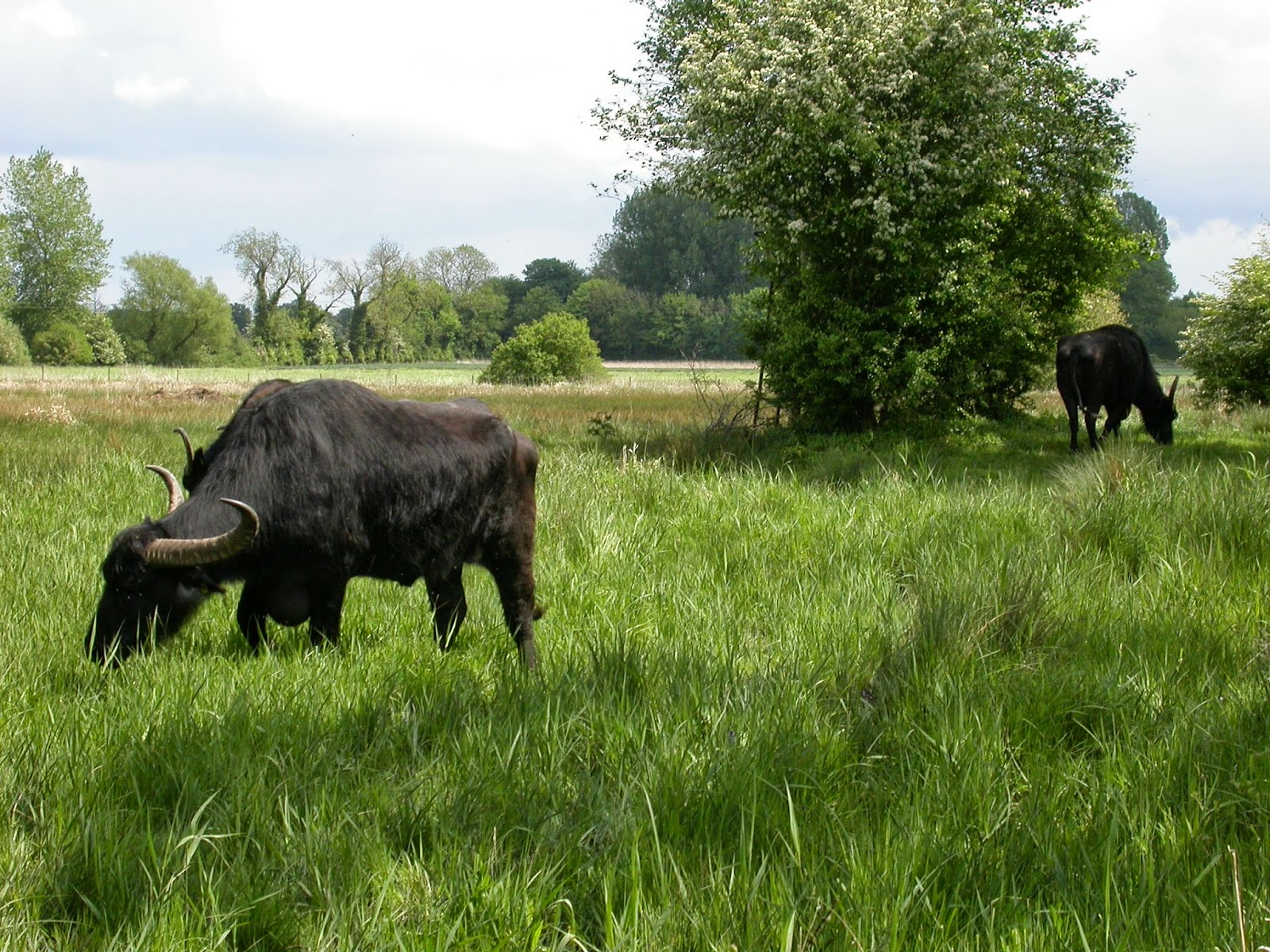
I've been to Chippenham Fen today in Cambridge to look at the effects that Water Buffalo have had on the fen there over the last decade or so. I was really impressed at how at home they seemed and you can really see the accumulative effect of their grazing in the following photo. The left side has been left ungrazed while the right hand side gets a short amount of light summer grazing. The difference is striking, the left has dense Saw-sedge and lots of hung up litter but very little structural variety, the right has very little Saw-sedge (amazingly they seem to preferentially graze this) but a much more varied sward structurally and botanically. The right hand area is a hot spot for the Silver Barred moth (I was too early) while the left hand side has many rare spiders in the litter. Both communities are catered for by this sort of management.

In this area, tussocks of Black Bog-rush with Cambridge Milk-parsley have done very well with the grazing regime. In this area I found the very smart Na beetle Cerapheles terminatus.
I did manage a small amount of sieving, and in the first sieve we found several Hygrolycosa rubrofasciata (a stunning Na wolf spider I found new to Sussex at Stedham in 2012) and most excitingly, a couple of immature Marpissa radiata, a Nb species which is also a specialist of this area!
Graffham Common is not just your typical 'trees off heaths' project. We were not starting with a featureless conifer plantation, there were already some nice sunny glades, areas of wet heath and big old granny pines in among the plantations. We surveyed theses areas extensively before starting management there, so that we enhanced what was already there, rather than replace it with what we thought should be there. One of the real surprises, even from pitfall traps, was the number of saproxylic species there. I've almost got enough to put together an SQI for the site and it's scoring surprisingly high.
In 2012,
in a five minute period on a single fallen birch log with
Razorstrop I recorded
Diaperis boleti (RDB2),
Colydium elongatum (RDB3) and (just confirmed by Peter Hodge)
Ampedus cinnabarinus (RDB3). That is a really good five minutes of recording for a conifer plantation! Given the habitat, you would expect
Diaperis, but the other two?
Colydium is a predator so it goes where the food is and I have now seen it on birch and (I think) pine. I rolled this log yesterday and found this odd looking larvae with two upward pointing black hooks which I believe is probably
Colydium elongatum. Anyone else seen the larvae of this beast?
21/03/2014 UPDATE: I came to the conclusion that this is actually the larvae of the much commoner
Nalassus laevioctostriatus after finding another one at Flatropers
and Mark Telfer said the same thing too
.

But Ampedus cinnabarinus on birch? I have only seen this once before under Beech bark at Cowdray, the expected habitat according to Peter Hodge. Maybe though we are missing the real resource needs?
Other saproxylic beetle highlights from Graffham include: Leptura aurulenta (Na), Prionus coriarius (Na), Pogonocherus fasciculatus (Nb and new to Sussex) and Melandrya caraboides (Nb).
If we can replicate at least some of those needs on a site like Graffham, we can enhance a site for such species rather than create a uniform heathland that replaces it. What we have done there is leave more trees than would usually be left (about 30% canopy cover). Connecting the existing glades, leaving some areas wooded, opening some areas right up and providing a range of different microclimates. What we hope to achieve is something more like parkland but with pines and birches instead of oaks and heath instead of grass. The best of both worlds. I believe that shelter is a really important resource for invertebrates but is often overlooked.
When the felling happened, we left a few trees as deadwood too and even had a few 'hung up'. These blew down in the storms but on a visit there yesterday I was pleasantly surprised by how many had blown down. We are going to leave as many as we can without negatively affecting the management of the future heathland. The great thing is these winds were predominantly from the south, so the root plates are all facing south. Fantastic habitat for all sorts of things but they should be really good for aculeates.
Some like the eight foot tall root plate above, have produced their own peaty pools too! Or this one that has pulled up a great plug of mineral soil.
And this one with its exposed roots.
There are few snags too where the tops just blew right off! I'm betting there will be a Woodlark on there by the end of the year.
I can't wait to see how this site develops. Heather, Bell Heather and Cross-leaved Heath is growing well on site and the major management issue currently is staying on top of Bracken control. I'll be repeating some pitfall traps and quadrats this year that we set up in 2009 and again in five years or so. Watch this space! Finally a big congratulations to Jane Willmott for making such a success of this project!
Many of you will be familiar with the common Green Tiger Beetle Cicindela campestris but it has a much scarcer cousin, the Heath Tiger Beetle Cicindela sylvatica which probably went extinct in Sussex several decades ago. This species is a Biodiversity Action Plan species and is nationally scarce (Na) with the major population centres being the New Forest and Surrey Heaths. The last unconfirmed sighting in Sussex was at Iping in the 1980s, so it was decided that this would be a good place to reintroduce it. Often confusingly called the Wood Tiger Beetle, this species is very much restricted to lowland heathland and is not really a woodland species. Here it is again in all its glory.
And the smaller and more brightly coloured Green Tiger for comparison.
Prior to the reintroduction, the reason the species went extinct on the site needed to be addressed first. This was loss of bare ground and pioneer heathland. We create this at Iping in a number of ways such as burning, scraping and turf-stripping but it is the turf-stripping that seems to produce the best results for the Heath Tigers and a suite of other scarce invertebrates. In 2007, six females were introduced followed by a further 16 in 2009. The species has been recorded annually in small numbers each year since then and would appear to now be established on site. Turf-stripping is carried out annually to ensure that there is always some suitable habitat and the turf is sold on to golf courses whereby new heathland is created there. Everyone is a winner! Here is the small turf-stripped area I saw the Heath Tiger on, immediately adjacent to the original release site.

When I came to write up this work over the winter, it became clear that we hadn't been keeping track of where and when this management had occurred so I went out there on the 1st May to digitally map and 'age' the scrapes. I also wanted to see what else was benefiting from the management. Heath Tiger emerges a little later in the year than Green so I was surprised to see one. I kept hold of it for an hour or so to cool it down and show the volunteers and it kept still enough to allow the above shots. Proof that the Coolpix 4500 consistently produces good macro shots! Not bad for a ten year old camera.
I picked up a few carabids on the turf-stripped areas but it wasn't until this morning that I realised that the Pterostichus I had picked up on one area only put in this winter was in fact the Heath Short-spur Anisodactylus nemorivagus! This generic looking carabid has as many letters after its name as the Heath Tiger Beetle (BAP and Na) and would appear to be only the third Sussex and second West Sussex record! I trapped it in a pitfall trap at Graffham Common in 2009 and Mark Telfer identified it. Peter Hodge also pitfall-trapped it in Ashdown Forest. This means that I am the only person to have seen this beetle alive in Sussex!
Anyway, after mapping and monitoring 55 turf-stripped scrapes, I recorded about 90 Green Tigers to my one Heath Tiger but it is still early in the season so I hope to see more spreading around the site later in the year.
Birds were good too with a singing Redstart in the same place it was recorded last year and a Hobby catching bumblebees on the wing.
On the 9th January I met up with Sharon Pilkington and Tom Ottley to look at some of the rare bryophytes growing on the sandrocks at Eridge Rocks. It was an interesting day, I managed to see seven species I hadn't seen before (4156) including some quite scarce ones for this region. It was good to talk about the management of these often over-looked plants and to see that we are mostly getting it right too. Tom thought that the rocks were probably looking the best they had done in the last 50 years for this rare assemblage of tiny plants. A few tweaks that we could make include clearing brambles from some of the boulders and removing some of the lower branches from evergreen shrubs to let the dappled sunlight that these plants demand (direct sunlight or complete shade are a sure way to eradicate most of the species).
Here are a few of the species we saw. This first was perhaps the rarest of the mosses,
Dicranum scottianum (we only saw three tiny plants) but I was particularly pleased with this shot. It is taken with the lens looking directly up the side of the sandrocks. It was an incredibly dull, overcast day which I think the Coolpix 4500 does well in.
This TINY liverwort is known
Scapania umbrosa and was yet another species the bryologists were quite excited by. Nearby, this boulder, with a birch growing from it, was also a hot spot for a few scarce bryophytes.
Including this endearing little acrocarp (did I just say that). Tiny luminous-green sea urchins spring to mind. It's yet another species that can thrive on the sandrock,
Campylopus fragilis.

A phrase that kept popping up in the species accounts in the literature for these scarce species was 'hyper oceanic', essentially meaning of a far north-westerly distribution close to the Atlantic. In the Weald, we have many of these species, particularly on the sandrocks, but they are often very rare in the region (where they might be common in the north-west). It must be a specific set of climatic and substrate conditions that are provided here but it is something well worth holding on to. Without the appropriate management at Eridge we would certainly lose these plants to succession as Holly, Yew and Rhododendron cast their dense winter shade over the rocks. This is a great example of monitoring and management working hand in hand with the specialists feeding their knowledge and advice straight to us at the Trust in the field. If we want to hold on to rare and scarce species that have such specific requirements, we cannot rely on a 'one-size fits all' approach to their management and natural processes here would be damaging. Species-assemblage focused management is therefore vital if we are to maintain the more unusual plants and animals at Eridge. Small scale management like this is often referred to as 'gardening' by some conservationists these days. Call it what you like, I see it as
exactly what is required to maintain a rare and precious assemblage and that's exactly why I have conservation written through me like a stick of rock!

During a walk around Iping and Stedham today, I spotted two little green plants in an area of wet heath. A particular shade of green that I know very well so I knew instantly we were talking about Marsh Clubmoss! This is not a common species and the plant was last seen towards the far south eastern side of Stedham, some ten years ago. Scrapes were put in in this area but as yet, we have not recorded the clubmoss in this spot. So it was a complete surprise to find two plants growing close to each other at the opposite end of the reserve. It's great to see that the poaching and bare ground caused by the cattle will have helped this early-successional species get a new lease of life at Stedham. Brilliant news!
The rest of the day followed a similar pattern, with several RDB beetles and nationally scarce spiders turning up at Graffham but after a long day, that will have to wait until another time...
I've been back to the New Forest today to discuss management of Holly so that we can gain experience for the proposed management at Ebernoe Common, Neil Sanderson was our guide and was, as ever, very helpful and informative. I managed a few ticks, best for me was a number of these smart hoverflies, Sericomyia lappona feeding on Bramble flowers in the woods near Pig Bush car park. On the edge of the wood, Neil was able to show me the leaves of Soft-leaved Sedge that I could not find two weeks ago but looked for. Probably because it was hardly in flower!
Nearby we also stumbled upon a Lesser Butterfly Orchid. I might not have seen this since I was a kid.
Neil also pointed a number of rare lichens that I could not possibly hope to re-identify so I won't be adding them to my list however, this Usnea ceratina is pretty distinctive and can't tolerate much pollution. We also saw the acid loving version of the moss Thuidium assimile which is called Thuidium delicatulum. I end the day on 3430 species.
Many years ago, the Woods Mill stream was split in two for a short section to create the mill leat to feed the mill wheel. The stream itself, in an unnatural position, has dug deep into the clay and is very steep sided and uniform in appearance, the area does not function very well as a flood plain for this reason. There is no ecotone between the river and grassland plants. A joint project is underway to realign a section of the stream and this started last week. In the above image, the new stream route is being plotted by removing the top soil.(the current stream follows the line of trees in the distance and to the right of the digger). Riffles, oxbow lakes and woody debris will be added to the design and the project should be finished in two or three weeks. I can't wait to see how it recovers and what new species it will attract. Exciting times! I will be taking photographs throughout the project.
Birds today included the first Redwings this end of the year, Yellowhammer, Skylark and Cormorant. There were still quite a few inverts around today, including Roesel's Bush-crickets and Long-winged Coneheads. I spotted this Nursery-web Spider Pisaura mirabilis. I like this spider, mainly 'cause it is the only one in the genus and there is nothing else that looks like it! It is very, very common and reminds of the big 'facehugger' like huntsmen spiders you get in Australia!


 Posts