An Alternative Natural History of Sussex.
This blog shows the highlights of my day to day findings as a naturalist and ecologist living and working in Sussex. Delivered with a pinch of nihilism, a dash of sarcasm and absolutely no tweeness, here is my attempt to show natural history as it really is: Brutal, beautiful, uncompromising and fascinating...and occasionally ridiculous.
I have been studying natural history for some thirty years, nineteen in a professional capacity. I currently work in Sussex as a freelance entomologist, ecologist and botanist and specialise in nature reserve and rewilding management advice based on the interpretation of the surveys I carry out. I also run a number of identification courses. An advocate of the pan-species listing approach. My main areas of interest are birds, plants and invertebrates and a lot of my spare time is spent in the field. I am the county recorder for spiders and bugs.
Thanks to my school teacher Steve Cooper I got into moths and moth trapping around about age 13. So for the last two thirds of my life I've been moth-bothering, with the middle third involving a lot of moth trapping. The latter third however has been more concerned with recording moths in the field and this involves a lot more micros but also, moth larvae. There are quite a few generic green or brown moth larvae that are really not easy to identify, then there are quite a few that are much easier and really abundant such as Mottled Umber and Common Quaker etc. Larvae are really useful on invertebrate surveys as they show you the botanical associations of the species, as moth traps can suck moths in from off the site you're surveying. The only problem with learning moth larvae is you have to do everything twice, learn the adult and the larva. The other difficulty is that although there are some really common ones, many of them I've only ever seen once. Such as the Brindled Beauty above that we saw at Brickfield Meadow a couple of weeks ago. There is so much going on there!
This one turned out to be Cypress Carpet beat from an ornamental evergreen at a site in Worthing. Again only seen once.
This beauty is the Chamomile Shark swept from mayweed. Only ever seen this once.
This is the amazing looking Black Arches. A moth I've seen many times before, but this year I have seen the larvae twice. This was beaten off oak.
This one took a bit if time and help from Butterfly Conservation, it's Pale Eggar beaten from oak at Ebernoe. I like the repeating pattern of Boba Fett's helmet! Only seen this once.
And this odd little thing turned out to be a Brussel's Lace, beaten from an old Blackthorn covered in lichen at Seaford Head. I've seen loads of the moth, only ever seen the larva once. So get out there and beat some bushes and see what you can find.
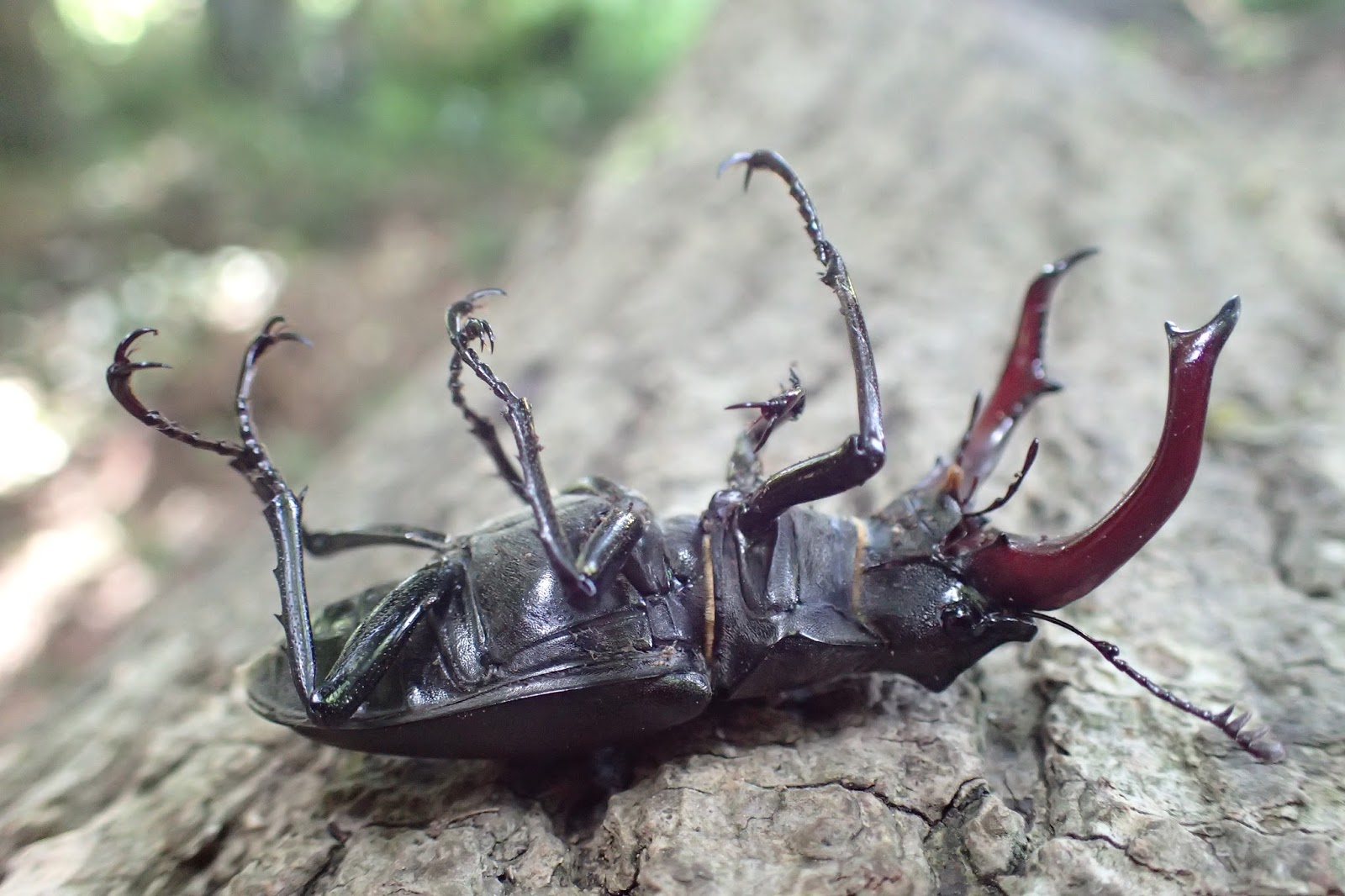
During a survey at a site in Worthing at the weekend, we found four stag beetles on one log!!! That's three males and a female. This one was recovering from a bender. There isn't much to say about these magnificent beasts so I will leave you with the images.
And the female is also a huge and impressive beetle...
A couple of evenings ago, ago I tagged along on the first Shore Search event of the year. The weather was grim and there were only five of us. Fortunately, Gerlad Legg and Olle Akeson were there to guide me through the weird and wonderful word of...Worthing Pipe?!
As promised by the title, sponge. I thought this looked like something from a paint-balling centre or Jackson Pollock's hangover. The blue one is Terpiosa gelatinosa and the blood red one is Microciona atrasanguinea. I think there is also Breadcrumb Sponge in there (the beige one) and maybe Amhilectus fucorum. We saw at least five sponges. I quadrupled my sponge list.
As promised, blobs. Great big massive dangly blobs. These were the biggest anemones I had ever seen and were all in one huge cluster. Turns out this is actually a common species that is rarely exposed. As you'll never get me under the water, I'm really lucky to have seen the Plumose Anemone. Think this was the star of the show!
As promised, squirts. This leathery looking thing is actually an alien species. This is the Leathery Sea Squirt and is quite possibly the most ugly looking thing I have ever seen. I doubt I would have ever recognised it as a living thing!
As promised, a pipe. Worthing Pipe was an early attempt at the Channel Tunnel. One by one, Victorian's were loaded into the pipe like bullets in a gun and propelled at high velocities across the channel using compressed air. The regular 'Fop', 'Fop' followed by jubilant screams was a frequent soundscape of this part of the Sussex coast. In France they enjoyed day trips for as little five guineas. It was briefly successful until Queen Victoria herself became lodged in the pipe and a 30 mile chimney sweep's brush had to be deployed to rescue her.
OK, it was just an old Victorian sewage pipe. There was something very Iain Banks about this structure though. My left ear was freezing!
On the left here is Poseidon, God of the Sea, AKA Dr Gerald Legg. Thanks Olle for the photo. On the way back I found half a Painted Topshell. I couldn't believe how big it was, can't wait to see one of these alive. I really didn't think Worthing Pipe would be that exciting but that was one of the strangest and surprising hours of natural history I've ever done. I can't wait for the next one!
The process by which a wild plant or animal, through being particularly well marked, rare and cute, is rendered down to the level of a sickly-sweet pudding in the eyes of drooling Internet obsessed naturalists.
I just had to get hold of some decent photos of the Desert Wheatear (or Dessert Wheatear as I think you'll find fits better - but Pudding Wheatear is a step too far?). A big thanks to Juliet and Chris Moore who took the top and bottom shots respectively. It really does look good enough to eat. In fact, I might put this bird right up there as one of my all time favourites. It leads to one burning question though. Is there a Starter Wheatear and what does it taste like? I mean look like?
No wheatears (of any kind) were consumed during the writing of this post and the author does not in any way condone the eating of wheatears. Now has anyone ever noticed how much Great Shearwaters look like Vienetta?
I think these are the darkest conditions in which I have ever ticked a new bird. I found myself on Worthing sea front before light to see the Desert Wheatear which was even more effortless than the Siberian Stonechat at the weekend. This is my 4095th species of all time and my 7th new bird of the year. I hung around for a bit until the light conditions got a little better but I had a narrow time window. This is a really nice bird and also incredibly tame. It's also very well camoflaged against the shingle and is almost exactly the same colour as a can of Special Brew. What's gonna turn up next in Sussex?
Was the most frequent thing any one said to me as I stood by the main road in Worthing staring into a bush. Why you ask? Well, I went to Worthing to see the Yellow-browed Warbler (and to but some new running shoes for British Military Fitness - I am not joking, I have been doing it for two months now). Where was I? Yes, Worthing and one of the strangest twitches. The bird has been very faithful to some ornamental bushes around the edge of a small car park near central Worthing. After about half an hour of messing about, it showed. It was very close but hard to see. I recorded it calling, I have heard them before but I must say I originally mistook it for the call of a Pied Wagtail.
It has clearly become something of a local celebrity as many people stopped to ask if it had been seen or what we were up to. Even a rough looking bloke that I overheard talking to his mate about getting out of prison asked what we were doing. It's a funny place Worthing, a completely different demograph to Brighton. The presence of two universities in Brighton means that there are so many young people and all the sub-cultures are well represented. In Worthing, I only saw a small flock of Hipsters and an immature Goth. Living in Brighton I forget how crazy the place is.


 Posts