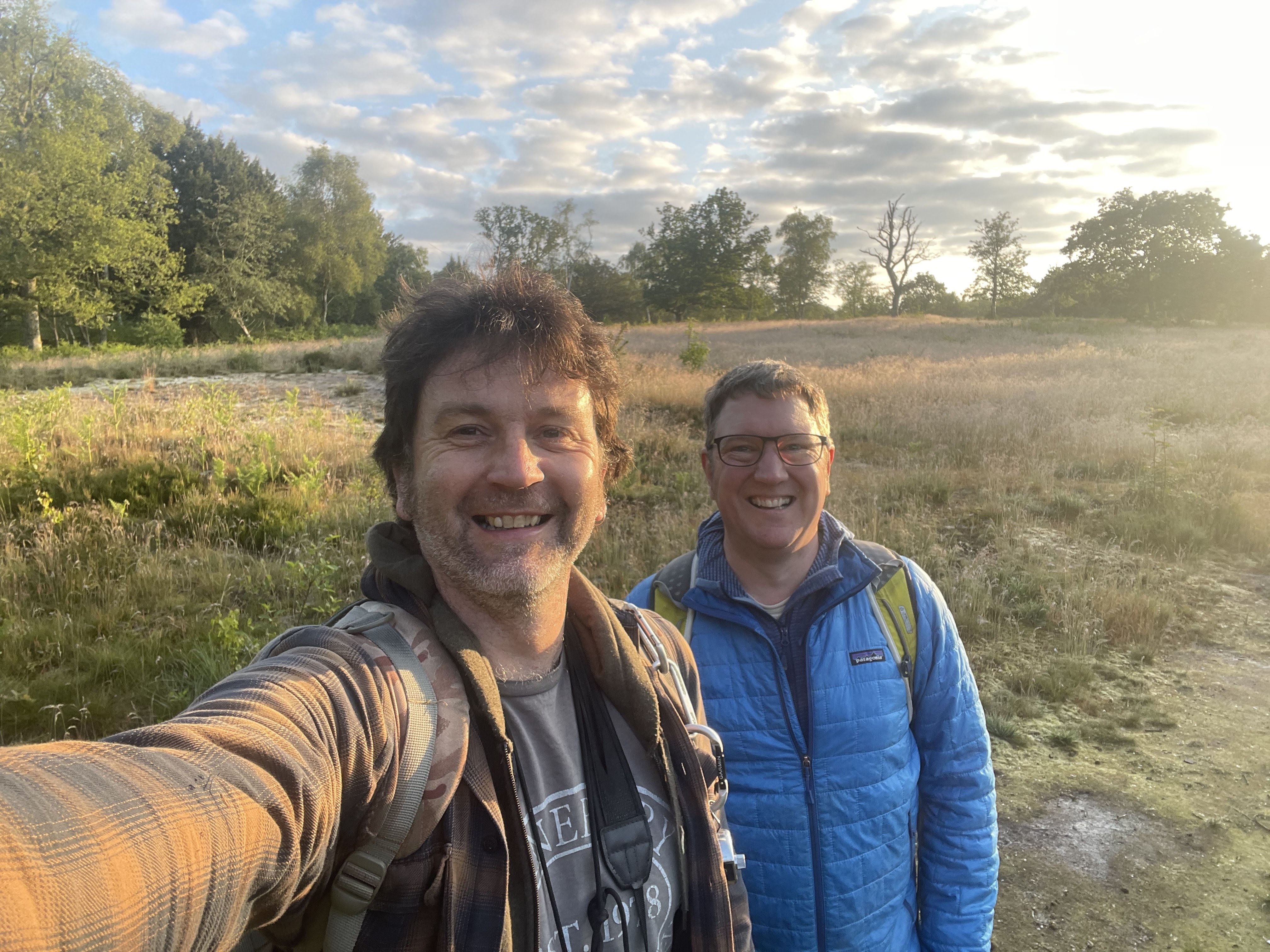
This following italicised sections were written by Matt Phelps, who first heard
this unusual cricket...
I strolled over to Sussex Wildlife Trust's Waltham
Brooks reserve from home a bit before sunset on 13th July. It
was another balmy evening after yet another scorcher of a day. There had been a
few Night Herons popping up in other parts of southern England in
recent days and weeks so it was primarily this species I had in mind as I
approached the lake, especially as it was pretty much four years to the day
since the previous record of the species here. Aside from quite a few
Mallards and flyover Little Egret there wasn’t much going
on here, so I decided to start heading for home.
As I crossed the bridge
over the old canal my attention was immediately drawn to a loud
chirruping sound coming from somewhere ahead of me. I crept towards where
I thought the sound was coming from but, each time I felt like I
must be right on top of it, the source of the sound seemed to
move! I’m certainly not the world’s greatest expert when it comes to Orthoptera, but I was certain this wasn’t something I had
heard before. I scoured through some Juncus tussocks in the hope of
finding the culprit but could only find Lesser Marsh Grasshopper, so I decided
to record some video of the song for posterity before heading home.
The following day I sent the
video to Alice Parfitt, in the hope she might recognise it. I was
then off work sick for a couple of days and, as I hadn’t heard back
from Alice, the whole thing slipped my mind somewhat. I made a return
visit on the evening of 19th July and, sure enough, heard
the very same sound in the same place. Again, none the wiser to what it was or
where it was coming from! Funnily enough, Alice text me back a day or two
later to say she’d exchanged messages with the Sussex Orthoptera Recorder, Ralph Hobbs, who was a bit mystified, but suggested Tree Cricket.
Neither Alice nor I thought this sounded right at all, when compared to
recordings online.
Here’s where I come in. Last week at a Sussex Moth
Group event at Petworth Park, Matt showed me the above video he had taken a few days before. So I suggested we headed there
to look for it on the first day we could get out there together.
Sunday (26th July) night, Karen and I met up with Matt (later we were also joined by Steve Baines) and did a bit of casual recording before it got dark.
There was lots of nice things to see but we needed it to
get nearly dark before this cricket would start up.
Like clockwork, it did just that, and as we edged closer to it, it seemed to move
wildly around. We decided to try and triangulate it as there were four of us,
but we all seemed to be pointing at each other. I think we were all
assuming it would be coming from a tussock of vegetation. Then I thought it was
coming from under an old railway sleeper, so I bent down to listen closely and
it suddenly sounded like it was metres away in the hedge. Then it dawned on me,
we had been stood right on top if almost from the moment we got
there. It was in the middle of the path, deep down in a crack in the bare ground!
It was only occasional calling, so I had to try and
pinpoint where I thought it was. I had my head torch on by now then suddenly I
caught site of it, about 20 cm down and impossible to get to. It looked like a
large, dark Wood Cricket but it was gone again, out of sight. About an hour of breaking the
sun-baked ground up with nothing but our bare hands and multi-tools filled much
of the fissure up with dry loose earth. We were starting to think we had blown
it by causing a little too much disturbance when I tried turning the torch off.
It sang within seconds and was suddenly right there in the open, only to
scuttle back into a crack that was yet again impossible to reach into.

It was nearly 10.00 pm by this point and I was
starving! I had no idea how much time had gone by. Karen suggested using a
feather to coax it out (something I have done successfully before with
spiders). One attempt and it worked, the cricket popped out and bounced around
frantically for a few seconds before I got him in a pot!
Here it is!


It clearly wasn’t a House Cricket or a Wood
Cricket. Consulting “Grasshoppers of Britain and Western Europe” I thought it
was closest to Svercus palmetorum on looks but the call
was totally wrong. A few days ago when I had shown Peter Sutton
Matt’s recording, his first thought was Eumodicogryllus bordigalensis. But
both of us dismissed this at first as this animal appeared too dark, especially
compared to the photos in the book. I posted images on a Facebook group to see
if any one had experience of Svercus in Europe so I
could rule it out, when Chris Tindal suggested it could indeed be Eumodicogryllus bordigalensis.
Sound recordings on Xeno Canto were a good match. Now this species is heading
north in France, it’s just over the Channel in fact. Also, macropterous animals can
fly, so it is actually rather more likely than not that this animal
got here on its own. Suddenly this has gone to a ‘first for Britain’
scenario, rather than just some escaped pet food (it did seem odd to me
that an escaped cricket would walk for half a mile from the nearest house to
set up home where it did).
There is a Polish paper that suggests macropterous males can remove their wings, but this doesn't seem to be backed up with good evidence. So are there more animals at Waltham? Did it get here under its own steam and this is one of the young from a previous generation or was it introduced accidentally? I believe that we have to work under the assumption that this is the start of a likely natural colonisation. This species has been marching north in Europe rapidly - Peter told me it is already in Scandinavia, so it it seems it was inevitable this species would make it here at some point.
As I wrote most of this last night, I turned on Channel 4 News to see the piece about the fires in Bordeaux - utterly heart breaking. Yes, seeing new animals colonising the UK is interesting to us entomologists, as is the wish to be the first to see or find a new species but it does also make me feel like a disaster capitalist on occasion. This really would be unlikely to be happening without man made climate change. Yet, it's vital that these events and species are catalogued so we can adapt to our ever-changing invertebrate fauna.
Peter Sutton is happy it’s Eumodicogryllus bordigalensis. So it
looks like we have a cricket new to the British Isles (it has not even been recorded on the Channel Islands yet). The common names are numerous: Bordeaux Cricket, Southern Cricket or Verge Cricket, and it’s quite common in
France. I don't really like those first two names, so suggest we use Verge Cricket here (place names are not very helpful). Apparently, they are known to enter cracks in the ground
during the day – just like this one did. I predict there will be more of
these animals on the south coast, in the near future, if not already.
It just goes to show, if you hear or see something a bit
different it is worth putting the hours in. Persistence does pay off in natural
history.
Back to Matt for the final word!
I’m delighted that I was able to pick this cricket up from its unusual call, and that it stuck around long enough for us to pin it down. Huge thanks to Graeme for the time and effort he put into finding and capturing it, and for his detective work on confirming the identification. This is the first time I’ve ever found a species new to Britain! It really does go show to what else could be out there, waiting to be found.
Yep! That's an Aulonia albimana spiderling, a Critically Endangered/Nationally Rare and rather odd little wolf spider that no one has ever digitally photographed in the UK, as it was last seen here 40 years ago in 1985! Madonna's "Like a Virgin" was in the charts the last time this was seen here. So how on Earth did we managed to find it? Well, like all such adventures it started with a hunch. Mark Telfer has a 'Species Recovery Project' contract this year, lead by the National Trust and funded by Natural England. Part of the brief was to try and find Aulonia albimana. It has only ever been found at three disparate sites in England (check out the SRS page here) but the Isle of Wight site is on MOD land and furthermore, has scrubbed over. Making it simultaneously not worth visiting and nearly impossible to get to. This spider seems to like short, bare areas with broken turf. Which may be dry or recently wet - it's not all that clear.
When I was over at the end of August to see the mantises, I offered to come out for the day with all batteries fully charged but spending over half of September in rockpools chasing nudibranchs, it ended up drifting into October. Yet my theory was that in early autumn, there are always loads of wolf spiders in the suction sampler. They are typically sub-adult Pardosa that are mostly impossible to identify but hugely outnumber the adults they become the following spring (after a winter of being whittled down in nature's great reality TV show elimination process). Yet Aulonia is very different to all other wolf spiders here. It's in a genus of its own. It's tiny (3-4 mm as an adult) and it's odd looking: It's gracile with orange legs (except the front femora are contrastingly black) and most famously of all, it has white 'knuckles' to the palps. All of these features are clearly evident in immatures (which Roberts also states), so we didn't need to find an adult to prove this species is still present. This was an epic long shot - we were about 2 km from where it was last seen but I was buoyed up by a successful British Arachnological Society trip to Wicken Fen at the weekend and on a roll. And I do love an epic long shot. I almost forgot, Mark had another target; the saltmarsh wolfie Arctosa fulvolineata.
Any day in the field that requires two boat rides (although my first was a ferry) has to produce something memorable. Especially as it was dead calm, mild, with not a drop of dew and with more sun than forecast. As perfect as you could get for a field day in October. We were kindly shuttled out by the NT Harbour Master to this tiny area called Brickfields in Newtown Harbour. You can't get there directly due to the MOD firing range. Here's Mark and Jo Hodgkins (Mark's wife and NT advisor) as we head out to Brickfields. After a 15 minute boat ride, were unloaded at a narrow wooden jetty.
It was about 10.00 am. We had to be back at the jetty promptly at 2.00 pm. The clock was ticking.
T-MINUS 240 MINUTES
The narrow shore line was littered with old bricks. "This looks perfect for Arctosa fulvolineata" I said. I got turning, I had turned about 10 bricks when Mark turned his first one and found it! New to the island and a rare beast in its own right (Nationally Rare, Near Threatened & Section 41). It's going to be one of those days then (I turned another 60 bricks and nothing)! Amazing how these things cope with twice daily inundation during these big tides at least. The intergrade between habitats is remarkable here; saltmarsh, scrub, ancient woodland, grassland, soft rock cliffs and damp Wood Small-reed clumps all occur on a postage stamp size area of land. We got the vacs out along the southern upper saltmarsh edge. Hundreds of Silometopus ambiguus peppered the sampling trays. Nationally Scarce but pretty common on saltmarshes. I vac'd an immature Liocranoeca striata (also Nationally Scarce), and last seen on the island 40 years ago. Here's the Arctosa.
And one of Mark's shots of it. Look at that beast!
Heading inland, we walked into this strange looking meadow. It had clearly been grazed quite well at some point this year. I first thought it was tightly grazed chalk-grassland but a closer look revealed, as well as species like Knapweed, Burnet-saxifrage and Yellow-wort, there were lots of old meadow species too. Chiefly Saw-wort, Pepper-saxifrage and a bit of Dyer's Greenweed. Here's some of Jo's photos (as usual, I forget to take any landscape shots or shots of us surveying).
We vac'd a little but were mostly finding lots of Pardosa (mainly young Pardosa nigriceps), Alopecosa pulverulenta and a few Pisaura mirabilis. Hahnia nava was abundant too but there was little else here. Round the corner, a scrubbier ungrazed version of the same grassland type tempted us.
We found a few nice things here but it didn't feel right to me for Aulonia. We had Myrmarachne formicaria (Nationally Scarce but well represented on the Isle of Wight), Clubiona diversa, and some typically more wetland species. Mark vac'd two Crustulina sticta here (Nationally Scarce) that were new to the Isle of Wight. We only had about an hour left. We headed to some north facing, partly vegetated soft tock cliffs.
T-MINUS 60 MINUTES

The sun was out by now but we didn't find a lot. What was there was interesting though. I spotted a young Wood Cricket and a Lesne's Earwig. Mark vac'd an interesting Leiodes but the spiders beyond the large young Pardosa and immature Myrmarachne there were thin on the ground. We had about 20 minutes left so I thought I would vac the meadow hard.
T-MINUS 20 MINUTES
I was finding just the same species as before but I hadn't given up. By this point we were at the southern end of the meadow, within shouting distance of the jetty. Time was running out!
T-MINUS 9 MINUTES
Mark and Jo headed back to the jetty to get ready, I was determined to keep going up to the bitter end. There in the vac was a thin, black bodied and yellow-egged spider moving like a wolfie but not much bigger than Hahnia nava. Could it be? I had fought really hard all day to keep my search image focused not on wolf spiders like Pardosa but for something small like a Hahnia or Micaria - it payed off. I got it in a tube had a closer look. There were those pale palpal 'knuckles'. "MAAAAAAARRRRRK!!!" I yelled. Here is the first ever digital photo of Aulonia albimana taken in the UK!
T-MINUS 5 MINUTES
With one shoe on and one shoe off, Mark "Diddle Diddle Dumpling" Telfer came hurtling into the meadow. I was shaking with excitement at this point and barely coherent. Uncontrollable laughter erupted from all persons. But we had five minutes left. No time to waste chuckling like fools! I had one more chance to vac this end of the meadow. I only went and found another one!
T-MINUS 1 MINUTE
I could hear the outboard approaching but there was another immature in the tray, time for a few quick snaps! That has to be the best spider find of my life. Utterly stoked.
My hasty attempt at a habitat shot as we dived over the style into the boat.
WOW, that was an intense end to an awesome day in the field. So here's where we were in relation to the last place it was seen 40 years ago, some 1.86 km away. It could well be in all such suitable habitat in this area.
Here are some better shots of mine.
And a great shot Mark took down the microscope. That pale area on the palp clearly visible here. I suggest we give this spider the common name White-knuckled Wolf Spider for more reasons than one!
My 559th spider in the British Isles and probably the best one of them all. White-knuckle, high-octane arachnological gold dust on a biblical scale. Now I did go on to do two low tides before I left the island the following morning, but in the interests of staying on message, I will talk about the awesome new nudibranch I found some other time. It made the whole 24 hours just magical.
What I love about this record is that it only happened through collaboration and lots of things coming together. Mark's hunch, his contract and the fact he moved to the island, Jo's work with the NT and my stubbornness and relentless energy all came together to make this happen. Add in that ticking clock to make that one of the most memorable four hours of my natural history life! Thanks for letting me tag along Mark! If you ever a hunch, no matter what the odds are, just go for it - 99% of this game is just turning up.
I am trying to finish my annual monitoring of the arable margins of the Norfolk Estate this weekend but the weather has been challenging. I shot up to Lee Farm for an hour yesterday afternoon at 3.30 pm after the storms dried out (to make this afternoon a more realistic possibility). This is year six of me monitoring the Peppering side (and year three of the Lee Farm side). This year has so far been exceptional and it is amazing just how any new species are still turning up.

So, here is what happened in just one hour of monitoring two arable margins of two fields yesterday. I recorded 103 field dets in that hour, not in itself exceptional. At about 26 minutes into the survey I looked in the net and saw this!!! Carpocoris purpureiepennis. A recent colonist and a lifer, with very few UK records so far. It was the first to be noted on the new pan-species listing website. I was pretty stoked with this, as there are very few shieldbugs in the UK I have not seen now. I carried on looking through the same sweep net sample, and saw this! The same species but showing how variable they are.
Here they are side by side.
They are pretty big bugs, and strikingly different to anything else. They also look pretty odd underneath.
I walked back and swept a third one, which was very soft and clearly teneral, showing confirmed breeding. Apart from a nymph of this genus recorded in Kent earlier this month, this seems to be the first confirmed breeding of this species in the UK according to Tristan Bantock. Now there are lots of other species in the genus on the Continent, so you really do need to check any Carpocoris carefully.
On the same margin, I turned one big flint and found Eratigena picta, a Nationally Rare house spider with very few records nationally. I had in this field last year and last month.
Other species seen in that hour included a nymph of a Vernal Shieldbug, Dark Green Fritillary, Sitochroa palealis and Cerceris quinquefasciata. It was an eventful hour. I particularly enjoyed this five-spotted ladybird, which is clear an aberrant Seven-spot Ladybird, but shows the importance of correctly writing common names.
But the other day at Peppering was also really exciting. The first margin had a Hornet Robberfly! The first one I have recorded up there in six years.Small Blues have colonised the margins this year with the new seed mix providing plenty of Kidney-vetch.
I found this scarce migrant moth, Loxostege sticicalis. A lifer and with less than 30 Sussex records. Sitochroa palealis and Evergestis extimalis were also new to the site. There were plenty of Clouded Yellows too.Then I nearly tripped over this huge Large Conehead, another recent colonist! This is my first for the site and my first West Sussex record. This is an impressive cricket.
I also heard a Whimbrel flying over and found Knapweed Broomrape.
Last month was exciting too! I stumbled on my first ever Small Marbled there.
As well as a couple of Bordered Straws! Who needs a moth trap when you can just stumble upon moths in fields like this?! It also shows just how much insect migration is happening this year (although I have recorded many more migrant insects here than anywhere else on the Downs this year).
These arable margins are all in place to help the Grey Partridge project up there, which is a fantastic initiative and is really working to help biodiversity across the board. The farmers and keepers are working together with ecologists to produce something really exceptional. I have recorded over 1,000 species on just 16 fields over the years (and have hardly mentioned here the host of native rare species, with over a 100 noted so far). This year, the margins have been incredibly exciting and diverse though. Now hopefully I can get up there this avo and finish the survey for the year...
So, we didn't get to 1500 species as hoped. In fact, we were considerably short of it. We got to 1,069 species (expect this number to change a bit as I process the data, I suspect it might go up a little actually but not by much). Now this is more than we achieved in 2017 but not by much and interestingly in 2017 we got to 1,000 species way before we did this time (in 2017, species 1,000 was Drilus flavescens at around 19:30 at Levin, while on Saturday it was Rosy Footman at 22:00!). Despite seven years more experience, better planning and better health (hay fever and bad knees didn't scupper us this time), we struggled at times to build up that big list of inverts we had hoped for.
The same view as above obscured by two dodgy-looking Homo sapiens (species no 1).
Firstly, it wasn't for want of trying - the whole thing was a mixture of incredible highs and a few lows. We did not stop for the whole 24 hours. Getting up at 22:45 with just four hours sleep was brutal. Then hearing Nightjars, Field Crickets, Woodlarks and Nightingales all around Burton and watching the sunrise there was just wonderful. Feeling feint on Levin was really nasty but seeing the huge diversity of wildlife at Hoyle Farm was a site to behold. From species 2 at 00:00 being Field Cricket through to the final species at 23:59 being Great Silver Water Beetle at light, we did not stop for the whole 24 hours except to drive between sites and eat.
Several things didn't line up for us. Despite great weather in the day, between 02:00 and 8:00 it got very cold, and the dew was so heavy at Burton Pond it made sampling then impossible. It's not been a great season for moths either, so the first moth traps at Burton, were very light on moths. We also had a couple of sites that didn't produce as many species as we had hoped and finally, by 17:00 the sun went in and it got very cold again. It's also a lot harder to identify species at the microscope when you are tired out of your mind than I was expecting! And collecting specimens takes time too, which must eat into this. Game theory is quite key to this challenge and some things that you think will work in your favour don't necessarily pay off. However, all of these specimens will be identified (probably this week looking at the weather). And I will include them when I write a more detailed blog later this week.
I have entered nearly half the data so far and a few early stats include 109 species of spider, 15 species of butterfly (including this lovely Brown Hairstreak larva at Hoyle Farm) and and 146 beetles. I was hoping for something like 400 beetles and 200 spiders, clearly I was wrong to aim so high. Is 1,000 inverts possible in day? I think so easily but maybe if you are only doing inverts. Not sure how many plants we have but the Sand Catchfly at Climping was a highlight for Dave.
And finally, the really amazing thing is how much people have donated! We have raised £2284 for Sussex Wildlife's Trust reserve management! A huge thanks to everyone who donated, especially to the Pebble Trust, Edward Norfolk and Charlie Burrell for their incredibly generous donations. You can still donate here on the Just Giving page. Anyways, watch this space for a full write up later this week.
Well, this is exciting! We have always liked the idea of having a tick-list based on the UK Species Inventory (UKSI) on the Pan-species Listing (PSL) website but it was beyond our expertise, funding and available time. Those capable guys at BUBO however, have decided that some 17 years after the launch of the excellent (and free) bird listing website BUBO, that now is the time to add the UKSI to it. Effectively, meaning that you can use the sophisticated listing package to collate and maintain your PSL list.
A phased approach
First off, we are doing this several groups at a time over the next few moths. Starting with butterflies, dragonflies & damselflies and orthopteroids (crickets, grasshoppers, cockroaches, phasmids, earwigs etc.). The idea on this is to trouble shoot as we go, not overwhelm ourselves and the users in the process and allow the 'targets' feature to develop a little, away from the existing c5600 or so users who are all at this stage just able to list birds. The 'target's feature is great, it's a quantifiable way of showing you what your 'bogeys' are based upon the species that most other listers have seen that you have not. Bird lists will therefore NOT automatically populate your PSL list at this stage, but something like this is coming down the line.
What about the PSL rankings and website?
The PSL website will very much remain the home of the PSL rankings and more. Listers are encouraged to use BUBO simply to collate and maintain their lists, then add the totals in the relevant taxa category on the PSL website. There are some more features coming to the website in the next few months, to show a stronger link between biological recording and PSL - an exciting time for the movement. If you use BUBO and/or the PSL website, please do remember to submit your records by some other means, such as iRecord or direct to your local records centre or a recording scheme. In an ideal world, one website would link to the other and populate the totals in the appropriate places but we just don't have that luxury I am afraid. This is however, a huge improvement on collating your totals in spreadsheets, scribbling them down in notebooks or counting your sea-gooseberries on your fingers.
There are a number of possible scenarios:
1) Already on BUBO but not PSL?
If you are already listing birds on BUBO and think some or all of the other taxonomic groups are of interest for you, then please do join the PSL website here. You'll have to populate the PSL website with your species totals. Don't be put off by some of the huge lists there, you could always end up being a top lister for say butterflies in the short term. And by focusing on the lesser known areas of natural history, you could end up in the UK5000 club before you know it! The best thing to do if you are already on BUBO is to read
this first and then please do also sign up to the PSL website
here. Please do use your real name and put a line or two in your profile, as we get a lot of bots and fake accounts.
2) Already on PSL but not BUBO?
My priority here, managing a smooth transition for any existing PSLers who want to move to BUBO for managing their lists. First off, sign up to BUBO
here. Select 'Create New List', then from the location name, select 'Britain, Ireland, Isle of Man & Channel Islands (PSL)'. The quick way to do this is to type PSL into the location drop down. The rest of this set up is all very intuitive. Then you can start ticking off your butterflies, dragonflies and crickets or whatever groups we have launched this week.
3) Already on both?
Well, I reckon you've probably got it figured out already, and with the above, it should all be very simple. Start at scenario 1 above if unsure.
4) New to PSL and BUBO?
Start by setting up a PSL account
here, (do please use your own name and write a few lines to show you are a naturalist and not a fake account), read up on the movement first and get to grips with the idea. Then I would sign up to BUBO
here and skip back to scenario 1 above. This is a great way to get into PSL from scratch, as you will be in a unique position, able to add a few groups and orders at a time with a community of other people doing the same and offering support.
This (being the next few months) really is a once in a lifetime opportunity to break into PSL in a unique way. Be careful, it's addictive and it might just change your life!
Finally, do please consider donating to BUBO as although it's free, it does cost the guys to run it. As a top ten lister and founder of the movement, I really felt like I should set up something regular on a monthly standing order to help out. If others are able to do this too, no matter how small, it will make sure that PSL and BUBO can work together in perpetuity.
Coming soon...maybe mammals, reptiles, amphibians and fish...or do you have any suggestions of what you'd like to see next? Everything is coming in time, we just didn't want to do it all at once or start with say, 4100 beetles!
For the last few years, I have been keeping a daily total of all the invertebrates I have identified in the field (field dets) on any given day's surveying on a single site. Every day I do this and weirdly, I seem to be able to remember each day, within one or two species. So why bother? There is a very good reason; gamification. By constantly competing against myself, I get better and better at identifying in the field. This serves a number of important functions:
1) I have to kill fewer invertebrates to identify them. They are very happy about this.
2) Which further saves me time in the winter at the microscope.
3) I become a more effective naturalist, by understanding what I am seeing in the field as I see it, which benefits my understanding of autecology. Identifying all specimens at home feels a very detached way to record to me.
4) It helps to push the boundaries of what is considered identifiable material, something that is particularly relevant with spider recording.
5) It allows me to frame how good the day's surveying has been based on the other totals I have been recording that year. Anything over 200 always feels like a good day and 250 is exceptional, for example.
6) It keeps my energy levels up and is fun!
This shot was taken by the owner of the site, Bianca Pitt. It's been great that Bianca was able to come out with me not just once but on every visit. So much so that I could see Bianca learning her plants over the summer but also, it's a great way to learn about habitat management, grazing, surveying etc etc and the two way flow of information makes it easier for me to write my report and tailor the recommendations. And I enjoyed having the company, as it's rare that someone is so keen to come out. I wish all my clients would do this at least once. So many people who work in land management find themselves too busy to spend time in the field, learning about wildlife and understanding the sites they are managing. How can this be right?
I digress, back to the field identifications! If I am not sure, I still take the specimen and 'ground truth' it back home, this being an important 'bridging' technique towards being comfortable at making a call in the field, however some species will never be field identifiable and you will always have to take them to ID them correctly. It's important to state that you can't fast-track this process; you can only confidently identify in the field after spending years identifying things at the microscope. You need to know exactly how and in what position to hold the invertebrate, where to point the hand lens and what to look for and do this efficiently. You also need to be able to hold identification guides, keys and spider genitalia images in your head. Again, something that comes from a great deal of repetition. It's peak entomology!
Late May/early June has always seemed like the time that I would get the biggest lists. Last year, I got two sites in the 270s in this time period, with the record for the total number after microscopic identifications being 355. Prior to this my record was at Ken Hill in 2019, again in May/June. So, I was not expecting to blow this out of the water in early August! Especially, as to the untrained eye, it might seem like a bad year for invertebrates; it really is not though. There is a LOT out there at the moment, with some very high species-counts to be made.
The site was Hoyle Farm in West Sussex. It has a number of features that make it perfect for a large day list:
1) It's in the West Weald. This part of Sussex is a fantastic landscape for invertebrates.
2) It's on the edge of the Green Sand, so has some magic soils and associated vegetation but this moves to heavier soils in places, adding to the diversity. There is some woodland with glades too, that is also very rich in invertebrate life.
3) It's a medium-sized site at c100 ha, that's compact and easy to get around, so I could spend six hours solid recording without lots of time moving between compartments.
4) The site is sympathetically managed. Chiefly, the grassland is not over or under-grazed and significant parts of the woodland have an open structure. The site has a great deal of nectar sources, bare ground, some old growth oak, plenty of shelter shelter and structural heterogeneity - perfect conditions for invertebrates.
The method was my standard farm 'bioblitz' method for recording on farms. Split the site into six roughly similar blocks and spend an hour in each. I record as many invertebrates, plants, birds, mammals etc as I can. I was pretty surprised therefore, that this methodology (and not just an invertebrate survey) would be the one to beat my record and it wasn't until I finished the first hour that I thought I stood a good chance of beating that record. I was on 101 species and had recorded the sandiest, most open compartment first. In this 101, I think I had had about 10 species with conservation status. So, I decided to go for the record. Five hours later, I was on 298 field identifications. I fast-tracked the microscope work, adding a further 69 species. This ended up being 367 species in all (with a whopping 32 of these having conservation status). A total of 789 records were made on the day. Rewarding but exhausting work
This is an amazing site. I can honestly say it's the nicest acid-grassland I have seen in Sussex and some of the best I have seen anywhere away from the coast or the Brecks. It has some amazing plants that I could write a blog about alone (including several I have not seen in Sussex before), including; Hoary Cinquefoil, Mossy Stonecrop, Smooth Cat's-ear, Knotted Clover, Subterranean Clover, Common Cudweed, Corn Spurrey and more Common Stork's-bill (below in May) than I have seen before! The first bird I heard as I got out of the car on my first visit was a Woodlark.
So here are some of the goodies from 2rd August (I have included a full species list of the 367 species found on the day below). One of my all time favourites, the Hornet Beetle Leptura aurulenta, a Nationally Scarce longhorn beetle and THE beetle that got me into beetles, after I went looking for it in 2009 at Ebernoe on a hunch, and found it! Fourteen years later, I have seen 1653 species of beetle in the UK.
Beating this Lichen Running-spider Philodromus margaritatus from Ash was a real surprise! After Graffham Common and Lavington Common, this is only the 3rd known site for this charismatic spider in Sussex. Nationally Rare, Near Threatened and Section 41.
And I had a trio of lifers too.
The hopper Aguriahana stellulata, which I have long coveted.
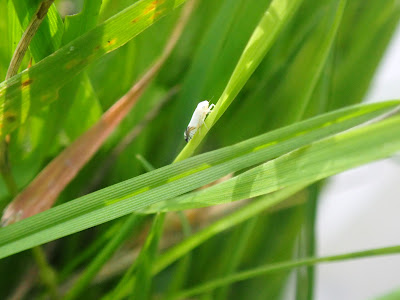
The Nationally scarce a weevil that feeds on Dark Mullein, Cionus nigritarsis, was a long overdue lifer too.
And a striking cranefly swept from the woods (with yellow wings and legs) turned out to be the Nationally notable Tipula livida. Here is the female's paraphernalia under the microscope.
Other highlights included Woodland Grasshopper (Nationally Scarce).
And Attactagenus plumbeus, a Nb weevil I see on acid-grassland occasionally.
This was taken earlier in the year, but the much smaller spiderlings of Alopecosa cuneata are still field identifiable now and are much more widespread. Another benefit to learning the early stages of species.
Probably the rarest thing though was a species I had new to Sussex at the neighbouring farm in 2020 (c500 m away from this record). The pRDB1 Scythris potentillella (no photo I am afraid). Scythris are small micro moths that I encounter (possibly more than any moth-er in Sussex does) by using my suction sampler, which is a great way to record this whole genus - almost all of which are classed as scarce or rarer. This one feeds on Sheep's Sorrel. Targeting Sheep's Sorrel for Dalman's Leatherbug is therefore the way to find this rare moth (as on both occasions, that's what I was looking for). I also found the Nationally Rare rhopalid bug Rhoaplus rufus.
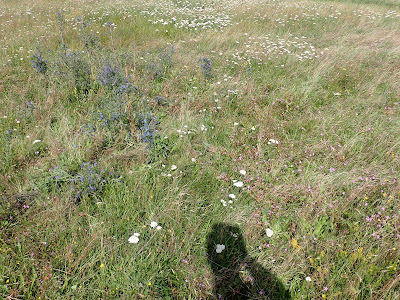
I run the day's data through Pantheon (the Biological Record Centre's online database for analysing lists of invertebrates) and the SQI (a measure of site quality based on the proportion and weighting of the rarities present) came out at 137, this is really high for one of my surveys (my average is 123.9). The true SQI is likely to drop a little when the the three dates are combined but this was a really interesting exercise. A total of 32 species for the day (at least 50 for the whole survey) is quite remarkable. My average for all surveys (ranging from three to six days - not just one visit!) is 34.5 species with status. Showing this has both quantity and quality. Here is the sward in August, full of nectar and rare invertebrates.
We discussed habitat management at length and it's great that many of the changes required to make this site even better are tweaks rather than radical changes in direction. This is an important, low nutrient, low pH site, with an invertebrate assemblage closer to a nature reserve than a farm and I am glad it's in safe hands. I can't wait to go back in a few years and see how it has changed! Now, here is the entire species list, starting with the field identifications. Species with status highlight in bold and conservation statuses in brackets are thought to be out of date. NS = Nationally Scarce, NR = Nationally Rare, Nb = Nationally scarce b, Na = Nationally scarce a, NT = Near Threatened, S.41 = Section 41, Nn = Nationally notable, etc.
And then a further 69 species identified at the microscope, which I fast-tracked so I could write this blog.


 Posts