An Alternative Natural History of Sussex.
This blog shows the highlights of my day to day findings as a naturalist and ecologist living and working in Sussex. Delivered with a pinch of nihilism, a dash of sarcasm and absolutely no tweeness, here is my attempt to show natural history as it really is: Brutal, beautiful, uncompromising and fascinating...and occasionally ridiculous.
I have been studying natural history for some thirty years, nineteen in a professional capacity. I currently work in Sussex as a freelance entomologist, ecologist and botanist and specialise in nature reserve and rewilding management advice based on the interpretation of the surveys I carry out. I also run a number of identification courses. An advocate of the pan-species listing approach. My main areas of interest are birds, plants and invertebrates and a lot of my spare time is spent in the field. I am the county recorder for spiders and bugs.
I decided to purge my cold and spent the whole day spidering yesterday and feel much better for it. I got THREE county firsts for my efforts (all under 2mm, all with the suction sampler) too so was pretty pleased, and five new spiders for the year ending the day on 315 species.
First, quick recap on the spider year listing. It all got a bit much for me from July onward with work. Too busy surveying spiders to actually find spiders. I know this sounds crazy but it's true. Now I have some more free time I can get out and go where I like. Also, from July onward, I find spidering really dull until about now. The game is back on. So where are we? I make no apologies if you haven't seen any Marvel movies and that some of what I am about to say will appear as gibberish...
Captain Devon. Matt's reached the 340s. People think that's a shield, it's actually a tray for sieving spiders. A prototype for the more successful Captain America, he lost interest in fighting and started hanging around cobwebs. They had to let him go.
Thive. I'm like Thor but one better. Attracts rain instead of lightning. If I put my hand out, my suction sampler flies into it no matter where it is (keeps smashing my car boot window though so easier just to open my boot now and not use my powers). Can't distinguish between 'th' and 'f'. On 315.
Theridiron Man. Tylan's on 178. Catchphrase: "Has anyone seen my Potts?" Actually has Cryptachea blablabla living inside his suit.
Fanos. Not actually playing along but some bloke Captain Devon knows was somehow beating us all even by early summer, despite not actually year listing spiders. Currently on somewhere between more than me and a 1000. It definitely has something to do with infinity stones.
As a group, we have seen at least 60% of the UK's fauna, probably two thirds by now.
Anyway, the whole point of this tenuous analogy? It's the last three months of the year and we are moving into a different chapter, the endgame. Time is running out for lots of big spiders, new opportunities opening up for linys. Can I comeback from this far behind now?!
So yesterday, I headed for West Sussex. Called in at Burton Pond where I hadn't seen yet Larinioides sclopetarius for the year! Not actually a hugely common spider in Sussex.
I had a dig around in New Piece and picked up Scotina celans new to the site and Mermessus trilobatus (new to West Sussex from the suction sampler). Both these were on my year list though. I did remember that the edge of the pond is good for Tetragnatha striata. One sweep of the pond edge produced about half a dozen of the distinctive immatures. Really different to the other members of the genus, none of which I would feel comfortable identifying from immatures. In ten years I have only seen this spider here and on one site in the Pevensey Levels.
I suction sampled a couple of old Tussock-sedges and got a funny looking bug. This is a county first for both counties, Ceratocombus coleoptratus. Really odd hairy antennae and a long hairy 'Roman nose'.
Then to Stedham Common. Where I picked up some nice things that I had already seen this year such as loads of adult male Alopecosa barbipes. Note the Marsh Clubmoss in the background!
Then I found Fanos had dropped the Reality Stone! On closer inspection it was actually Cercidia prominens. This was one of the first spiders I recorded in 2019.
I spent the rest of the afternoon suction sampling. I managed to get FOUR new spiders for Iping and Stedham, making the site list 220 with exactly 25% of these having conservation status. Firmly cementing the site as the best spider site in Sussex in terms of species and rarity, that's 55 species with cons status! Amazingly, Mermessus trilobatus was one. The rarest was Meioneta mollis from Stedham (a Nationally Rare species). Also new for me and both counties was the tiny Araeoncus humilis below. I'm quite surprised that this hasn't been picked up before. I like that this has been given the English name 'Modest Forehead'. Also new for the year was Centromerita concinna, the first site record since 1968.
I found a huge patch of Sphagnum magellenicum or Sphagnum medium as Brad tells me its now called. Actually quite gutted about that name 'change'. It's a strikingly beautiful moss. Here it is with an adult female Trochosa terricola.
And my fith and final new spider of the day was Segestria florentina at the only site I have ever seen it, the middle of Chichester! It's still really uncommon down here with only three 10 km squares. I have had more records for Zoropsis in iRecord than this. I didn't however manage a photo, as I was racing against time to see one against the parking ticket.
So, I am definitely back in the game. Next up, I need to find Araneus marmoreus, another scarce species in Sussex.
UPDATE: I found Araneus marmoreus before finishing writing this blog! I was about to give up but found this adult female at Woods Mill after the fungi workshop! That's 316. I have worked at Woods Mill for 12 years and this is the first I have seen in Sussex outside of the Ashdown Forest, well done to Ryan for finding a pair there a couple of years ago.
Yesterday was an epic day! I did visit 4 of the Iping and Stedham invertebrate survey. I picked up some 50 species in the first 30 minutes and this included some great charismatic species such as Woodland Grasshopper, Bee-wolf, Heather Shieldbug, Alydus calcaratus, Phytocoris insignis, Thomisus onistus, Vespula rufa, Mottled Grasshopper, Araneus sturmi (the 208th spider recorded there), Xysticus kochi (the 209th spider recorded there), Pilophorus clavatus (the first West Sussex record since 1997, my first and the first on an SWT reserve), Hydroporus melanarius (new to me and all SWT reserves) etc etc...and that was just on Stedham.
However, when we returned to a different area of Stedham later in the day with our Conservation Committee, I got rather excited when we stood in a purpose-made scrape looking for Marsh Club-moss. A tiny plume was barely visible in the vegetation. Having seen Sundew Plume before at Graffham Common last year, I know how easy it is to lose sight of one. So when I yelled "NOBODY MOVE" I was pleased to see that everyone ignored me and pounced on the moth! I managed to miss it with my net, only to find I had caught it all along and there were actually two individuals present! So all the Sundew Plumes recorded in Sussex in the last 20 years have been recorded on SWT reserves in areas that are actively managed! This shows how important early-successional habitat management is. This species couldn't survive without this long term. Grazing alone just wouldn't be enough to keep the M16 and sundews going.
I mentioned the Heather Shieldbug above. This is a real oddity. I have swept and swept and swept Heather at Iping and Stedham over the last ten years and I have never seen it before there (it was last recorded there in 2015 but not by me). Going through my database I have only two records for this species. Once sieved from Sphagnum at Burton Pond and the other sieved from a pile of birch brash in mid winter at Selwyns Wood in 2015. So this is the first I have swept one from Heather. However, even that isn't strictly true. The bug was clearly dead, it seems I swept it from a spider's web no doubt suspended between two Heather stems. I wonder why this bug is so hard to find? Could it be nocturnal? Any ideas?
I had a moth new to Iping, myself and the reserve network too, the sooty-black pyralid Matilella fusca. Mike Edwards suggested I try looking on flowering Dodder for weevils and just by tapping one clump I dislodged a Thomisus onistus and a Smicronyx jungermanniae (my fourth new species for the day but know to the site). Whatever next?! Man, I love Sussex.
Yesterday I ran a new course for the Trust entitled 'Invertebrates of a Heathland'. The idea was to show the participants how to find and identify some of the many species of invertebrate that thrive in this habitat. So where better to run it than at our third most speciose site and arguably the richest heathland in Sussex than Iping & Stedham Commons?
It was a good group with 11 in attendance including staff from Sussex Wildlife Trust, Surrey Wildlife Trust, Species Recovery Trust, National Trust and Thames Basin Heaths Partnership. My approach was to get them to get their hand's dirty, so nets and pots were handed out and id didn't take long until we built up quite an impressive list. I have included below the whole list as promised to the course attendees with some notes on the species they saw. 'N' is new to the site (14 in all), 'NN' is new to the site AND the reserve network (amazingly there were three of these!) and GL was new to me. I had four new species taking me into 7th places on the PSL rankings.
Taxon group
Species
Status
beetle
7-spot Ladybird
beetle
Cream-streaked Ladybird
beetle
Exapion ulicis
beetle
Heather Beetle
beetle
Heather Ladybird
beetle
Micrelus ericae
beetle
Neliocarus sus
beetle
Paradromius linearis
beetle
Pine Ladybird
beetle
Poecilus cupreus
beetle
Protopirapion atratulum
N
beetle
Silpha atrata
N
beetle
Sitona lineatus
beetle
Sphaeriestes castaneus
NN
beetle
Striped Ladybird
beetle
Welsh Chafer
butterfly
Gatekeeper
butterfly
Red Admiral
butterfly
Small Tortoiseshell
N
butterfly
Speckled Wood
centipede
Lithobius forficatus
N
centipede
Lithobius variegatus
N
crustacean
Porcellio scaber
dragonfly
Azure Damselfly
dragonfly
Black Darter
dragonfly
Emperor Dragonfly
earwig
Common Earwig
harvestman
Paroligolophus agrestis
N
harvestman
Phalangium opilio
hymenopteran
Ammophila pubescens
hymenopteran
Apis mellifera
hymenopteran
Bombus lapidarius
N
hymenopteran
Bombus pascuorum
hymenopteran
Bombus terrestris
hymenopteran
Cerceris arenaria
hymenopteran
Colletes hederae
N
hymenopteran
Epeolus cruciger
GL
hymenopteran
Formica fusca
hymenopteran
Formica rufa
hymenopteran
Formica sanguinea
hymenopteran
Neodiprion sertifer
NN, GL
hymenopteran
Nomada rufipes
hymenopteran
Philanthus triangulum
lacewing
Chrysoperla carnea group
moth
Angle Shades
moth
Beautiful Yellow Underwing
moth
Eupoecilia angustana
N
moth
Fox Moth
moth
Horse-Chestnut Leaf-miner
moth
Large Yellow Underwing
moth
Lesser Yellow Underwing
moth
Rush Veneer
moth
Setaceous Hebrew Character
orthopteran
Bog Bush-cricket
orthopteran
Common Ground-hopper
orthopteran
Long-winged Cone-head
orthopteran
Meadow Grasshopper
orthopteran
Mottled Grasshopper
orthopteran
Roesel's Bush-cricket
orthopteran
Speckled Bush-cricket
spider
Agalenatea redii
spider
Anelosimus vittatus
spider
Araneus diadematus
spider
Araneus quadratus
spider
Arctosa perita
spider
Argiope bruennichi
spider
Evarcha arcuata
spider
Evarcha falcata
spider
Gibbaranea gibbosa
spider
Hypsosinga albovittata
spider
Labyrinth Spider
spider
Linyphia triangularis
spider
Mangora acalypha
spider
Metellina segmentata
spider
Philodromus histrio
spider
Pisaura mirabilis
spider
Simitidion simile
spider
Theridion sisyphium
spider
Thomisus onustus
spider
Trochosa terricola
spider
Xerolycosa nemoralis
spider
Zygiella atrica
true bug
Birch Shieldbug
true bug
Drymus sylvaticus
true bug
Gastrodes grossipes
true bug
Heath Assasin Bug
true bug
Hairy Shieldbug
true bug
Himacerus apterus
true bug
Kleidocerys resedae
true bug
Macrodema micropterum
true bug
Nabis ericetorum
true bug
Neophilaenus lineatus
N
true bug
Orthotylus ericetorum
true bug
Phytocoris insignis
NN, GL
true bug
Pilophorus cinnamopterus
true bug
Rhyparochromus pini
true bug
Scolopostethus decoratus
true bug
Stenodema calcarata
true bug
Tortoise Bug
true bug
Ulopa reticulata
true fly
Chrysotoxum festivum
true fly
Dasysyrphus tricinctus
N
true fly
Episyrphus balteatus
true fly
Hornet robberfly
true fly
Machimus atricapillus
The most exciting find for me was Phytocoris insignis. This rare heathland species that looks like a small and dark Phytocoris varipes was swept from Heather on Stedham. It's only the second Sussex site for this RDB3 species.
But the stars of the show were the Hornet Robber Fly and Thomisus onsitus. Hornet Robber Fly because it was new to all the attendees and was the biggest one I had ever seen. What a beauty! Thomisus onistus because one of the attendees stated at the beginning how much they wanted to see this strange spider. I instructed that it was best to sweep Bell Heather and after some furious sweeping, she turned up the only one!
Bee Wolf was EVERYWHERE!
And Epeolus cruciger was a new one for me. It's hard to believe this is a bee!
Spiders came in at 22 species, with the stonking Philodromus histrio a real favourite.
Another attendee found Ivy Bee new to the site too. So it was really great to not only give people some guidance but also to show that they can directly contribute to the recording of such well recorded sites. Of the 105 species mentioned above, 14 were new to the site! This really surprised me and some of them seem like they might be errors on my part when I put the master spreadsheet together (Small Tortoiseshell and Bombus lapidarius particularly). The reserve network now boasts records of some 9908 species and 2781 of these have been recorded at Iping & Stedham. We didn't add any new spiders though, it's really tough going to find a new spider for this site. No Heath Tiger Beetles but we were cut short on that one by a monster of a storm. It was a great atmosphere and I would definitely run this kind of course again.
A few weeks back, I suddenly remembered we had had an outbreak of Sudden Oak Death Phytophthora ramorum on Rhododendron at Stedham and this was not a species that we had on the spreadsheet. I was just checking the spelling on the NBN when I discovered the team who described the species...
Werres, De Cock & Man in 't Veld
Cue the childish giggling. I'm just really glad they were in this order. There are six permutations of three names, so there is only a 16.7% chance that this arrangement was down to coincidence. I therefore conclude it's much more likely that this team intentionally put their names in this sequence just for the Hell of it than not!
There can be only one specimen that is a county first. I wasn't expecting this at Levin Down yesterday! Platyrhinus resinosus (Nb) new to West Sussex! Would you believe it but there is only one record for this species in Sussex being in East Sussex. It is associated with King Alfred's Cakes but is very rare in the county compared to Platystomos albinus (which I saw at Levin two weeks ago). North, east and west of Sussex and it seems fairly frequent. Anyway, found two yesterday on some felled Ash at Levin Down. I've only seen this once before in Berkshire and the individual shot into a hole faster than I could get my camera out. So I was very glad to see a big, bright and cooperative one in Sussex during a survey on one of our reserves.
A LONG time ago, Scotty Dodd described this beetle to me as looking like the Kurgan from Highlander. That image stuck. I've waited a long time to write this blog...
If you're not convinced, maybe the soundtrack will get you more in the mood...it goes a bit weird after two minutes, think that was edited from the movie.
Anyway, here are some more shots of this awesome creature.
Underneath, it's a much more convincing bird-dropping mimic! It has a habit of tucking its legs and rolling away. Very cool indeed. So despite rather changeable weather yesterday, We recorded nearly 90 species in the field with many more specimens that require microscopic identification, that's going to be today's job. Ollie Sayers came out with me and had a great day learning where to find invertebrates and soon found something quite uncommon in the form of Oedemera femoralis (Nb). A good day for saproxylics on a chalk-grassland site. It gets better though. Under some very dull looking brackets (Turkey-tail and Hairy Curtain Crust) on stumps of recently removed scrub I found four of these.
This is Tritoma bipustulata (Na) and possibly the first records in Sussex for 30 years. I think it's only been recorded at Stedham Common and Arundel Park and considering how much saproxylic work we have done in this part of the world, I doubt very much we have overlooked it. The field season has already started with a bang for me but you know what they say:
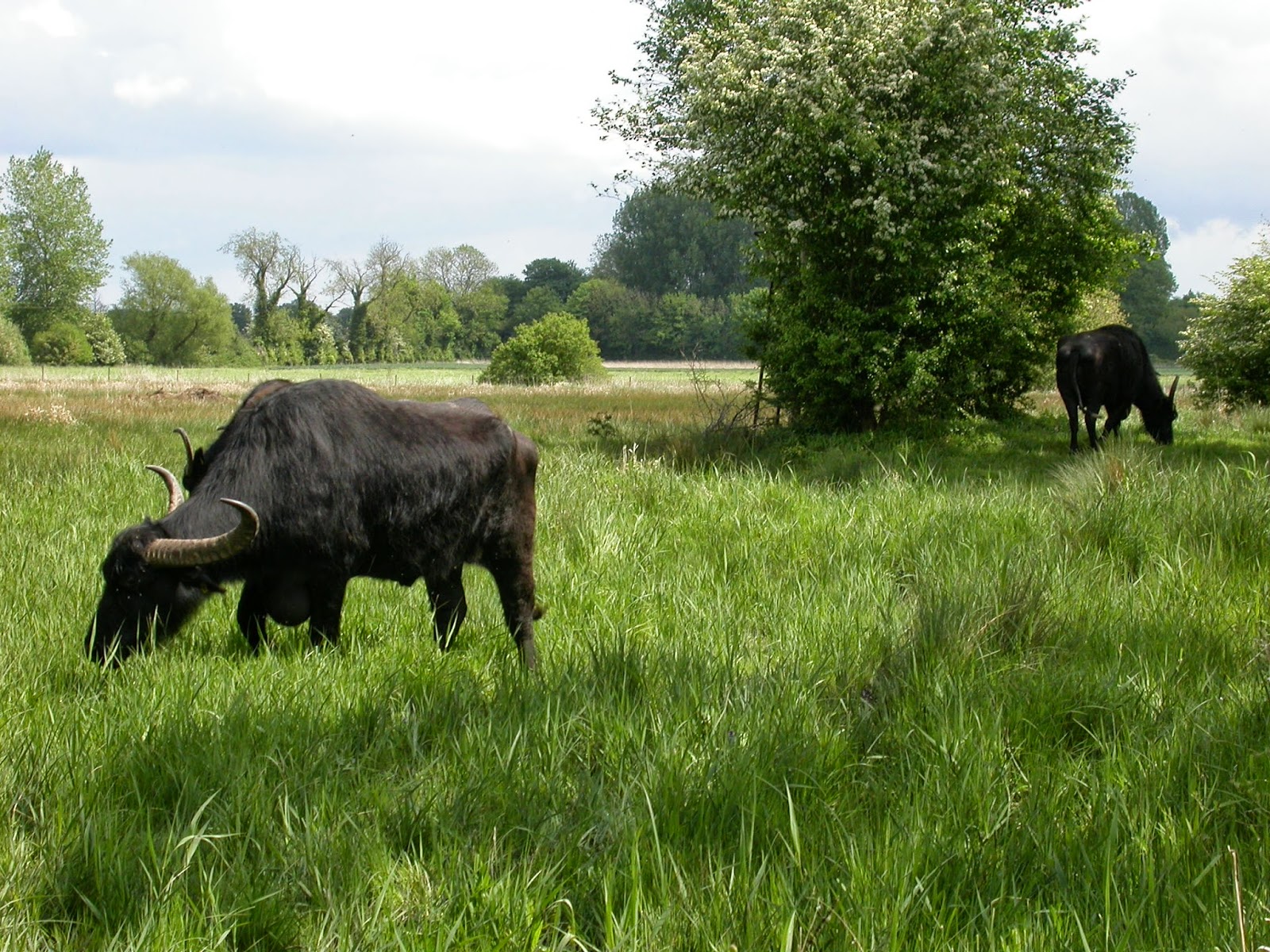
I've been to Chippenham Fen today in Cambridge to look at the effects that Water Buffalo have had on the fen there over the last decade or so. I was really impressed at how at home they seemed and you can really see the accumulative effect of their grazing in the following photo. The left side has been left ungrazed while the right hand side gets a short amount of light summer grazing. The difference is striking, the left has dense Saw-sedge and lots of hung up litter but very little structural variety, the right has very little Saw-sedge (amazingly they seem to preferentially graze this) but a much more varied sward structurally and botanically. The right hand area is a hot spot for the Silver Barred moth (I was too early) while the left hand side has many rare spiders in the litter. Both communities are catered for by this sort of management.
In this area, tussocks of Black Bog-rush with Cambridge Milk-parsley have done very well with the grazing regime. In this area I found the very smart Na beetle Cerapheles terminatus.
I did manage a small amount of sieving, and in the first sieve we found several Hygrolycosa rubrofasciata (a stunning Na wolf spider I found new to Sussex at Stedham in 2012) and most excitingly, a couple of immature Marpissa radiata, a Nb species which is also a specialist of this area!
I was pleased to see my Silver-studded Blue butterfly photo in the excellent journal British Wildlife today. Robin Crane has written an article on the South Downs National Park which I will be reading right about now. It's great that the Sussex Wildlife Trust reserves are getting a big mention and that lots of other friends have photos in there too!
There is something quite disturbing about the flowers of Henbane. The purple veins remind me of films such as the Exorcist, Evil Dead and Event Horizon. It's a botanical zombie and it's not really a surprise that it's poisonous and smells so foul. I saw lots on a farm survey which was a surprise. There are more comparisons to a black hole beyond just the film Event Horizon, as the gaping black pit at the bottom of the corolla reflects no light at all. Speaking of points of no return, I have just hit 3500. I'm past the halfway mark now and feel like I cannot possibly give up. So, what was species 3500? I'm afraid it was quite dull. Spear-leaved Willowherb, photographed in an incredible thunderstorm and the only shot that came out OK was of a leaf (blunt tip and presence of a stalk are clinchers). I had read that it grew around the village of Stedham and I found one within about 10 minutes.
I then called in briefly to Graffham to look for Green-flowered Helleborine. Pretty sure this is one, there were two growing next to a Broad-leaved Helleborine so I could see the differences, the bracts were much longer on Green-flowered but I will go back in a week or so to confirm. The light was bad and the rain was coming down so the photo is pretty poor. Just as I was leaving I looked up and saw Spear-leaved Willowherb! I must have got my eye in.


 Posts
Posts