An Alternative Natural History of Sussex.
This blog shows the highlights of my day to day findings as a naturalist and ecologist living and working in Sussex. Delivered with a pinch of nihilism, a dash of sarcasm and absolutely no tweeness, here is my attempt to show natural history as it really is: Brutal, beautiful, uncompromising and fascinating...and occasionally ridiculous.
I have been studying natural history for some thirty years, nineteen in a professional capacity. I currently work in Sussex as a freelance entomologist, ecologist and botanist and specialise in nature reserve and rewilding management advice based on the interpretation of the surveys I carry out. I also run a number of identification courses. An advocate of the pan-species listing approach. My main areas of interest are birds, plants and invertebrates and a lot of my spare time is spent in the field. I am the county recorder for spiders and bugs.
But unless you're a moth larva, moth pupa or a False Truffle (and you might well be yet) you're probably OK. Either way, I am hoping that a shameless blog title like this will get lots of hits and shares.
Before the TV show, before even the computer game, I have been onsessed with this weird group of fungi. I have seen four of the fungi that are generally referred to as Cordyceps but three of these are actually in two different genera now (Tolypocladium and Ophiocrodyceps - this latter was specifically referred to in The Last of Us though).
Anyway, here are the four species I have seen in Sussex and Surrey, in order of how frequent they are on the NBN.
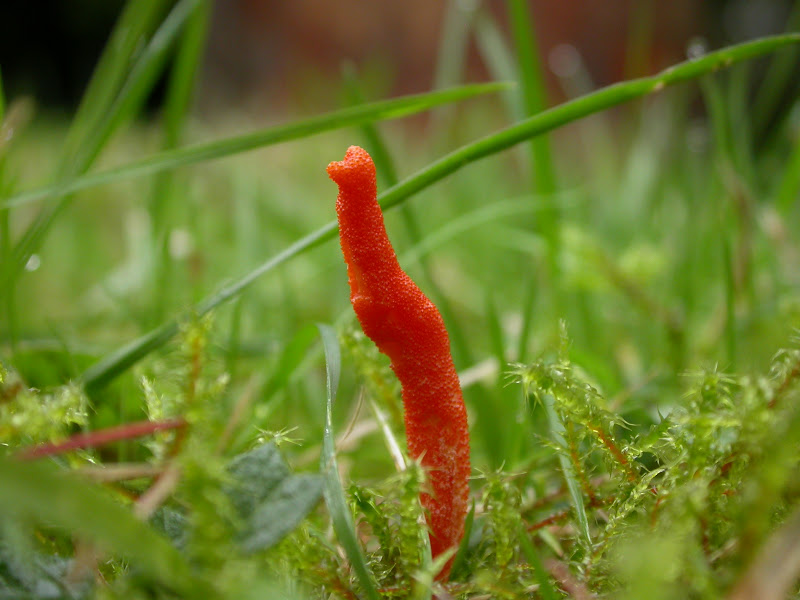
Scarlet Caterpillarclub (Cordyceps militaris)
Who doesn't love Nice 'n Spicy Nik Naks? This one parisitises moth pupae underground, bursting right out of the poor sods with these bizarre orange-red fruiting bodies. Ebernoe Churchyard is a great place to see them. I have also seen them in Brookwood Cemetery and Kent & Sussex Cemetery but that's about it.
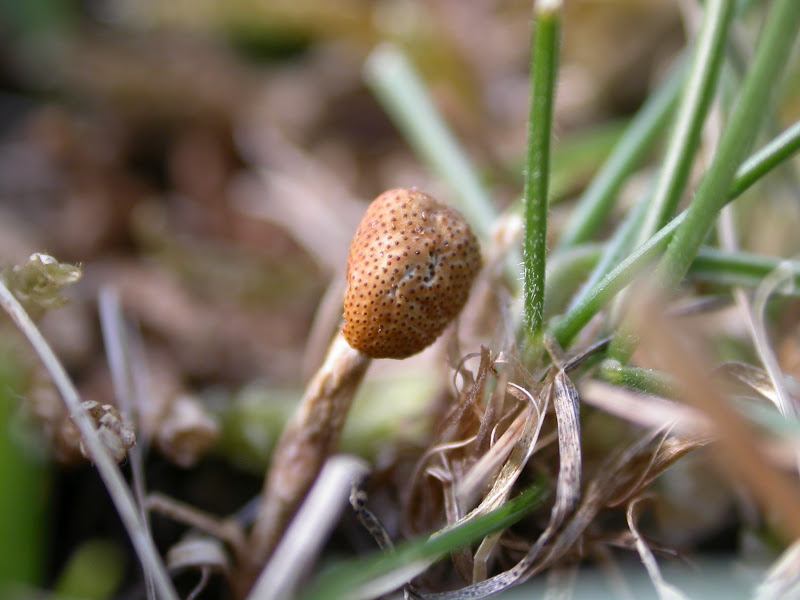
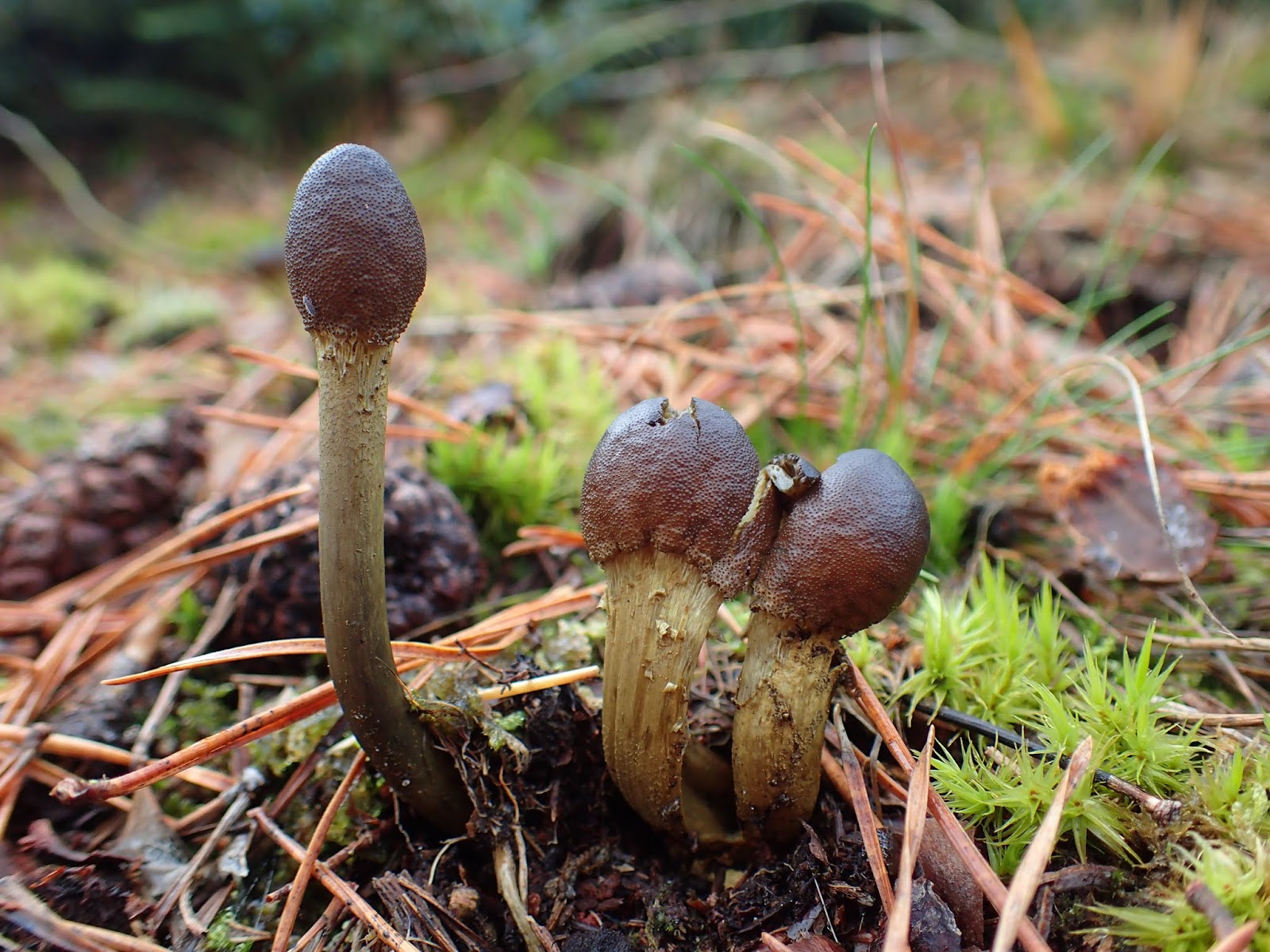
This is one of the ones that parisitises False Truffles, rather than insects. I have only seen it once, at Brookwood Cemetery. Such a great English name!
Ophiocordyceps gracilis
This one parisitises moth larva, I think I read maybe even specifically the Common Swift, which feeds underground at the roots of various plants. I was shown this one several years back in 2012 at Mill. We stumbled on another in 2017 at Levin Down and then I found one in chalky secondary woodland at the back of Brighton in 2020. I have only ever found one at a time and never in the same place twice.
Drumstick Truffleclub (Tolypocladium capitatum)
The other species that targets False Truffles. Probably my favourite of the four, because I stumbled on this one myself at Graffham Common a few years back while looking for spiders. They look like cartoon matchsticks.
There are some other species, I believe. But I am yet to see them. Would love to see photos of other UK species if anyone has them, especially if the host is known.
So, I don't think we are quite at the stage where these fungi are going to start infecting Human brains but it's nice to see just how close to home the very real nature that inspired the computer game and the excellent TV adaption came from.
Do you remember Nice 'N' Spicy Nik Naks? That's exactly what these little fungi reminded me of. I had a great day at Ebernoe with Jennie looking for fungi. Scarlet Caterpillar Club Cordyceps militaris was one of the target species and there were loads in the churchyard, I walked right past them! On the end of each of these, burried underground, will be a moth pupa (not larva like the different species of Cordyceps from Mill Hill). I'm not sure if this one is host specific or a generalist on moths that burry themselves underground when they pupate. I imagine Large Yellow Underwing would be a good host but many species of noctuid could be candidates. Some of the fungi go a bit wrong and develop some strange protuberances.
Considering the rain, numbers of fungi were very low and we didn't see much else beyond the usual Saffron-drop Bonnets and Garlic Parachutes. I saw this Lapidary Snail on the Brick Kiln, only the second time I have seen this strongly-keeled snail and we also stumbled across the BIGGEST Wild Service Tree I have seen (measurements to follow). I can also recommend the venison at the Stag Inn at Balls Cross. Back to Ebernoe today for work. It's a hard life!
Well, if you're the Belladonna Flea BeetleEpitrix atropae that is. This is the characteristic feeding damage of this tiny little flea beetle that I only spotted yesterday because Dave Green asked what the plant was. I also have Dave and Penny to thank for the inspiration to take this shot with the Sun in the back ground.
Dave and Penny also showed this little moth larvae, feeding away in the old seed heads of Carline Thistle. This is Metzneria aestivella.
And of course, the rare and beautiful Pancalia schwarzella is everywhere up there right now.
With your feet in the air and your head on the ground
Try this trick and spin it, yeah
Your head will collapse
But there's nothing in it
And you'll ask yourself
Where is my mind?
Where is my mind?
Where is my mind?'
Thanks to Jake Everitt for finding this Caterpillar FungusCordyceps gracilis at Mill Hill this weekend. I headed up there with Dave and Penny and sadly, my bad back tagged along too. I thought I had seen the back of it (see what I did there) but alas it appears that no amount of strengthening of my core muscles is enough to keep it at bay. It's not the disk this time though, just muscle spasm but it's very painful. The extra strong painkillers make me pretty spaced out and I can't drive with them.
Anyway, I saw the strange little fungus which was a tick for me. I found this short video from Planet Earth on YouTube which basically tells you about the genus Cordyceps. This species parisitizes Lepidoptera larvae, someone told me specifically Common Swift moth larvae, before sending the little fruiting body up out of the caterpillar's head to produce yet more of the spores. I had two more ticks at Mill Hill yesterday evening too but that will have to wait for another post...
I started the Butcherlands bird survey this morning and picked up my first Nightingales (three) and Cuckoo of the year. I didn't see much else other than this little micro moth at rest on a gate post. It's Semioscopis steinkellneriana. It's a smart little moth which looks a little bit like a small Hebrew Character, I have seen it before in some numbers when moth trapping at Mill Hill.
Mothing at Mill Hill last night was quite good despite being windy. We picked up half a dozen Barred Tooth-striped (I took the photo two years ago) in the time Oli and I were there. Other highlights included a roosting Grizzled Skipper, a Powdered Quaker and several of the rather stunning carabid, Carabus nemoralis. Nice to be out looking at the stars and it reminded that I must make time to do more astronomy with Oli this year.
On the way in to work this morning I saw a Red Kite flying over the Ditchling Road by the start of the 60 mph zone and there are two singing Nightingales currently at Woods Mill.
Here is a female Alopecosa barbipes. I saw a male at Southerham but couldn't get a photo. They look quite different but both sexes are really nice looking spiders. This shot was taken at Mill Hill last week. I have a thing for cryptically patterned invertebrates, even more than I do for glaucous plants and pied birds.
The little moths from Mill Hill have been confirmed by Tony Davis as the rare Pancalia schwarzella, the first records in Sussex since 1931, a great find. Seriously, there is no April fooling here. Although I did nearly scupper myself when I thought someone else was fooling me back in 2005. I was living in Stafford and I got a text saying there was a Belted Kingfisher within four miles of my house at Milford near Stafford. I was moving house so I couldn't check on the Internet. I waited four hours before I finally got on line and on the off chance that he wasn't joking, I checked BirdGuides. It was of course, true and fortunatly I did manage to see the bird. It was nearly the biggest dip of all time.
Anyway, here is the break down of my pan-species list. It currently stands at 3190, up 118 from 3072 at the end of January, edging ever closer to 3200. I have not updated like this for two months so some lists have gone up quite a bit in that time (I have added 50 beetles!).
I went back to Mill Hill after work to look for a specimen of what I think is Scarce Violet CosmetPancalia schwarzella (with permission from SDJC of course!). I thought I would count what proportion of the Pancalia were schwarzella types (i.e. c 7 mm long with no white patch on antennae - top photo). Interestingly I found 17 schwarzella types and only two that were definitely Violet CosmetPancalia leuwenhoekella (bottom photo - c 5.5 mm long with white patches). All the moths I saw fell easily and distinctively into one camp or the other. I will hopefully get some help with a dissection to confirm the ID. The alternative is that this is one species that is sexually dimorphic. There is only one very old record of schwarzella in Sussex.
However, I also found a nationally scarce carabid which was a new one to me and was a nice surprise. I recognised it in the field as being one of the species with unusual jaws (like pinball flippers). A couplet in the key I have never answered yes to, I have always wondered what these flat-faced beetles would look like. It had a very punctured pronotum and was 10 mm long. This is not the best photo but at least you can see what it is (the hole on the side of the pronotum is damage). It's Licinus depressus and is a Nb species adapted for eating snails and is found on chalk-grassland according to Luff.
So, worst case scenario I have got the ID on the moth wrong but I have still added two Nb species to my list. If I have it right, it's two Nbs and a pRDB2! Mill Hill is looking like a good place to stop on the way home from work.
1st April (no fooling) UPDATE: Tony Davis confirmed that the top moth is indeed the pRDB2 Pancalia schwarzella, the first records in Sussex since 1931. Penny Green and I are both really pleased to have rediscovered this species in Sussex!
There are more Hairy Violets in flower at Mill Hill than I think I have ever seen. As well as the violets, there were a few invertebrates there that are associated with them. I spotted a couple of tiny Violet Weevils Orobitis cyaneus which can roll themselves up to look just like a violet seed.
There was also a beautiful little orange and black micro moth that after some effort I finally managed to photograph. There were lots of them actually. I think it's Pancalia schwarzella and one of the food plants is Hairy Violet. It wasn't until later that we realised there were probably two species present, the other being Pancalia leuwenhoekella, with obvious white sections to the antennae, which also feeds on Hairy Violet. Both would be new ones for me. However, considering schwarzella is pRDB2 (both photos) and leuwenhoekella is Nb I will get a second opinion. Watch this space! The greatest lesson I learned today though was not to try to attempt Mill Hill without my walking boots, I very nearly ended up at the bottom several times.
I forgot my lunch today and so a trip to Henfield to get a sandwich from Truffles replaced my usual walk around Woods Mill. As I stepped out of the sandwich bar I spotted this Herald on the other side of the road next to a man waiting for the bus. This has got to be one of my favourite moths, I love the bright white dots and stripey legs. My first encounter of these was in caves in the Peak District, lots of them, along with loads of Tissues that I have only ever seen once in Sussex (at light at Mill Hill).
The moth trap is out at Woods Mill tonight for the first time this year, I can't wait! I can only liken moth-trapping to how Christmas morning felt when I was a kid! Of course, I will only be looking at micros and by-catch if I want to see something new at this time of year. Oh, the photo is with the Canon by the way.


 Posts