An Alternative Natural History of Sussex.
This blog shows the highlights of my day to day findings as a naturalist and ecologist living and working in Sussex. Delivered with a pinch of nihilism, a dash of sarcasm and absolutely no tweeness, here is my attempt to show natural history as it really is: Brutal, beautiful, uncompromising and fascinating...and occasionally ridiculous.
I have been studying natural history for some thirty years, nineteen in a professional capacity. I currently work in Sussex as a freelance entomologist, ecologist and botanist and specialise in nature reserve and rewilding management advice based on the interpretation of the surveys I carry out. I also run a number of identification courses. An advocate of the pan-species listing approach. My main areas of interest are birds, plants and invertebrates and a lot of my spare time is spent in the field. I am the county recorder for spiders and bugs.
Or as I initially called this blog post: Passive sampling vs. active sampling.
I am a big fan of moth-trapping, don't get me wrong. It's a great way of racking up vast numbers of records for a site in a short space of time without leaving the comfort of your home but just how valuable are these records? The moth trap we run at Southerham picks up lots of moths off the chalk but it also gets lots of moths from the nearby Lewes Brooks wetland that are definitely not breeding on site. There was even a Pine Hawk-moth recently and there is very little pine nearby.
When I am doing surveys of invertebrates, I treat moths like any other taxa. You never catch a 100 species in a day, no way near that, but the moths that you get are almost always species that are breeding on a site. In the last month Glenn and I have been carrying out a vegetation survey of Malling Down and I have been constantly distracted by moths during these surveys. Although this site is extremely well recorded, we have added quite a few rare and scarce species.
First is Mecyna flavalis. This pRDB3 species is known really only from Deep Dean in Sussex, I went there with Michael Blencowe to look for it eight years ago and have not seen it since. It occasionally turns up in moth traps but this is the first record in the field of a specimen away from Deep Dean. Frustratingly I did only see one, which is a lot less significant than two, but the habitat was exactly the same. Extremely tightly grazed south facing chalk-grassland. This moth was not here by mistake and I would expect we will see this moth here again soon.
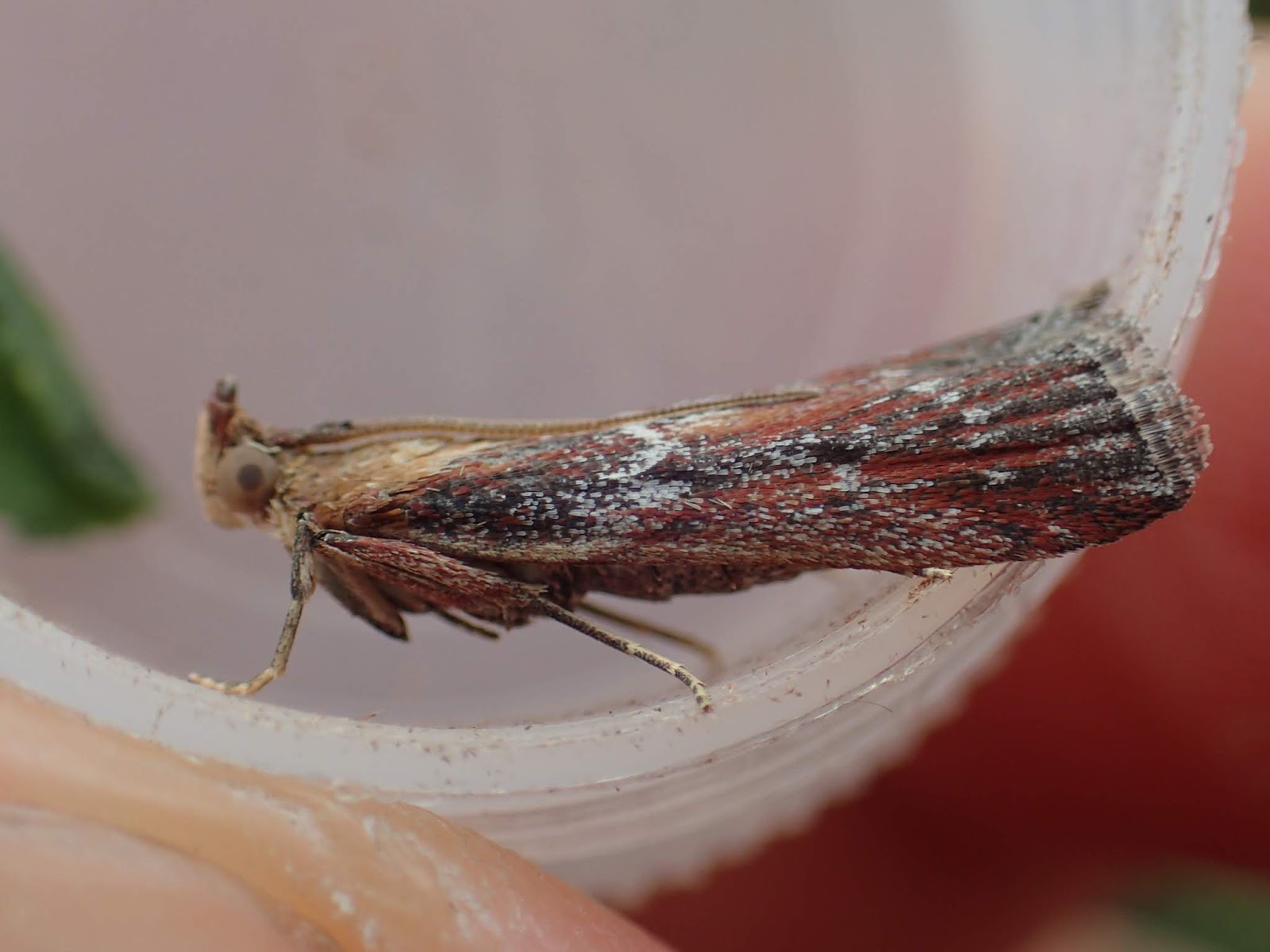
Yesterday we found the smart looking Moitrelia obductella (pRDB3). It would seem that this is the first record in Sussex that wasn't in a moth trap and it was also new to Malling Down.
Also yesterday were two Chalk Carpets (known from the site but I always get an eight-figure grid ref for these as they are on the real S41 list).
And the nationally scarce b Dingy White Plume which is common enough on the Downs where there is Marjoram, also new to the site.
Yet finding larvae in the field is even better. You're guaranteed it's breeding on site if you find larvae. Not rare but Glenn spotted this Small Elephant Hawk-moth in a plot last week, the first I have seen of this species. It really does look a bit like a Grass Snake! It lacks the spine at the back of Elephant Hawk-moth but also the eye spots are more detailed and a bit more like Peacock butterflies eye spots.
I would love to see more people finding larvae and adults in the field. And just so you know you don't need a trap to find rarities, here is a quick reminder of the Purple Marbled I found at Seaford Head a few weeks ago when I didn't even have my net to hand, just a tiny glass tube.
And out of county but last week I found a Vestal in a bog in the middle of nowhere.
And if you target a specific food plant for inverts that only eat that plant then you often turn up the goods. I beat a Crab Apple at asite in Surrey recently and this Argyresthia ivella came off it, the only time I have ever seen this Nb species. What was perhaps more unusual was the bare-footed man who appeared out of nowhere playing the theme tune to Lawrence of Arabia on a flute. I would like you to appear doing this whenever I get a lifer from now on please. It was magical.
And I got a lifer in my own house yesterday morning whilst brushing my teeth. I looked up next to my dried Hops to see a little pyralid I didn't recognise. I had the back door open the night before so it must have come in that way. Or so I thought. On closer inspection it was an Indian Meal Moth Plodia interpunctella (it was neither spicy or filling I should add. Om nom nom). An adventive species, I think I found it right next to its food plant. They must be eating my dried Hops! It's quite a smart little beast though.
So you don't need a moth trap to find rare and unusual moths, but they will probably be mainly micros!
Now Game of Thrones has all finished, you might need a new hobby. I suggest natural history as it's just as brutal, even more complicated and never ends with a disappointing conclusion. The chalk this year is feeling the spring drought, late and shy flowering. After a hard winter graze, the area we affectionately call the 'Bastard-toadflax area' has sprung to life. There is more Bastard-toadflax there than I have ever seen and masses of Chalk Milkwort too. It just goes to show that there are always winners and losers. I have for example, never had the fortune to photograph them both together like this.
But it doesn't have it easy. There were more Bastard-toadflax ShieldbugsCanthophorus impressus there than I have ever seen before, I saw five adults crawling around on the plants. You are lucky to see one!
Bugs have been doing reusable straws forever. Look at this video of one cleaning its rostrum after feasting on some Bastard-toadflax juice. They also drop very quickly once they have seen you and disappear, burrowing unto lose chalky-soil very quickly.
You shouldn't feel too sorry for the Bastard-toadflax, it's also hemiparisitic on other plants in the sward, It's a dog eat dog world out there! Or it's a Bastard-toadflax Bug eat Bastard-toadflax eat Chalk Milkwort world out there.
And like busses. On Saturday night I sucked up the first Small Plume in Sussex from a site in Eastbourne (I was looking for a spider with the suction sampler - you would be surprised how many moths you get in them). Yesterday I walked right up to one on a bank full of the foodplant, Mouse-ear Hawkweed. This a Nb species that until this week I had only ever seen in the Burren in Ireland. I wonder if it is having a good year? Has anyone else seen this moth this year?
Introduced species are the second greatest cause of extinction. So it was bittersweet to catch the first Boxworm for a Trust reserve today at Southerham, this seems to be one of the most rapidly expanding introduced species right now. There were lot of migrants too, such as the smaller Palpita vitrealis you can see next to it. I used to think this was a real rarity. There were two of those in the trap last night too. So this image really conveys how much our moth fauna has changed, and continues to change, through Human behaviour. I'd never heard of either of these moths 20 years ago.
Until today, I've only seen two Boxworms (in London) so I was pretty surprised to the melanic form, what an incredible moth. It has a purple sheen not unlike the Purple Emperor.
Probably the best migrant was a single Small Mottled Willow. I've only ever seen a handful of these.
There was also a Vestal.
A Delicate.
Several L-album Wainscot and White-points too. I guess you can't really call them migrants now being pretty well established.
More aliens though. On the wall of the office was the first Western Conifer Seedbug for Southerham. A species from the other side of the Atlantic originally, it's now very well established. As verifier for Sussex records of Heteroptera in iRecord, nine records have come in today alone across Sussex! There was only one other shieldbug record in the same batch. This has been the trend for the last four or five weeks. I'm amazed at how many people who's names I don't recognise are recording this bug. iRecord really is a great way of capturing these records. So it might be another invasive but it's another big, impressive, eye-catching beast so at least it's getting people recording wildlife.
Finally I was showing Alex some of these species in the fridge when I noticed a tiny piece of symmetry in amongst the mud on the floor of the kitchen Symmetry = invertebrates. It was only a lifer for me!!! Finally, a mouse spider! Scotophaeus blackwalli. Also a new record for any Trust reserve leaving us on 10,147 species. I wonder why I have not seen this synanthropic species until now. It is certainly not common in Sussex.
Yesterday I was mapping Bastard-toadflax at Southerham. I walked up to the first plant and there was the Bastard-toadflax (or Downs if you prefer) Shieldbug Canthophorus impressus. The next plant had these three TINY little Bastard-toadflax Shieldbug nymphs on. I then didn't see another individual all day. Now this little bug eats ONLY this restricted and nationally scarce plant that only grows in chalk-grassland. At Southerham it only grows in an area a few square metres in extent and within that, the bug has only ever been found on the steeper (and presumably hotter and more sheltered) area either side of the path. I have mapped the plant and the bug over the years but that's gonna take a while to generate. In the mean time, the following came to mind, so I am just gonna leave this here...
Many moons ago all the shieldbugs and squash bugs were eating any old thing and squabbling over who ate what. The oldest and wisest of all the bugs, Doc Squash, called a meeting and all the bugs mustered around the big table in the juice bar.
"This incessant fighting over what to eat must stop!" exclaimed Doc. "I propose we divide up the plants evenly between the bugs so that everyone can have their fair share. Now, I have decided to specialise in Rrrrrrumex. A delightfully abundant plant which means my offspring will never grow hungry. I might even have the odd bit of Rrrrrrhubarb for afters. Now some of you might want to generalise or pick a habitat to focus on. Or you might wish to specialise, like me, on a particularly common family or plant. So, with all that in mind, starting with you Dom the Downs Shieldbug, what do you think is a sensible thing for you to eat? Choose wisely mind"...
But I'm afraid you'll have to wait another day for part 2! It's been years since I've picked up a pencil, really enjoyed doing that!
Last night, Mark put the trap out at Southerham and we opened it this morning to find a single gravid Thyme Pug (Nb), the first in Sussex since 1925! A cracking little pug. Two nights earlier we recorded some other really nice moths such as the first Chalk Carpet (Nb & BAP) for the site and some really nice pyralids including THREE Moitrelia obductella (pRDB3 but expanding and in Sussex only ever known from the Lewes Downs but new to all SWT reserves) and a cool little Nephopterix angustella. Three of those were new for me, I'm edging ever closer to 7000. Only three to go.
What happened in my head when I spent too much time in the sun today
1925. The Last of the Time Pugs, while attempting to interfere with the birth of Margaret Thatcher, misses Lincolnshire and ends up in Sussex (she really did need the help of Space Pug to get that right but they were off-planet). She fought off an invasion by an intergalactic swarm of cybernetically-augmented parasitic wasps while she was there though.
Soon after the aliens had been thwarted, she received a distress signal from the distant future. The year 2018. A rogue band of Gigantic Humanoid Conservators have constructed a Mercurial Star Trap, capable of transfixing the minds of the innocent citizens of Earth and trapping them in silicone tubes where they are to be recorded and entered into a huge database, for all eternity!!! A scarce Chalk Carpet, hiding on the underside of the mega structure where the light cannot reach them, was able to get the distress signal out.
However she was too late, three Moitrelia obductella were already trapped in the sinister blue egg chambers within, zombified and awaiting incarceration. Look at their poor vacant eyes...
She jumped in the TARDIS (Thyme and Rosemary Drifting in Space). No sooner had the Time Pug appeared above the cruel device, she became transfixed by it too! And one particularly ugly giant captured her, placing her in the dark refrigeration unit! She had one chance to escape however. This particular beast was stupid and had a selfish urge to capture an image of the Time Pug for his own perverse reasons, outside of the holding device in a natural setting. Nearly 7000 innocent souls have been permanently captured in it's database. What a foul creature! Yet as soon as the vessel was opened, the Time Pug flew out, smiting the evil giant on the head with a mighty blow, before jumping in the TARDIS and heading off into the future.
That giant was me. I barely lived to tell this tale as some scales rubbed off on my forehead and now my left eyebrow is permanently stuck in in 1963.
But when will the Time Pug next make her next appearance I hear you say? Why not read one of her other adventures:
In the year 2023, the Last Time Pug defeats the Brexit Cannibals by bringing a can opener from the past to save the few remaining giants as they huddle around tins of dog food.
The year 2118, the Last Time Pug escapes from Prison Island One, formerly known as Great Britain. After the giants reject the world, the world rejects them and erects a fence around the whole island, leaving Automated Mechanical Demons to police the last survivors.
The year 2015. The Last Time Pug just kicks back and enjoys life.
I think I need a day out of the sun. Quite enjoyed those two moth traps though.
I've recently stumbled across quite a lot of good species whilst doing other things. Firstly, I noted this Field Mouse-ear while mapping Chalk Milkwort (below) at Southerham this week. It turned up on the site in 2016, a record came in via Dave Bangs when I did the review of the species list but I have never found it on the site, so I was pleased to find it there!
There is masses of Chalk Milkwort in this really rich area and more Adonis Blues than I have ever seen there before, all down to finally being able to fence out this compartment from the arable reversion and gain better control of the grazing. It's looking great!
When I was showing Steve the mouse-ear, he spotted something shiny in the short turf! We managed to get it, a Scarab Shieldbug! A new record for the site of this now Nationally Scarce species, despite a thorough survey with a suction sampler here a few year ago.
Then yesterday I was at Amberley Wildbrooks helping the RSPB with a CBC there. Right at the end I stumbled on a field with about 100 Narrow-leaved Water-dropwort or Sulphurwort (Near Threatened and Nationally Scarce) plants in! It's been a few years since this was recorded here. Being an early flowerer and growing in the field centres (not the ditches), it's not one we pick up on the ditch survey.
Best of all though was last week. Jane and I were finishing a bird survey when I noticed a plant on an area that we couldn't access some distance away. I thought it was Large Bittercress. A really uncommon plant and it would be a new record for the site. So I rested my elbow on Jane's shoulder and took this terrible photo through my binoculars. Never had to do this before!
Frances went and had a look and found another plant nearby and confirmed it and while she was there, found the first Subterranean Clover there in 40 years. These surprises at Waltham are a direct response to the better graze it has been having the last few years. Jane took this photo of the Large Bittercress. The moral of the story. Always have a GPS and a notebook with you, whatever you are doing. And recording to eight figures IS really useful despite what some people say. Eight figures can always be turned into six but you can't do that the other way around. Additionally, I'm very fond of mapping plants using the basic unit of a 10 x 10 m square (or to eight figures) on the British National Grid in GIS.
If you want to find invertebrates that specialise in feeding on only one plant, then it's a good idea to look at areas that have LOTS of that plant. So when I was out surveying ditch plants at Amberley Wildbrooks last week, I spotted a lot of Arrowhead in one ditch. Now this is the only place I have ever seen the scarce Donacia dentataand then only ever once. Try as I might I could not find any reed beetles on this particular patch of Arrowhead but I did notice these feeding signs. Now, is this likely to be Donacia dentata and if so, is it enough to make a record? 17/08/2017 UPDATE: Clive Turner via Facebook has confirmed this is the case.
Lots of Anthocomus rufus everywhere at the moment. Even had one on the office door at Southerham, a chalk-grassland site, far away from its wetland habitat!
Amberley has incredibly varied soil types, I was working on the more acidic areas last week. There the sandy ditch-slubbings are a brilliant home for Green Tiger Beetle burrows once consolidated, here at a greater density than I have ever seen before.
Some of the ditches here are looking AMAZING. really wide with a gently sloping shelf-like profile and a messy edge. Full of flowers and insects everywhere!
The one species that I had not seen before was this gall on Nettle caused by the fly Dasineura urticae. Also new to the entire reserve network.
Last Thursday night, Alice put the MV Skinner trap out at Southerham and we recorded 95 species of moth (229 moths in all)! Five of these species were new to me and four were new to ALL Sussex Wildlife Trust reserves. This is remarkable as we have now recorded 1240 species on the reserves. We only started trapping at Southerham last year so many of these 95 species will be new to the site. I'm afraid I was a little carried away with the scarcer micro moths so I am afraid I forgot to photograph the three hawk moths that we had in the trap!
First up is Ethmia dodecea which I originally wrote down as Ethmia terminella - we had two of these last week and this is much more likely feeding on Viper's Bugloss. Ethmia dodecea feeds on Common Gromwell which as far as I know is not present on Southerham and Malling Down. However with that crazy heat we had, moths were dispersing all over the place. I haven't seen this moth since about 2004 and I'm glad we now have it on our reserves.
Then we had this Crescent Plume which I have seen at Benfield Country Park where I saw a similar amount of moths many years ago. It feeds on Restharrow which IS just up the hill from the office.
This Hollyhock Seed Moth is nationally scarce (Nb) and feeds on various types of mallows. These are in nearby gardens and hedgerows.
And finally Piniphila bifasciana which feeds on pine! No pine near Southerham! But that photo was too awful to be published. What's the largest number of species you've ever had in a single unattended MV trap? I'd love to know what the record is too!


 Posts