I have had a break from social media for the last month. This was triggered by a period of feeling really unwell for a while, a trip to A&E after six hours of agonising stomach ache and nausea and a yellow eye (of course, I still went rock-pooling in the dark in gale in this state). I self-diagnosed gallstones and this was confirmed by an ultrasound at the hospital. A radical and rather rapid change in what and how I eat has been extremely successful but it was really scary at first. Every time I ate something it was like playing Russian roulette with my dinner. So the only way to play it was to eat the perfect diet. Not only have I not had a serious attack for nearly four weeks, but I actually feel healthier than I ever have! So I used that time to get my head down and write up a lot of reports.
So, back to 2025. This was a tough year to rank, there were so many red letter days last year. I love the pan-species listing approach to natural history, even 15 years into it (and 38 years since I made my first biological record) there are still countless encounters of amazing wildlife to see and record in the British Isles. So to celebrate that, with each of these ten I will also give a reason to get into pan-species listing. In reverse order then...
10). My first encounter with Eelgrass beds
Back in March, Mark Telfer took me to Seaview on the Isle of Wight where I saw my first Straight-nosed Pipefish! Also on that trip I found these things new to the Isle of Wight at Bembridge Ledges. Sarcodityon catenatum.
PSL pushes you outside your comfort zone into ever strange new worlds of natural history!
9). Surveying the farmland around Brighton
This is an ongoing project I am doing for BHCC. I found a population of Woolly Thistle, the first in Sussex for many years.
A population of Tettigometra virescens was new to Sussex! This is landscape is vitally important for biodiversity.
If you work anywhere hard enough and long enough with PSL, it will come up with the goods.
8). Completing pipefish on Helford Sound in Cornwall
I spent a great day with Finley Hutchinson down on some more Eelgrass beds just round the corner from Falmouth. Deep-snouted Pipefish was a highlight, as it was my sixth and final pipefish in the UK! Yet finding Acanthocardia paucicostata new to me (and Cornwall) was a real highlight!
Some of the best PSL days are when you don't have any targets and you just find what you find.
7). The arable margins of the Norfolk Estate
This might have been the sixth year I have monitored these same eight margins, but in 2025 they were rocket fuel for migrants and recent colonists. I love living on the south coast! The first confirmed breeding of Carporcoris purpureipennis in the UK was great and a lifer for me!
Yet I think finding my first ever Small Marbled was my highlight.PSL is all about the long game. PSL definitely works best the earlier you start and as such, you could play this game for your whole life!
6). My third trip to Jersey
Now, I have to say it's testament to the following five highlights that Jersey rockpools are not higher up this list! A huge thanks to Nicolas Jouault for showing us around the marine habitats of the island. He was so generous with his time and I learnt so much from him. I was so glad to be there when he found Discodoris rosi new to the island. This absolute unit is Dendrodoris limbata. In fact, 2025 was the year of the nudibranch for me. I have seen 35 species so far in my life, ALL of which I also saw in 2025.
The main PSL listing area is 'Britain, Ireland, Isle of Wight and Channel Islands' and it's important to state we are not a recording platform. PSL is something you do as well as recording, not instead of.
5). Praying Mantis on the Isle of Wight
Seeing these breeding Praying Mantis with Mark Telfer was an absolute dream come true, this is probably the only twitch I did last year! In a normal year this should been number 1!
That evening, Karen I went to Bembridge Ledges and found this mollusc new to the island! Galeomma turtoni.
No PSL twitch ever happens in a vacuum. Even if you do dip, there's always a plan B...
4). Oh gawd this is getting tough now! You know it's an insane year when Rainbow Sea Slug isn't even in the top three!
It was a dream come true seeing three Rainbow Sea Slugs down at Falmouth with a whole bunch of keen PSLers, rockpoolers and naturalists.
It would seem you can't go out rockpooling at Falmouth now without seeing Spurilla neopolitana now too! Insane considering it only turned up in September.
PSL is about collaboration and cooperation, we all help each other out. If you have focused on the competitive side, you have totally missed the point. There are no losers in this game.
3). Meeting a whole bunch of brilliant Gen Z naturalists at Menai (and their sea slugs)
Meeting Nathan, Yolanda, Cameron and friends under Menai bridge several times this year was amazing, as well as seeing loads of amazing nudibranchs they have given me hope for the future! They're already brilliant naturalists, I am glad they've caught the PSL bug too! Here is Trinchesia cuanensis.
And Coryphella lineata. Just a few of the amazing beasts they showed me!
PSL is a really sociable way to do natural history. Yes, you can do it on your own but it's more fun to share some of it at least, some of the time and I have made a lot of great friends along the way.
2). Two days snorkelling on The Ecrehous
Thanks to Nicolas Jouault again, I had an amazing two days snorkelling on the uninhabited islands between Jersey and France. Black-faced Blennies were the commonest fish!
And this bonkers looking crustacean, Axius stirhynchus was a real highlight. I couldn't get out of the water. Amazing considering not two years ago I was frightened of putting my face in the water!
PSL breakdowns barriers and encourages you to be fearless - whether tackling a new group or jumping face first into a rockpool!
1). Finding Aulonia albimana on the Isle of Wight with Mark Telfer
This was the first record of Aulonia albimana in the UK in 40 years! It was a very exciting day and led to me sitting on the sofa on BBC Breakfast. The story got amazing coverage, I did six interviews and I think something like 70 media outlets ran the story!
The morning after we found the spider, at 5.00 am I went down to Bembridge Ledges and found another new nudibranch for me, it was only the second record for the island! Trapania tartanella!
PSL is great fun, it's exciting, it opens doors. Literally anything can happen at any time. So why not sign up now? It's free and the 1st January is a great time to start something new.
A quick update on the book. Publication has been put back a little to the 26th February! Not long now, you can pre-order it here.
Now it's time to start my 2026 challenge, to see 6,000 species over the year! I have seen a Human so far, so I better get to work! Yo can follow my progress on the website, only 5,999 species to go. Happy listing!
Last year, I started monitoring the plants and invertebrates of a shingle translocation and creation project at Black Rock, Brighton carried out by Brighton & Hove City Council. Today, Karen and I were suction sampling an area having just found Pseudeuophrys lanigera (which I thought had to be obseleta but it wasn't). Buzzing off this high, Karen pointed to a jumping spider in the tray and asked "what's that?" There were three individuals in the tray from one suction sample. It was clearly a Heliophanus but not one I recognised. For a start, it had very obvious and striking black legs covered in white dots, as well as white-spotted black palps. I said it had to be Heliophanus auratus, a rare shingle species, as that was the only option (or so I thought). Which would have been a county first and a lifer. I was specifically suction-sampling the bases of large clumps of Yellow Horned-poppy. Here are some more shots of this incredible-looking little jumping spider.


I rushed home to look at one, only to find I had only collected females from two different areas but several were adult (actually, I didn't see any males). Two of these were hard to see as the epigynes were blocked but one was very clear. It was not auratus. I dissected the epigyne (below) and then it struck me - this must be a species new to the UK!!! I mean, it's obvious from just the general look of it. The palps aren't yellow for a start! I said at the time, the legs looked like nothing I had seen on a UK Heliophanus.

I jumped into the excellent website, Spiders of Europe (have a look
here for a relevant species account) and closed in on species that were present just over the Channel but not yet in the UK. There it was,
Heliophanus kochii. There is some more info
here that helped, which stated it's a species that likes warm places. Another species moving north due to climate change then and looking at the European distribution, it likes warm and dry places, rather than being a shingle/coastal specialist. So, expect this to be spreading through the UK soon.
The patterns on the abdomen & the cephalothorax, the palps, the legs and the epigyne, especially the ducts, all added up. As did the dense covering of hairs on the abdomen missing from the very rear behind the last two white spots. I rang Richard Gallon and he was in broad agreement it was this species after seeing the shots. Now it might be prudent to wait until we have run it passed a European spider expert before calling it but I have never been the most patient of people. So I am calling it as my first (well joint first with Karen) spider new to the UK and my 2nd UK first! What a result. It's also my 526th UK spider.
Here is the habitat shot from the first encounter. One area of shingle created several years ago just west of the sauna place (I assume by the Council) but we found three more in area B (including an adult female) that was definitely created by the Council about 100 m behind where this photo was taken.
Now, any questions along the likes of "is it dangerous?" can get in the sea. It's about 5mm long maximum and is about as dangerous as our other 40 or so jumping spiders. It mostly likely ballooned across the Channel and colonised naturally, given the location. How cool is that? Very happy indeed to have found this.
Last weekend was City Nature Challenge. It's hosted in iNaturalist. I am not a fan of this platform for many reasons that I won't go into here (I wish it was in iRecord) but I do like the challenge. So I have took part by sending my records in as casual observations (without photos that is - it's ludicrous to think I could take photos of even a fraction of what I record without completely wrecking the methodology). This way, they don't actually find their way back to the Sussex Biodiversity Record Centre, they get there directly from me in the same way as all my other data. Here is the current leader board for 2023, at the time of writing my records are not on there but they will be soon and I will update this blog when they are and the challenge is over for the year.
Some 23 'cities' in England are taking part. For the last two years Brighton has come top for the total number of species, and I have been pleased to play a big part in this. This year, I had more time free to do some recording for fun (not just using records from work). I recorded constantly for about 3.5 of the 4 days. You do get a bit of time to do the dets too, which are just finished. So my stats come out at 2801 records of 1014 species. This includes 570 invertebrates, 303 plants and 77 birds.
Day 1. A quick walk around BHASVIC Field with Karen first thing and then I headed to Woods Mill but it was sodden, so I just wandered around doing plants, bryophytes, molluscs and birds. I managed to refind Pepper-saxifrage in the valley field and saw a Cuckoo. Then I headed to Wiggonholt Common RSPB and things got really interesting. I targeted this site as one of the only significant areas of heathland within the project boundary. I recorded something like 150 invertebrates in the field over about four hours but it was the specimens that provided the most significant find of the weekend, probably my year. I had noticed lots (maybe around 15 or more) of paired up Nephrotoma craneflies flying up out of the Heather. I took a couple of males and when keying them out, I couldn't believe that it was coming out as Nephrotoma sullingtoniensis, the Sussex Tiger.
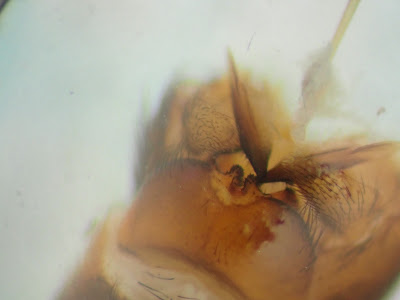
This cranefly has only ever been recorded three times and from one site - Sullington Warren. This small heathland is just the other side of Storrington to Wiggonholt, so it was certainly not out of the question. The book lists it as flying in June though, not late April. And lots of people have looked for it then and not found it. Could it have a much earlier flight period than people thought? I quickly got on to Alice Parfitt and told her all about it and she went and checked out Sullington (no joy) but did find it a third site - Hurston Warren. How amazing is this?! Especially as I just wrote a blog the night before about the importance of going out in April. Here are the rest of the microscope shots of this Endangered species.

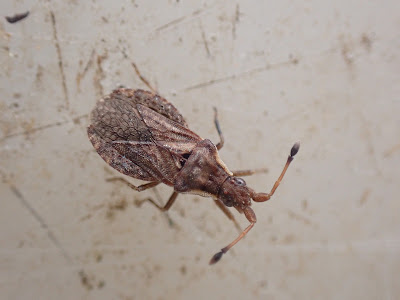
Other highlights included my first heathland Enoplognatha mordax (still it marches on inland into all habitats, I had one in woodland the other day - first photo), Cercidia prominens, Xerolycosa nemoralis, Sibianor aurocinctus and Hypsosinga albovittata. I had another lifer int he form of a scarce dung beetle, Euorodalus coenosus and I refound Spathocera dalmanii there (photo). I found a few Dieckmaniellus gracilis too, despite the lack of foodplant.
Day 2 I spent on the chalk with Kim Greaves. We did the morning at Malling Down and the afternoon at Seaford Head. We mopped up! Malling Down provided some really exciting records, but mainly things I had seen there before. The first sample generated an almost adult Phaeocedus braccatus (1st photo) in Bridgewick Pit. And a whole host of cool harvestmen, including Trogulus tricarinatus again and this awesome Megabunus diadema (2nd photo). I got a lifer on the way into Green Pits. This is a rather messed up looking specimen of Thimble Morel (3rd photo) which people tell me is having a good year.
Onto the Coombe and I found an adult Pancalia schwarzella at one of its few Sussex sites and Kim spotted this carabid, Lebia chlorocephala. This is only the third time I have seen this beetle in 13 years, the other two records being from Malling Down in 2010 and Southerham in 2017. The Horsehoe Vetch feeding pollen beetle, Meligethes erichsonii, was also a lifer.
To Seaford and a very casual twitch of the White-crowned Sparrow before mopping up on some Hope Gap specialities. Heath Snail, Moon Carrot, Lasaeola prona, Pyrausta ostrinalis (photo) and (possibly new to site) Astrapaeus ulmi. Oh and of course, loads of freshly emerged Anthophora retusa males. Amazingly we saw one male sitting on an Adder but I just couldn't get anywhere near it to get a photo. Picked up Whimbrel on call, when you do this you need to have one ear listening out all the time.
And I think these are my first Sussex Thick Top Shells (Phorcus lineatus) from the rockpools off Seaford Head. This seems about as far east as they come in the UK.
Day 3 and I spent it at work and made over 830 records to add to the set. Libby Morris accompanied me for about half of the day. Highlights included Bombus humilis and another Enoplognatha mordax. Oh and Aulacobaris lepidii which I see quite a lot on farms. But the best record was actually on what I believe to be Sussex University Campus land when I was trying to get back to my car. I saw that Martin Harvey had picked this up a few weeks earlier and I was gripped, can't believe I then went on to see this very odd yet charismatic sawfly, Sciapteryx soror. Yet another lifer.
And what must be the most Syntomus obscuroguttatus I have ever seen in one sample, this is just a fraction what was in the tray.
Day 4. I am broken after walking 27 miles in four days with 15 kg of gear. I spend most of the day entering records and identifying specimens. The weather is bad with some storms but Karen and I head out to Woods Mill to do some wetland invertebrate sampling in the afternoon and we do quite well. We find the ladybird Nephus quadrimaculatus, loads of new spiders in the meadow and finally Nightingale! Which was also Karen's first.
Here is my distribution over the four days, including some roadside botany. I am exhausted, 30% of the way through my field work for the year already and I have entered 8734 records in April alone. This challenge was immensely fun but talk about burning the candle at both ends.
Will it be enough to get us into top place for species again? I hope so. Here is the breakdown of the species recorded.

Zoropsis spinimana first turned up in Brighton as far back as 2014 but it's taken me until now to see one. A huge thanks to Ali Risby for connecting me with this absolutely huge and gorgeous spider. There is so much to look at! It's so much bigger than I thought it would be, rivalling a Dolomedes in size nearly, it's also REALLY fast. Given that this comes into houses, I can totally see it not being popular with some people, it was even making me jump when it would suddenly start running after a long period of sitting motionless. It's also good at climbing the sides of the tank it's in and is also known to be able to climb glass easily (thanks Gemma). That said, I would happily have these living in the house, so any moronic 'kill it with fire' comments are most unwelcome, I would rather have these in my house than muppets who come out with that sort of rubbish. It's a non-native that has spread rapidly through London over the last decade, but outside of London, Brighton seems to be the best place to see it. Here are some more shots of this BEAST of a spider.
You can read more about it on the BAS website here and the recording scheme page for it, is here.
I have mapped the current known locations of the spider in Brighton and Hove (the larger square is simply where the record's resolution was lower). It seems to have started off in an area just south of Seven Dials and that is probably your best chance of seeing it. This year it has been found in Kemtpown too, the records covering some 6 or 7 km, meaning that it could be anywhere in the city now! The most western record is likely one that was moved when a friend moved house, given that he also had it in his previous garden, this is too much of a coincidence. Now seems a good time to see the adults too, If you see it, please send me a photo and I'll add it to the records. That's 353 spiders for me in just under nine months in the UK.


 Posts


