An Alternative Natural History of Sussex.
This blog shows the highlights of my day to day findings as a naturalist and ecologist living and working in Sussex. Delivered with a pinch of nihilism, a dash of sarcasm and absolutely no tweeness, here is my attempt to show natural history as it really is: Brutal, beautiful, uncompromising and fascinating...and occasionally ridiculous.
I have been studying natural history for some thirty years, nineteen in a professional capacity. I currently work in Sussex as a freelance entomologist, ecologist and botanist and specialise in nature reserve and rewilding management advice based on the interpretation of the surveys I carry out. I also run a number of identification courses. An advocate of the pan-species listing approach. My main areas of interest are birds, plants and invertebrates and a lot of my spare time is spent in the field. I am the county recorder for spiders and bugs.
I went back to Amberley Chalk Pit today but this time, Tylan was with me. We got one of the target species. This is the first record of Eratigena picta in the UK since 2009. It was first found in the UK at Amberley Chalk Pit in 1982, but it hasn't been seen there since 1997. Now I am pretty sure I have been rearing a tiny one for the last two months since I first went there in early July, it's shed its skin twice but is still way smaller than all the ones we saw today. It's a nationally rare/vulnerable species only ever known from four hectads, and last recorded by Scotty on the North Downs in 2009.
As an adult, this thing is maybe just a little bigger than Tegenaria silvestris (which is abundant here but more tied to the scree).
Tylan was really good at finding them and it soon became clear it wasn't in the scree (like the one I found in July was) but on the slopes around the roots of the plants. The gentle rain helped highlight the webs.
Here are some more shots. I really like the speckled cephalothorax. It's really unlike any spider I have seen and the epigyne looks more like a big liny's, such as a Neriene. Here are some more shots.
And a fungus-infected Amaurobius ferox. What a strange looking thing. I have retained the specimen and will hopefully get it sent to the county specialist for identification.
That's 345 species for the year. Great to see Tylan after nearly a year. A nice distraction from everything else that's going on. He's closing on me now though, so it's still all to play for, for 2021!
A big thanks to Amberley Heritage Museum for their help too!
Whilst grubbing about for spiders at Devil's Dyke this afternoon, I noticed a few of these hairy little larvae in among the Common Rock-rose. They looked a little bit like small, dull burnet moth larvae. The food plant clinched it though, they must be the larvae of Cistus Foresters. We have three species, Cistus Forester, Scarce Forester (feeds on Knapweeds) and the Forester (that feeds on Common Sorrel). Collectively known as foresters (note that this is a really important example of why species names should be capitalised, so that a distinction between forester in the generic sense can be made from the species the Forester). Cistus Forester is probably the most restricted in Sussex with Devil's Dyke and Malling Down being the main sites. The larvae feed on Common Rock-rose and it's one of the dominant plants there on the south facing slope. If you go at the right time of year, you can see clouds of the metallic green adults.
Found a few nice fungi recently while walking around Graffham Common. I noticed what looked like a dirty oyster on a birch stump (not the usual place for an oyster) and when I turned it over noticed it had quite striking lilac gills. I was pretty sure it was Lilac Oysterling after a flick through the books and thanks to Martin Allison and Andy Overall for confirming, A new record for the site. Here it is from above.
Also new to the site and only the second time I have encountered it was Plums & Custard, it's not rare and very distinctive so I don't know why I have encountered it so infrequently. These grow on dead pines so it's not surprising that it's found at Graffham Common. The photos didn't come out so well, these are really attractive fungi.
Last Saturday I took the Sussex Fungi Group around the good bits of Ditchling Beacon (which probably tripled the site's fungi list) and was pleased that we came across Toasted Waxcaps in several areas. This is my 21st waxcap and a subtly beautiful one. It really does seem to be limited to chalk-grassland in the county so is a really good indicator.
On the 1st June, I ran a course at Levin Down called the Invertebrates of chalk-grassland. I promised to write up the species list so here it is, unfortunately a bit late but this has bee a crazy summer so I am sorry for the delay. I now realise important rainy days are after experiencing a summer without any, I actually started writing this at the end of June. Anyway, the course was about showing people what they can do in the field but also what the limitations are of doing so. Here, I also wanted to prove the point that habitat specialists are pretty uncommon by introducing some rather crude resource analysis.
We arrived at Levin to find it shrouded in low cloud. This did not bode well. However, we started the morning simply by active searching, waiting for the dew to burn off. Sweeping, beating and suction sampling did not begin until after lunch.
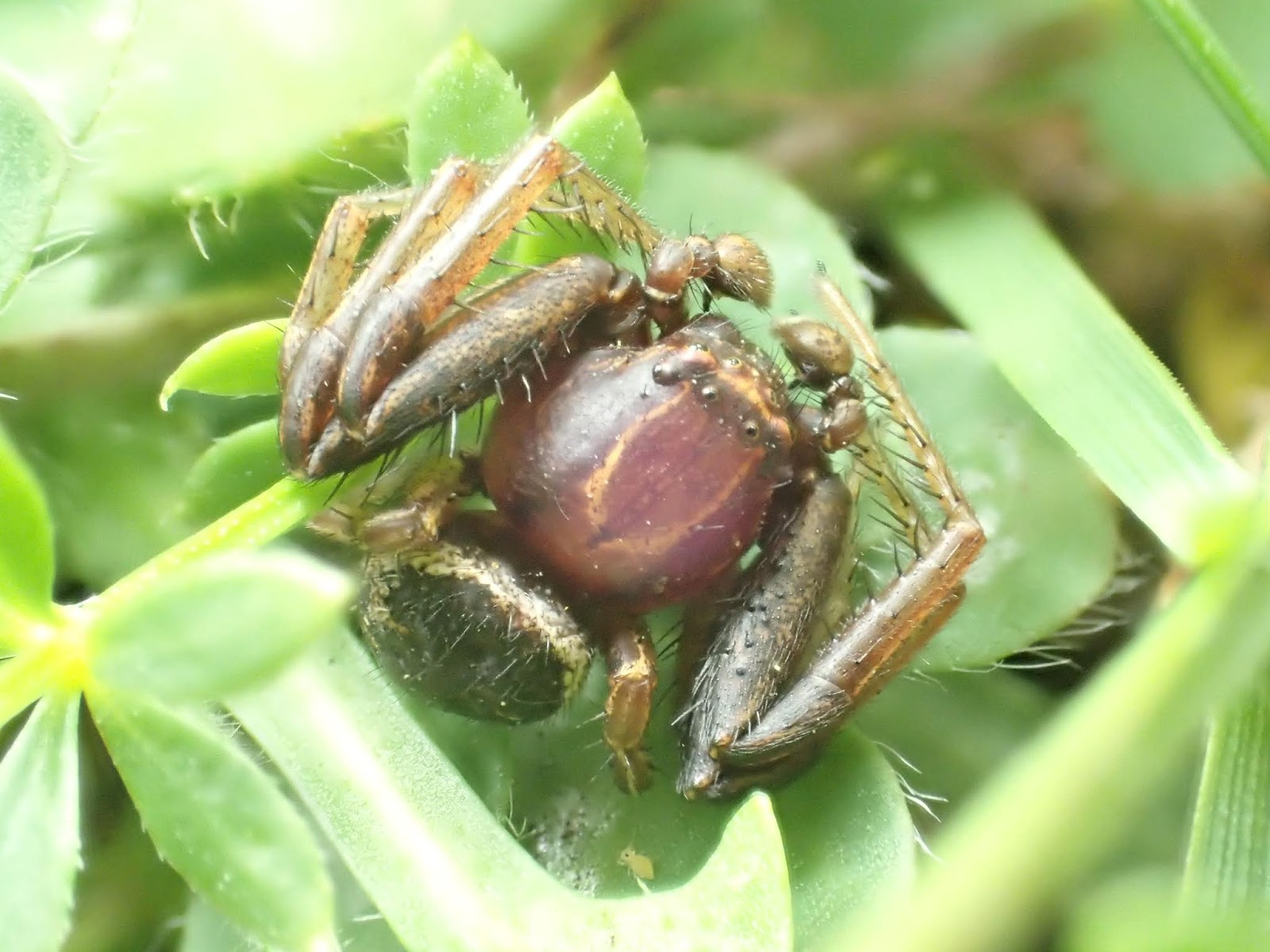
It ended up being a pretty awesome day. We recorded 120 species in the field. Turns out 23 (19.1%) of these were new to the site! Nine had conservation status (7.5%). I personally didn't get any ticks but the highlights for me were these two. At the top of this post is the suction-sampler special. The tiny little Southern Crablet Ozyptila nigrita. I have 11 records for this species and eight of them have been made using a suction sampler.
But the star of the show was seeing three of these, two males and a female. Xysticus bifasciatus. A rather smart spider. You can do this male by its genitalia on this photo, they are so large and distinctive (fnar fnar!) Not a chalk-grassland invertebrate at all though.
And the beetle Tritoma bipustulata. This is the only place I have ever seen this, it seems to be fairly easy on this site on rather dull bracket fungi on relatively small trees, scrub and stumps that have been cleared. Again, not a chalk-grassland invertebrate.
Here is the list with a few notes on its key resources and associations, the year of the last record and whether it has a conservation status or not (noted after the species name). Now, these are quick notes, I expect people will disagree on some of them, please don't comment on the detail as I won't have the time or energy to get drawn into another debate. As you can see, looking down the list, chalk-grassland specialists are actually few and far between and probably don't make up anymore than 10% of what we saw. Sorry this doesn't quite fit the page but it's a compromise of getting as much detail into a small a space as possible and the year of the last record is quite a useful thing to have here.
There can be only one specimen that is a county first. I wasn't expecting this at Levin Down yesterday! Platyrhinus resinosus (Nb) new to West Sussex! Would you believe it but there is only one record for this species in Sussex being in East Sussex. It is associated with King Alfred's Cakes but is very rare in the county compared to Platystomos albinus (which I saw at Levin two weeks ago). North, east and west of Sussex and it seems fairly frequent. Anyway, found two yesterday on some felled Ash at Levin Down. I've only seen this once before in Berkshire and the individual shot into a hole faster than I could get my camera out. So I was very glad to see a big, bright and cooperative one in Sussex during a survey on one of our reserves.
A LONG time ago, Scotty Dodd described this beetle to me as looking like the Kurgan from Highlander. That image stuck. I've waited a long time to write this blog...
If you're not convinced, maybe the soundtrack will get you more in the mood...it goes a bit weird after two minutes, think that was edited from the movie.
Anyway, here are some more shots of this awesome creature.
Underneath, it's a much more convincing bird-dropping mimic! It has a habit of tucking its legs and rolling away. Very cool indeed. So despite rather changeable weather yesterday, We recorded nearly 90 species in the field with many more specimens that require microscopic identification, that's going to be today's job. Ollie Sayers came out with me and had a great day learning where to find invertebrates and soon found something quite uncommon in the form of Oedemera femoralis (Nb). A good day for saproxylics on a chalk-grassland site. It gets better though. Under some very dull looking brackets (Turkey-tail and Hairy Curtain Crust) on stumps of recently removed scrub I found four of these.
This is Tritoma bipustulata (Na) and possibly the first records in Sussex for 30 years. I think it's only been recorded at Stedham Common and Arundel Park and considering how much saproxylic work we have done in this part of the world, I doubt very much we have overlooked it. The field season has already started with a bang for me but you know what they say:
Last month I blogged about a survey we are conducting at Malling Down and Southerham and this week we carried out our fourth visit and it was rather good. The highlight was hearing Chris Bentley bellow "DOROS!!!". Not knowing if he had caught it yet, I legged it down into the Green Pits at Malling to find Chris looking very pleased with himself and something large and wasp like flying around inside his net. I've always wanted to see the Phantom Hoverfly Doros profuges as it's one of the few species that has acquired an English name, albeit via the BAP process. It's a cool name none the less. It is genuinely rare and difficult to find and is quite a convincing wasp mimic, even moving like a wasp. Thanks also to Chris for the photo.
However, that was not the rarest find of the survey. I swept a bee that got James and Mike excited and this turned out to be the RDB1 Halictus eurygnathus! This species really is restricted to the chalk around Lewes and Eastbourne and is so poorly known that we were informing the autecology of the species just by sweeping it off plants it's currently not known to nectar on. Also in the Coombe at Malling Down James recorded the Na bee Andrena fulvago. Cistus Foresters and Rose Chafers were also recorded and we were all in agreement that the site couldn't look better with a wide range of structural diversity and nectar being available. Here you can see masses of Common Rock-rose, Dropwort and Bird's-foot Trefoil. Go an have a look this week, it's amazing!!!
Also of note was this larva. It was by far the most abundant larva we were sweeping and was present in all six areas surveyed. The only noctuid moth I could ever remember seeing up there in any numbers was Dusky Sallow. A quick Google search and we soon realised this was indeed the larva of Dusky Sallow. Another tiny piece of the infinitely large jigsaw puzzle added!
This summer another battle is unfolding above the streets of Lewes. On one side, Malling Down with its steep sided Combe and scrubby Green Pits and on the other Southerham Farm, with its secluded valleys and ludicrously named Bible Bottom. Yet which one is 'better' for invertebrates? There is only one way find out! FIGHT! Well, no. Actually it's to carry out a repeatable and standardised survey that can inform the management of these two superficially similar yet surprisingly different sites. That's exactly what we are doing this year and we have recently completed the third visit...
Once a month from March until September we are recording all the species we can find within six discrete areas (three on Malling and three on Southerham). We always record for the same time across all six areas. The sites are very rich, particularly in scarce weevils, and the total number of species recorded so far stands at 293! Above is the smart but diminutive (3mm) weevil Tychius schneideri. It only feeds on Kidney Vetch which is abundant at Southerham on Bible Bottom but mostly missing from Malling (conversely Malling has all the Common Rock-rose). So how do the two sites compare? So far Malling is winning with 201 species and Southerham is on 179 species. This difference is likely to be down to the lack of scrub at Southerham but that's not to say we want Southerham covered in scrub (but some scrub is good). A better way to compare the site's qualities for invertebrates would be to compare the proportion of species with conservation statuses but that will have to wait until the survey is completed. Remarkably, only 87 (30%) of the species were recorded on both Malling and Southerham (so not that similar after all or just an example of how hard invertebrates are to find? Or how many species recorded occur at very low densities?). Out of the six sites, the Green Pits at Malling is currently coming out best of all with 102 species. It has the most scrub of all the plots, the least amount of south facing slope BUT a hugely varied topography. It's an old quarry on the north of the site.
Perhaps the most extraordinary difference is the abundance of the RDB Carthusian Snail at Southerham which has so far not been recorded at all from Malling. In many parts of Southerham it's the most abundant snail and was recorded in all three plots there during the first visit. The sites are only separated by a few hundred metres of golf course!
Also as Southerham lacks Common Rock-rose, it also lacks the Cistus Forester that's present at Malling Down. Both sites are covered in Knapweed though but it's only Bible Bottom at Southerham that has the Scarce Forester that feeds on the Knapweed!? So which site will come out on top? I believe Malling will end up with more species but Southerham is likely to have a higher proportion of scarce species and species associated with chalk-grassland. We'll have to wait and see though!
I'm embarrassed to admit it's took a me a few years to figure out that the super abundant snail at Bible Bottom, part of our Southerham reserve, is the monastically named Carthusian Snail Monacha cartusiana. This is a red listed species but there are hundreds up there. I would say it was the commonest snail yesterday. I was quite taken with them and their understated beauty. Bible Bottom was also full of thousands of Chalkhill Blues yesterday, quite an experience to walk through, go and have a look if you get a chance!
Adrian and I were carrying out a grazing assessment as well as mapping some of the scarcer plant species such as Basil-thyme and Bastard-toadflax. The Bastard-toadflax has mostly gone over but we did see eight nymphs and one adult of the scarce Down Shieldbug Canthophorus impressus that I recorded new to East Sussex there last April. The nymphs are so bright! Great to see it and the plant doing well there and amazed at how the range of the Bastard-toadflax almost completely overlaps with the Chalk Milkwort (which flowers earlier in the year, there is not a trace of it left by mid summer). I would guess that they require the best chalk-grassland; with the lowest nutrients and/or the thinnest soils, accompanied with adequate grazing.
For the last five years I have looked for the mythical Burnt Orchids that Steve found around ten years ago at Southerham but no one has seen since. Until now that is! Yesterday I started mapping and/or counting the rarer plants of our chalk grassland site Southerham. I was concentrating on mapping Chalk Milkwort and White Horehound. I was going to attempt my annual search for the Burnt Orchids when I met up with Steve at Bible Bottom, I really didn't think we would find them.
Independently, Steve and I both came to the conclusion that Chalk Milkwort seems to grow only on the very best parts of the chalk and could maybe be an indicator for other interesting plants. The Chalk Milkwort is by no means ubiquitous at Southerham like Common Milkwort is, in fact it grows in discrete but diffuse patches that lend themselves well to mapping. In fact the area where the Bastard Toadflax is, is in a Chalk Milkwort area too (but that is too hard to find until it's in flower). I did see some yesterday but only by getting on my hands and knees, I'll go back to do this in a month. Anyway, we were surprised at how little Chalk Milkwort there was compared to what are memories were telling us, I believe this is the fault of our memories though and not a decline in the plant and demonstrates the importance of detailed monitoring. Memories change the more you access them, Excel files don't.
Right at the top of the slope, way further up than I would have thought to search, we found the first patch of Chalk Milkwort we had seen in all the huge area of Bible Bottom and ten metres beyond this I walked right up to a single Burnt Orchid. Suddenly there were four more and then Steve found another seven. Despite a thorough search, we didn't find any more. Twelve specimens tallies with what Steve recorded all that time ago. Another point this illustrates is the importance of taking accurate grid references, we only ever had a six figure grid reference for the old record. Now we can monitor these plants and keep an eye on them. A brilliant and unexpected end to the week! Not the best photo in the world but I don't care as this is evidence that we have our own Burnt Orchids!
Now, I was originally going to blog about the differences between Chalk and Common Milkwort so here goes. In the image below, the top plant is Common and the bottom one, Chalk Milkwort.
With Common Milkwort, the stems are usually a little longer, the leaves larger and more pointed but more importantly they are smaller towards the stems base and are alternate all the way down. With Chalk, the leaves are a little smaller and blunter and get larger towards the base where there is a 'false rosette'.
However, they can be separated on jizz and colour with experience. On the Lewes Downs, Chalk Milkwort is usually (95%+) white with a hint of blue and only occasionally electric blue as is the typical form (both are shown in the photo below). Common is white, pink or violet but is rarely the electric blue-white of Chalk. My camera doesn't quite do this shade of blue justice.
In addition, the flowers are arranged differently, much more congested but more neatly arranged all the way around the stem (first image below) while Common looks messy in comparison (second image below shows Chalk Milkwort in white and Common in pink). Chalk also appears more upright and forms denser patches of flower spikes about the size of a dinner plate whilst Common appears more scattered. With experience, it's quite easy. What really struck me yesterday though is that Chalk Milkwort is restricted to the most floristically rich CG2. Go and have a look now, as Chalk Milkwort is an early flowerer and will be over by mid summer.
Has to be the most awesome name for a fungus. I am fairly confident that this little fungus that I found on tightly grazed chalk-grassland at Seaford Head on Sunday is a Mousepee Pinkgill. It did smell funny but I must admit that I don't know what mousepee smells like. The fact that the stem bruised a strong blue-green seems to be a good identification feature as does the habitat. Just a quick one, busy day tomorrow...
Can't win 'em all. I went searching for a live Helicella itala today but failed. I did find a few more empty shells but found no live snails on the chalk except those under fallen wood. The above photo is a very common and easy to identify snail that I see mostly under logs in woods, it's Discus rotundatus. Here is today's snail list:
Cepaea hortensis Helix aspera (alive) Cochlodina laminata (alive) Discus rotundatus (alive) Pomatias elegens Cernuella virgata (one alive) Helicella itala (only two more shells) Candidula intersecta (alive)
So I didn't add anything new in the field. The mosses there were pretty boringfor a chalk grassland site with Fissidens taxifolius, Bryum capillare and Pseudoscleropodrum purum being very common and just the occasional bit of Homalothecium lutescens. I did however get three retrospective ticks looking through old notebooks. I found my notes from a trip to Abernethy when I was working at the RSPB. I had a day in the field looking at Sphagnum with Andy Amphlett and I saw Sphagnum fuscum, russowi and inundatum. That puts me on 3745.
As a child, every Christmas, I would flick through the Argos catalogue dreaming about which Transformers I would get. As an adult, I flick through natural history books, dreaming about when I will see this species or that. Seriously though, there is a great benefit to this. If you read around the subject and gen up, just sometimes, you will recognise species before you have ever seen them.
I've been looking for this rather large, flattened snail for a while since I acquired the FSC land snail key a few years back. Considering how much time I spend on the chalk, I'm surprised it took this long. Anyway, last night (whilst looking for something completely different) with Michael Blencowe and Mat Davidson, Michael found this shell. I can't tick it, as it was well dead like. It's the Heath SnailHelicella itala. I will be going back soon to look for a live one. Thanks to Michael for the photo and thanks also to Mum for getting me Optimus Prime.


 Posts