This is the eggcase of the
Small-spotted Catshark (also known as the
Lesser-spotted Dogfish!). After recent storms there were masses of these washed up on Brighton beach at the weekend. I can remember regularly seeing small dogfish washed up dead on the beach at Tal-y-bont in Wales when I was a kid. They were probably the same species. Frustratingly, I am yet to see one of these animals alive, so it's not one of the 69 UK species of fish I have on my list. The records though are valuable and I'll submit them. You can key out catsharks, skate and ray eggcases
on this website, it's a great resource. I was totally gripped though, as on the same day, a colleague found an eggcase of the rare Cuckoo Ray on the same stretch of beach. This was a stunningly beautiful looking thing and I'd love to find my own!
Dogfish to catshark? Quite a drastic name change! Next they'll be called Mousewhales. But seriously, anyone know why the name change?
On the 9th January I met up with Sharon Pilkington and Tom Ottley to look at some of the rare bryophytes growing on the sandrocks at Eridge Rocks. It was an interesting day, I managed to see seven species I hadn't seen before (4156) including some quite scarce ones for this region. It was good to talk about the management of these often over-looked plants and to see that we are mostly getting it right too. Tom thought that the rocks were probably looking the best they had done in the last 50 years for this rare assemblage of tiny plants. A few tweaks that we could make include clearing brambles from some of the boulders and removing some of the lower branches from evergreen shrubs to let the dappled sunlight that these plants demand (direct sunlight or complete shade are a sure way to eradicate most of the species).
Here are a few of the species we saw. This first was perhaps the rarest of the mosses,
Dicranum scottianum (we only saw three tiny plants) but I was particularly pleased with this shot. It is taken with the lens looking directly up the side of the sandrocks. It was an incredibly dull, overcast day which I think the Coolpix 4500 does well in.
This TINY liverwort is known
Scapania umbrosa and was yet another species the bryologists were quite excited by. Nearby, this boulder, with a birch growing from it, was also a hot spot for a few scarce bryophytes.
Including this endearing little acrocarp (did I just say that). Tiny luminous-green sea urchins spring to mind. It's yet another species that can thrive on the sandrock,
Campylopus fragilis.

A phrase that kept popping up in the species accounts in the literature for these scarce species was 'hyper oceanic', essentially meaning of a far north-westerly distribution close to the Atlantic. In the Weald, we have many of these species, particularly on the sandrocks, but they are often very rare in the region (where they might be common in the north-west). It must be a specific set of climatic and substrate conditions that are provided here but it is something well worth holding on to. Without the appropriate management at Eridge we would certainly lose these plants to succession as Holly, Yew and Rhododendron cast their dense winter shade over the rocks. This is a great example of monitoring and management working hand in hand with the specialists feeding their knowledge and advice straight to us at the Trust in the field. If we want to hold on to rare and scarce species that have such specific requirements, we cannot rely on a 'one-size fits all' approach to their management and natural processes here would be damaging. Species-assemblage focused management is therefore vital if we are to maintain the more unusual plants and animals at Eridge. Small scale management like this is often referred to as 'gardening' by some conservationists these days. Call it what you like, I see it as
exactly what is required to maintain a rare and precious assemblage and that's exactly why I have conservation written through me like a stick of rock!

This huge block of sand has been deposited by the stream at Woods Mill over the last few weeks. A much smaller scroll bar had developed there over the last few years but was a fraction the size of this. I measured it as being roughly 7 x 3 metres and about 0.5 metres deep (my foot print can be seen for scale). So, approximately 10 cubic metres of wet sand at 2000 kg/cubic metre comes out an impressive 20 metric tonnes! Now this is insignificant to the amount of water that passes down there every day but it is still an impressive force of nature. To see it so neatly piled up in one place with so little in the immediate vicinity is also intriguing. Several new scroll bars have started developing further down the stream too.
I flushed a Snipe from the furthest ox-bow lake and a surprise was a Painted Lady behaving like it was on migration;VERY fast and VERY straight. Lots of little beetles flying around in the sun too, mostly Helophorus sp. and Aphodius sp.
Do you remember Nice 'N' Spicy Nik Naks? That's exactly what these little fungi reminded me of. I had a great day at Ebernoe with Jennie looking for fungi.
Scarlet Caterpillar Club Cordyceps militaris was one of the target species and there were loads in the churchyard, I walked right past them! On the end of each of these, burried underground, will be a moth pupa (not larva like the different species of
Cordyceps from Mill Hill). I'm not sure if this one is host specific or a generalist on moths that burry themselves underground when they pupate. I imagine Large Yellow Underwing would be a good host but many species of noctuid could be candidates. Some of the fungi go a bit wrong and develop some strange protuberances.

Considering the rain, numbers of fungi were very low and we didn't see much else beyond the usual
Saffron-drop Bonnets and
Garlic Parachutes. I saw this
Lapidary Snail on the Brick Kiln, only the second time I have seen this strongly-keeled snail and we also stumbled across the BIGGEST
Wild Service Tree I have seen (measurements to follow). I can also recommend the venison at the Stag Inn at Balls Cross. Back to Ebernoe today for work. It's a hard life!
May was an excellent month for me for natural history, despite the weather. I saw 124 new species, the highlight of which was Pellenes tripunctatus. I ended May on 3999 species and all the additions are shown below. Spiders have overtaken mosses to become my sixth most speciose group. I have really enjoyed getting more into spiders, they are a lot easier than I thought they would be. I hope that June will be as exciting...
| Vascular
plants |
1156 (+1) |
| Moths |
858 (+14) |
| Beetles |
483 (+38) |
| Birds |
343 (+1) |
| Fungi |
206 (+1) |
| Arachnids |
139 (+31) |
| Mosses |
137 |
| True
flies |
98 (+10) |
| True
bugs |
91 (+5) |
| Molluscs |
75 (+5) |
| Aculeates |
67 (+9) |
| Butterflies |
53 |
| Mammals |
41 |
| Fish |
39 (+2) |
| Liverworts |
36 |
| Dragonflies |
32 |
| Lichens |
30 (+1) |
| Crustaceans |
30 (+3) |
| Crickets
& grasshoppers |
19 |
| Seaweeds
& algae |
7 |
| Reptiles |
7 |
| Amphibians |
6 |
| Anemones
& jellyfish |
6 (+1) |
| Mites |
5 |
| Millipedes |
5 |
| Lacewings
& allies |
4 |
| Cockroaches |
3 |
| Leeches |
3 |
| Caddisflies |
3 (+1) |
| Slime
Mould |
3 (+1) |
| Springtails |
2 (+2) |
| Parasitica |
2 |
| Centipedes |
2 |
| Mayfly |
2 (+1) |
| Lice |
1 |
| Silverfish |
1 |
| Earwigs |
1 |
| Aphid |
1 |
| Flatworm |
1 |
| Sponge |
1 (+1) |
I called in at Ditchling Beacon yesterday and boy was it bleak. Driving rain and a wind so strong it actually blew my camera case right off of my camera. I struggle with the tiny acrocarps but have often seen this one at Ditchling and decided it was time to figure it out. Under the microscope, you can clearly see the ID feature that separates it from others in the genus, the slightly projecting midrib. It's Trichostomum brachydontium.
UPDATE 10/12/2011: The above identification is wrong. Howard suggested that this species often gets confused with Barbula unguiculata. Told you I struggle with these! My moss is actually way too small to be Trichostomum and is in fact Barbula unguiculata.
I also saw Harebell in flower, a Lesser Bloody-nosed Beetle but best of all a Black Redstart. This is the first time I have seen one on a Trust reserve. I end the day on 3727. I have finally found a new house to live and will be moving over the next month. I am really excited about having access to a garden again after so many years. Now, the one good thing about Christmas is that once a year my work colleagues actually socialise, in a real pub with real booze. Tonight is that night, so don't be expecting any posts tomorrow!
When I should have been setting the cups up for last night's Sussex Moth Group meeting, I was in fact taking photos of the most amazing lunar corona I have ever seen, and Jupiter's presence added to the effect. When we came out of the meeting, the moon was showing another optical phenomena, a 22 degree halo, just like the one you see with sundogs.
Being so mild we put the trap out despite the bright moon. The highlight was this pretty little tortrix that Alice spotted on the wall. It's the Nb Acleris logiana, a recent arrival to the south that used to be restricted to Scotland. Thanks to Tony Davis for confirming the ID based upon the loose scales on the costa. That puts me on 3678 species!
Wow! Whatever next. Our discovery of the largest number of Flame Brocades seen in 130 years that may indicate an established population has made the national press (along with the arrival of loads of other migrant moths here and elsewhere in the country). The first I new of it this morning was that migrant moths were mentioned on both BBC Radio 4 and Radio 5. I got a call from Michael about 10.00 am saying it was in pretty much ALL the papers. I grabbed a Guardian and indeed there was the article with a nice picture of a Death's-head Hawk-moth. Here is a Vestal that Penny and I caught at Woods Mill last night, yet another migrant.
Now, I get back home and it appears the story has been run in all these publications too:
BBC News Online/Interactive
Scottish Daily Express - Online
West Sussex County Times Series - Online
The Independent - Online
There are at least another 15 to add to this list. Pretty amazing stuff really. It is frightening how fast the media moves.
Since writing this it appears the moth might also be on the ITV local news between 6.00pm and 6.30pm tonight AND apparently it is going to be on Autumnwatch too!!!
The stream flooded again today at Woods Mill and in the process dislodged hundreds of invertebrates, many of which climbed to higher ground and sought shelter on the gates and fences around the valley field. I went up at lunch time when the water level had dropped to see what I could find and there were lots of things around. Dozens of beetles but mostly staphs that I can't identify (yet!). I picked up a few carabids, a woodlouse and a harvestman that I will attempt to identify tonight so I will report back on those tomorrow. As I was searching the gate I noticed this tiny female Winter Moth. Considering how often I see the males this is only the second time I have bumped into a female. I am sure they are easy to find if you know how to find them but it was a nice find anyway. It's a bit tatty because it would have been in the flood with everything else...
...Imagine being a tiny caterpillar that against all the odds evaded being gobbled up by young Blue Tits, survived the larval stage free of parasites, emerged into the world as a flightless egg-laying blob in the coldest winter for a hundred years, then you get washed away in a flood, you manage to hold on to a passing gate, you dry yourself off only to end up being photographed by a giant hairy monster who puts you in a glass pot. Don't worry, Orvil will be released unharmed tomorrow.
Another strange day. Only seven Skylarks using the farm I surveyed today but there were hundreds flying high over the site. Between 9.00 am and 12.00 pm there was an almost continuous movement, many of single birds flying with some easterly component to their flight. I suspect these are birds moving back after a trip to the west during the cold snap. On top of the farmland birds, I also saw a few goodies. There was one each of Marsh Tit, Hawfinch, Firecrest and Red Kite! A great list, shame none of them are the target species.
However, a stranger encounter happened right at the start of the survey. I was heading down a very narrow country lane, just within the recording area of the farm I was going to survey and a mini was heading up in the other direction. There was only room for one car and a stand off was inevitable. I was reluctant to reverse as twisting whilst seated is not good for a recovering prolapsed disc. The other driver reversed but I could tell he was annoyed so I wound the window down to explain as I drove past. I was quite surprised to see Hugh Dennis and his huge cheesy grin. He sped off before I finished my sentence! What's the BTO code for Hugh Dennis?


Finally, I found these fungi literally bursting out of plastic-wrapped hay bales. I am pretty sure they are Split-gill Schizophyllum commune, Phillips states this is a typical place to find this fungus. This is a new species for me and puts me on 3021 for the end of the year. The challenge to get to 4000 species by this day next year is now on. I'll write another post about this tomorrow and hopefully I'll get a chance to play with my new camera too. Let's see what strangeness 2011 brings! Happy New Year!
Finally the fog lifts and I can get some surveys done! I have noticed many more 'gull kills' than I usually see today. Wood Pigeons are by far the most frequent raptor kill I find but today I saw four Common Gull kills. Given also that my Dad mentioned the other day he had seen Buzzards taking gulls, I wonder if that is what has been going on down here too? It could just as likely be Peregrines but on this particular farm, Buzzards are very obvious but I have yet to record Peregrine. I don't think I have ever seen a Buzzard catch a bird, I wonder if they drop on the gulls when they are on the ground? It's fascinating how cold weather changes the birds behaviour.
After the deluge of rain water that came down the new Woods Mill channel yesterday, it's already starting to look quite different. Extensive silty/sandy deposits have appeared along the whole of the channel, literally overnight! You can see them in the above photo as being purply-brown and slightly reflective compared to the orangy/brown of the bare clay. Several days ago this was all bare clay. In most places the deposits are around half a cm in depth but at one point I almost got stuck in the mud!
Perhaps even more remarkable is the appearance of a number of sand banks/bars, again, almost over night. Some of this must have built up over the last few weeks but the stream has only been running for 19 days. I am amazed how quickly things are starting to change.
I might not be there to witness it but the Woods Mill stream has flooded already. The contractors literally finished the job just in time. Thanks to Steve Tillman for these photos. There is going to be water in different places now at Woods Mill and it might take some getting used to but that was always going to be the case. It will be great to see what the new channel looks like when the floods have subsided. If you zoom in on the first photo you can see where a little tributary might be forming and what also looks like a large piece of woody debris moving down the channel! I can't believe how vast it looks, amazing!
On the way to Pulborough Brooks RSPB reserve to do some moth trapping on the behalf of Sussex Moth Group last night, we saw this amazingly bright sundog. These are formed by hexagonal ice crystals in the atmosphere that refract light at 22 degrees, giving the effect of a bright point of light horizontally to the side/s of the Sun. Often two sundogs appear left and right of the Sun and/or a complete ring all the way around the Sun, but always at a distance of 22 degrees (this must be defined by the shape of the crystals). A complete ring is formed if the crystal are orientated randomly but horizontal refraction occurs when the crystals are vertically orientated, which happens as they start to drift down (this is seen more often than the ring which I have only seen once in Scotland). They look like a patch of rainbow coloured light. Although only one was visible, it was the brightest one I have ever seen and Jo got this great shot from the speeding car on the A27.
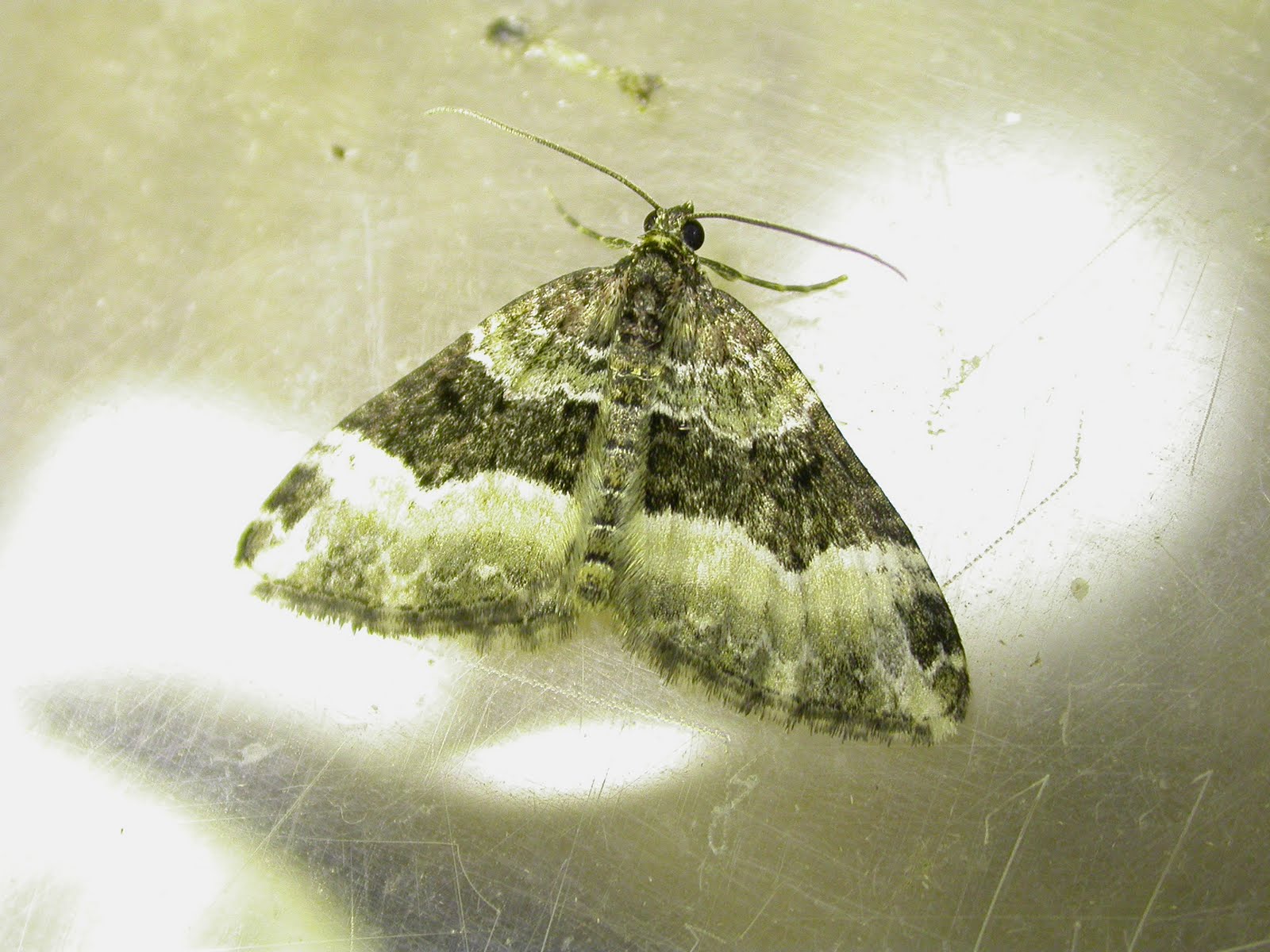
Moth trapping was fairly quiet (it must have been for a frequent atmospheric phenomena to usurp a moth tick from the title of a post), good views of the Moon and Jupiter proved quite exciting to visitors whilst the local Sharp-angled Carpet was a tick for me.


Yesterday it finally seemed like it was warming up with my first Small Copper of the year at Woods Mill and this squash bug, Coreus marginatus. However, that all changed over night as there was a thick frost in the valley bottom field this morning. Taller plants such as Cow Parsley and Winter-cress were hit the hardest. I finished visit 5 of my 10 visit CBC there this morning it and was just like a late March day with Great Spotted Woodpeckers, Marsh Tits and Chiffchaffs all singing. There were only two Nightingales singing this morning too. I really hope it warms up for National Moth Night on Saturday.


 Posts