An Alternative Natural History of Sussex.
This blog shows the highlights of my day to day findings as a naturalist and ecologist living and working in Sussex. Delivered with a pinch of nihilism, a dash of sarcasm and absolutely no tweeness, here is my attempt to show natural history as it really is: Brutal, beautiful, uncompromising and fascinating...and occasionally ridiculous.
I have been studying natural history for some thirty years, nineteen in a professional capacity. I currently work in Sussex as a freelance entomologist, ecologist and botanist and specialise in nature reserve and rewilding management advice based on the interpretation of the surveys I carry out. I also run a number of identification courses. An advocate of the pan-species listing approach. My main areas of interest are birds, plants and invertebrates and a lot of my spare time is spent in the field. I am the county recorder for spiders and bugs.
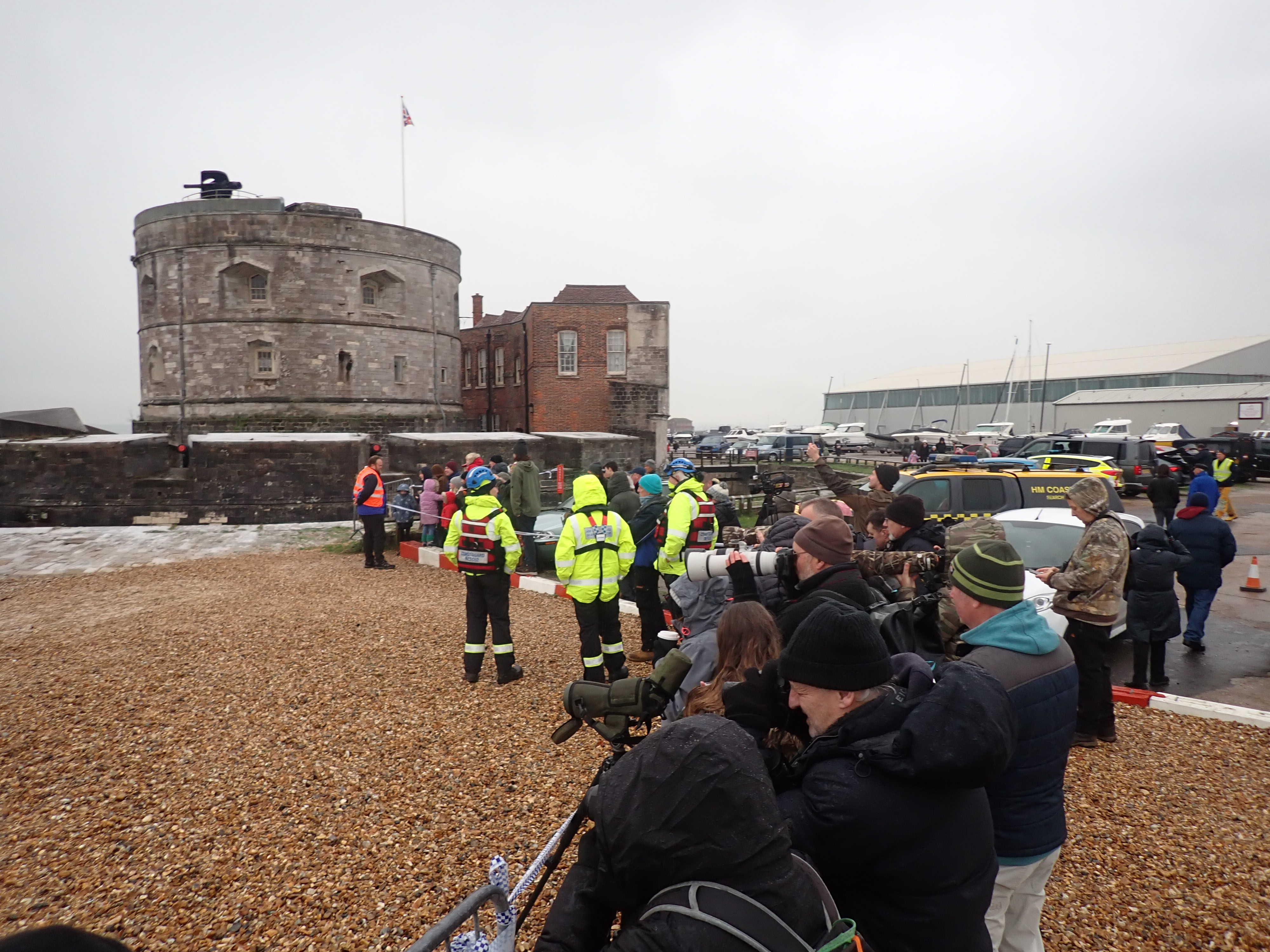
Most naturalists in the UK will be aware that over the last few years, there have been a few Walrus turning up. The one in Wales and Isles of Scilly and the ill-fated Shetland animal (ask the Norwegians) last year. So, it was quite a shock to hear of one actually swimming around Pagham Harbour yesterday afternoon. It was last seen yesterday swimming west, away from me in Brighton, towards Selsey Bill. I got up this morning ready to leave early if there was any sign but I wasn't expecting much. Then I got a message from Danny Widerscope saying it was at Calshot in Hampshire. I called Tony Davis to let him know and of course, the spawny git Seth was with him. I gave Karen the pre-discussed 15 minute's notice to walrustle into action, and then we were on the road. I wasn't convinced we would see it but by about 11:15 we got to Calshot Castle and we were looking at a male Walrus (Odobenus rsomarus). I may have had a little cry of excitement.
A small crowd of maybe 50 people were present, about two thirds were members of the public. It was well policed, by police, coast guards and marine mammal medics. We watched it for about an hour. Here are a few blurry shots. It was a joy to spend an hour with it. The fishermen were there first, by the way. It really wasn't fussed by people, who were kept at a realistic distance. You couldn't get much of it in the scope at once.
And here is our 'Walnut Selfie'. For some reason I have been saying Walnut all day instead of Walrus. I mean, they're pretty much the same thing, right?
Seth said it had moved up the beach a few times as the tide came in. It did just that soon after, letting out a mighty roar as it did so. You can't really hear it doing that in this video but it was well primal.
And then, after about an hour, for no obvious reason it just got up and buggered off. Remarkably quickly. They are fast in the water and could easily avoid detection when on the move. I felt so privileged to have seen it and getting on the road quickly was well worth it. What an unexpectedly wonderful moment!
So I'm 12, it's 20th February 1991 and I'm on a quest for a Black-bellied Dipper...
We followed the mans instructions, two bends in the road and stop at the bridge next to a water mill. We did so, it was a very dirty river it didn't have many obstacles in it, to me it looked the complete opposite of dipper country. And to top that the wasn't no one else in sight (appart from an old aged pensioner timing himself up and down the road). Oh Little Graeme, you disappoint me with your reliance on other twitchers to connect with birds and use of double negatives in the same sentence.
We went up the one side of the river for around 30-40 yards (I have no memory of ever working in yards?!) and headed back. We had a quick look on the other side there was a rather mangled dead bird at the bottom of the river (I think I had an obsession with dead things even at 12), and there, in the middle of the river was a branch, with some thing moving. I lifted my binoculars and it flew, black and white, that was it, I'd spotted the black bellied dipper! Mr Gardner set up his scope and I noticed that it was ringed, we compared it with the normal dipper, there wasn't much difference bar were the dipper had a glint of chestnut on it its belly, while the black bellied dipper had a (drum roll, yes you've guest it!) black belly like its name states (you could do this for a living if you carry on at this rate Sherlock!). With our hopes up we went to look for divers and grebes at Holkem.
Before you read anymore, I think it best to set the atmosphere so hit play below. Even though it was 20th February 1991, this music was actually playing at the time. Despite being six years before the first book was written.
Now my notes tell me we were in Wanefleet, Leicestershire but it didn't take me long to realise today I was actually in Lincolnshire. Clearly, it didn't really matter to me what county or town I was in, as along as it started with the right letter, had a similar number of syllables and we saw the birds. Anyway, imagine being 12 years old and going to see a Snowy Owl in the UK. Oh, yeah, probably copied (not traced I'll add!) that picture from the Reader's Digest book again...
We either could have gone straight to Norfolk and stayed there all day or gone to Wanefleet to see the Snowy Owl, and , depending on how long it took to see it either go to Norfolk or Gibralter Point.
We found the infamous (?!) sea lane and carried on a long it, the fields spread for miles (definitely Lincolnshire then), it could have been anywhere we began to think it would be one of those days. we got to the end of sea lane and saw three cars, two were empty the third held one man (a little dramatic Little Graeme). We pulled up next to him and asked him where it was, he said (with a mouth of salad sandwich, go down the right hand sea wall , follow it till you get to a barrier the Dyke on your left, follow that up and there it is.
We followed his instructions and before we got to the barrier we had saw it. A big (enormous even), huge white owl. pure white with strange half closed cat like eyes. It sat more like a halk than an owl, and it didn't do much, the hole half hour we was there the most it did was turn his head. After a while, we headed back down the sea wall, and heard a strange , lapwing noise but we could see nothing we got back to the car and Mr Gardner went and lost his lense (I'm guessing this was just a lens cap) to his scope we went back to look for it but all we saw was some speedwell and a Snowy Owl! (God, Snowy Owls are just so boring after the first thirty seconds, gimme a lens cap any day to stop the intense boredom, ha ha). We didn't find it so we headed to the car and headed towards Norfolk...
I've not seen a Snowy Owl since. What an amazing experience. Don't miss the next installment from Norfolk where not only do I get three more lifers but I nearly lose all my bird-watching equipment in a reckless bet.
I was struck by how cathartic it was writing about my old bird diaries. It wasn't an easy period in my life and I didn't have many suitable male role models growing up but those bird-watching days were of real importance to me. I really can't thank Ewart and Richard enough for their influence. I believe my drive to go to uni, my career in natural history and much of my inquisitive scientific mind come from those adventures.
Anyway, at 12, I might have known what a Waxwing was but I clearly didn't know that I was actually in Nuneaton not Nottingham (thanks for the update Ewart). You'll be telling me that the Snowy Owl wasn't in Leicestershire next!
Blithfield Reservoir is definitely in Staffordshire however. Well, it definitely was in 1991...
We set of to Blithfield, we found a dead dunlin and we walked across the ice on some of the small inlets.
We searched the teal for this greenwinged but the numbers where to great. we walked around for a while and saw a nice male pintail and a male gad wall. We went back to the bus and sent a few icebergs out to see while I stood on them! We talked for a while about the mobius ring, atoms and anti matter, we then went home.
Only a short one this time. Tune in next time for a trip to Leicestershire to twitch a Snowy Owl...
Although it wasn't my most prolific blogging year, 2013 was an amazing year for natural history. Here are the top ten in reverse order.
10).Pearl-bordered Fritillary dead on a sundew at Graffham Common. When Rachael said 'I've never seen anyone get so excited over a dead butterfly' was the moment she realised her new boyfriend was an obsessed maniac.
9). Six new birds in 2013 which were: Western Bonnelli's Warbler, American Golden Plover, Hermit Thrush, Radde's Warbler, Semipalmated Sandpiper and (see below). The twitching trip to Cornwall in search of the Hermit Thrush with Mark, Neil and Seth was a blast. Despite seeing the Hermit Thrush, I thought the smartest thing that day was this Blue-rayed Limpet. It just goes to show that twitching with a bunch of pan-species listers can go in all sorts of directions.
8). An autumn at Rye Harbour NVCing the whole nature reserve. I found a Pectoral Sandpiper but this female Red-veined Darter was a highlight for me.
7). Teesdale. Lots of scarce new plants including this Alpine Bartsia.
6). It was a fantastic autumn for fungi, this Starfish or Anemone Fungus is still giving me nightmares. And boy do I LOVE nightmares!
5). A summer of fish surveys with Sussex IFCA. I saw so many new species, I couldn't decide between Little Cuttlefish or Thornback Ray as my favourite.
4).Micrommata virescens and Carabus arvensis, just two of the 584 species Chris Bentley and I recorded at the Old Lodge invertebrate survey.
3). 67 Heath Tiger Beetles at Iping Common using purpose made scrapes put in with a turf stripper. Great to see this reintroduced species not only present on site but thriving. The 1st August was a great day and so glad I was able to share it with Shaun Pryor.
2).Lumpsucker and Montagu's Sea-snail at St Mary's Island. Sublime.
1). The 'elusive' Corncrake at Beachy Head. Say no more.
So is that it for 2013? I was hoping for an Ivory Gull on the way back south tomorrow but they all seem to have gone now. I think I might have a day at the microscope on the 31st...
If you look really closely in the above photo, you might just be able to make out Cornish Elm. Yesterday I found myself thundering down the M5 with Mark Telfer, Neil Fletcher and Seth Gibson to, at very short notice, twitch the Hermit Thrush down at Porthgwarra. It put up a fight and we didn't see it for two hours or so, so it was all the better when it did show some five hours after being last seen. Prolonged views were had by all. I threw coffee all over myself and was only part way through my pasty when the inconsiderate bird appeared. It was indeed a pretty little thing. However, I was really surprised when I saw the above photo to see how small Mark's arms appear in relation to his head.
We called in VERY briefly at Penzance to see the beautiful Maidenhair Fern. So quickly that I forgot to take a photo. Several donuts later around B&Q car park and the immature Rose-coloured Starling was nowhere to be seen. I was itching to get down to the seafront and turn some stones over so we headed to Longrock Beach. I attempted to search for the White-rumped Sandpiper but my heart wasn't in it and I had non-avian ticks on the mind. Seth, scopeless, was already on the beach where he found these amazing Blue-rayed Limpets. A stunning species I have wanted to see for years. Grey Top Shells were also present.
Hope you don't mind me using your photo Mark!
I turned over some stones and found a very cool looking coastal staph called Cafius xantholoma that Mark identified. Also nearby was a cool little red linyphiid I identified called Ostearius melanopgyius also new for me. Mark found three specimens of a very scarce snail known as the White Snail Theba pisana.
Mark also showed me a few slugs, I still struggle to be interested in them. The thing that has got me most excited though was a specimen I collected from under a stone Seth turned over. It certainly didn't look like anything I had seen before and after dismissing the orb-weavers, I realised it was a well marked theridiid. It soon dawned on me that it was one of the more interesting Enoplognathas and after a few frantic emails back and forth to Peter Harvey today, he told me it is unfortunately not yet quite mature. No wonder I struggled to match it up to a species. It would seem that the most likely option is that it is Enoplognatha oelandica, which is RDB3 and would perhaps be new to Cornwall. If it's not that, it might even be more interesting. Here's the problem. I might have to keep it alive as long as May/June for it to reach maturity. So you might be watching this space for quite a while yet.
A massive thank you, particularly to Neil for driving all that way, that takes real stamina. The exchange of species during these encounters with other listers is thrilling, I really enjoy these times. Salad days indeed.
So I added at least 10 species, ate one Cornish pasty, watched a grown man lose it over a cloud formation (it was a VERY cool cloud formation), travelled for 15 hours over 600 miles to spend five hours in Cornwall but loved every minute of it and ended the day with this photo at a service station. What are the chances of that?! So where we going next?
Possibly the strangest thing I am ever going to see EVER. I called in to twitch the Starfish Fungus on my way north today. Must be the first fungus I have added to my list in nearly a year (#210). An introduced species from Australia, it certainly doesn't look like it belongs here. I made the mistake of smelling it and I can confirm it is somewhere between dog muck and rotting corpse. Disgusting, beautiful or somewhere in between? It just leaves one question. WHAT THE HELL IS THAT BROWN STUFF?!
WARNING: This post contains the details of an offensive encounter, some of the most shocking behaviour I have ever seen in a birdwatcher and a moth-related euphemism that triggered a painful trip down memory lane. It's about 90% rant and 10% wildlife.
Yes a lot went on yesterday. For those with less time on their hands, here is the abridged version: I ticked Radde's Warbler on the edge of Brighton and saw Southern Chestnuts at Ambersham Common.
Now the long version. Where to start with such a day? I was in the middle of some work when I heard about the Radde's Warbler up at Sheepcote Valley, just to the east of Brighton. I needed this bird so I legged it up there only to find it had not been seen for three hours. After half an hour of watching Ring Ouzels flying all over the place (I saw at least six) the Radde's was relocated in a thick bramble bush. It was not showing well, diving out of the top and then flying straight into thick cover and only rarely calling. A birder played calls of it repeatedly before actually crawling into the bush to flush it and play more of its calls to it. Is this normal behaviour in birding circles now?! It was enough to put me off twitching for life. The total disregard for the bird's well being was disgusting, to certain individuals it would seem that tired and disorientated wildlife exists for one reason. Their amusement. I saw the bird, sadly probably because it was flushed. I would rather have not seen the bird. I left the site feeling dirty thinking to myself 'bad things happen when good people do nothing'. So this is my protest to such behaviour. I would like to add thanks to all the decent birders who were not doing this!
I picked up the gang and headed off to the other end of the county to do some real natural history but not before I recall my last encounter with a Dusky Warbler (a bird very similar to a Radde's Warbler) 12 years ago...
...I was at Dungeness RSPB at the time as a residential volunteer. Dave Walker had found a Dusky Warbler at the Obs so I dashed around on my push bike and when I look back it was a very similar feel to the Radde's twitch. Lots of people rushing from bramble bush to bramble bush but birders didn't use bird song or crawl into bushes back then, they used field craft and patience. The bird was relocated some distance from where I was and I jumped onto my bike landing heavily on a rather sensitive region of my body. I fell to the ground in agony as birder after birder ran past and over me without stopping to help! I guess some things never change. Jesus, birders are so unfriendly sometimes. I saw the bird. Memory lane sucks, I'm going back to Ambersham...
...It was cold last night and despite four traps, we only saw about five moths. Grey Pine Carpet, Grey Shoulder-knot, Black Rustic, Red-green Carpet and at least four Southern Chestnuts. A pretty little moth. It wasn't exactly mothing at its best though and I was a bit concerned I might have put Rachael off mothing for life. That said it was a stunning evening with a beautiful sunset and an amazing cold mist that crept in across the heath. Would you believe this was my first time to Ambersham Common?! I really must go to more none SWT sites. We saw one other person all evening, a young lad taking his remote control car for a walk. Pretty strange but not as strange as what happened next. Two strangers from the Midlands were also moth trapping. Friendly as ever, I wanted to talk to them. This is the exchange that happened in front of Rachael and my friend Simon.
Me: Hiya. Are you finding much?
Stranger: I would do if you lot would go away. This place is big enough for us all to have some space.
For once in my life I was speechless! I'd only been in that spot just long enough to net and pot up a Grey Pine Carpet for ID. I think that's the rudest a stranger has ever been to me during a natural history event. I can't imagine how debilitating this behaviour is. We have such a laugh when we go out on events like this, the company is so important, especially as I do so much natural history alone. Why do people sink to the lowest common denominator in crowds?!
We went to the pub afterwards, where po-faced bar maids continued the theme of rudeness.
Rude people of Earth, I remind you of the words of Bill and Ted: 'Be excellent to each other!' A big thank you to Tony Davis, Dave Gibbs, Simon Cullen, Shaun Pryor and of course the lovely Rachael Dover for being, as ever, excellent!
When was the last time you saw SEVEN species of vertebrate you hadn't seen before in the UK? I can't remember. I also now that this time yesterday, I hadn't heard of a Reticulated Dragonet but I saw one today. I got up at the ungodly hour of 4.00 am to go and volunteer with Chichester Harbour Conservancy and Sussex Inshore Fisheries and Conservation Authority with some of their annual monitoring of fish populations. I was expecting a few new species, but six new fish and two new crustaceans was a real treat. I haven't been that excited since I first started moth trapping years ago!
Other highlights included three Great Pipefish all around 30 cm long. I also keyed out the spider crab you can see in the image below. There are several different species but this one was the Long-legged Spider Crab. I saw some unidentified pipefish under rocks on Anglesey years ago but these were a totally different looking beast.Much more like the sea horses they are related to.
Here is one of the beautiful Sand Smelt as it was being measured and put back in the sea.
I hadn't realised how many gobies there were, but I learnt how to identify Black Goby today. New fish number four!
We caught quite a few young Pollack. My fifth new fish of the day.
The final fish I hadn't seen before were Herring but I didn't get a photo of those. We also saw Common Goby, Shanny, Sea Bass, Long-spined Sea Scorpion and this Mackerel.
I picked up a very odd looking shrimpy thing which keyed out easily to Chameleon Prawn. Yet another new species! On the way back we saw a Little Tern, six Common Seals and two Grey Seals (one Grey is visible to the bottom right of this photo). A big thank you to Ed Rowsell and colleagues for the opportunity. I'll definitely be going back.
But that's only six vertebrates I hear you say. Well, the 7th was at the opposite end of the county in the Cuckmere. I just went and twitched a first summer male American Golden Plover that Matt Eade found yesterday. A nice bird and one of my bogies! So, after what seems like a very long day I end the day on 4314 species.
I may be doing less natural history than usual but I still had an amazing year in 2012 so I thought it only fair to pull together some of the highlights and my favourite photos! I saw an additional 414 species in 2012 starting the year on 3735 and ending the year on 4149 species. So, in reverse order then my highlights were:
10). Crazy day of natural history in West Sussex
I found Marsh Clubmoss at Stedham after not being seen for a decade. We also then went onto Graffham and found three RDB saproxylic beetles on a single fallen birch tree including this Diaperis boleti.
9). Honey Buzzard at Butcherlands
I put this in as it was such a great view, shame the photos didn't come out so well.
8). Seaford Head
Really enjoyed working up there this year and this is my favourite photo of the year.
7). Rock-pooling!
Who would have thought such strange things are lurking just off Brighton Beach? This is the Long-spined Sea Scorpion.
6). Seven new birds in 2012.
Getting the twitch on again is always good value. Common Yellowthroat, Spanish Sparrow, Dark-eyed Junco, Paddyfield Warbler, Kentish Plover, Siberian Stonechat (photo {of a photo})and Desert Wheatear.
5). A very painful first for Sussex!
This is Pogonocherus fasciculatus and I really did get bitten by Wood Ants whilst trying to get a photo.
4). Pan-species listers field meeting featuring Mr Lumpy.
This was the Fern Weevil Syagrius intrudens. A remarkable alien weevil that got everyone excited and was my highlight of the meeting. I hope someone is going to organise an event next year.
3). Ireland
The pictures say it all really. The Burren was one of the most stunning places I have ever been to.
2). Spiders at Stedham
This is the second cutest jumping spider in the world. Aellurilus v-insignatus
1). Pellenes tripunctatus
This is THE cutest jumping spider in the world, ever! So, 2012 was the year I got into spiders. What will 2013 bring? Seriously, I am running out of taxa.


 Posts
Posts




.JPG)


