An Alternative Natural History of Sussex.
This blog shows the highlights of my day to day findings as a naturalist and ecologist living and working in Sussex. Delivered with a pinch of nihilism, a dash of sarcasm and absolutely no tweeness, here is my attempt to show natural history as it really is: Brutal, beautiful, uncompromising and fascinating...and occasionally ridiculous.
I have been studying natural history for some thirty years, nineteen in a professional capacity. I currently work in Sussex as a freelance entomologist, ecologist and botanist and specialise in nature reserve and rewilding management advice based on the interpretation of the surveys I carry out. I also run a number of identification courses. An advocate of the pan-species listing approach. My main areas of interest are birds, plants and invertebrates and a lot of my spare time is spent in the field. I am the county recorder for spiders and bugs.
I had my first weekend off in ages. What did I spend it doing? Looking for spiders. This blog was going to be called 'I have seen 300 species of spider this year!!!'. I needed six species. I worked all day and got one new spider. However the supporting cast of other inverts was far more exciting and I got some nice photos too. At Graffham Common, I swept some heather and young pine and in the first sweep got Scarce 7-spot Ladybird (Na) new to West Sussex (as far as I know it's only known from Flatropers, Chailey Common and Broadwater Warren). A couple of years ago I searched extensively for this in this area (it's only found within a few metres of Formica rufa nests). I think it's highly likely that this has only colonised in the last couple of years as there are more Formica rufa nests now. This in turn is down to the great work Sussex Widllife Trust have done to produce such amazing habitat. I saw three all day and walked right up to one. It's a different shape and has much bigger spots. Here is one next to the ubiquitous 7-spot Ladybird.
The power of the spreadsheet we compiled really works not just as a snap shot but as a way of capturing constant effort. The proportion of inverts with conservation status could be assessed from a single survey yet a more accurate result can be made by the accumulative records of all surveys and casual records, the 'true' proportion being slowly converged on by this approach. Graffham Common is unusual in that it's now our fifth best site for this metric. Only Rye Harbour, Iping Common, Seaford Head and Malling Down have higher proportions, all of which are heavily designated sites. Graffham Common is only partly designated as a Local Wildlife Site. Findings yesterday actually increased this proportion from 10.5 to 10.8%. I've got the spreadsheet set up so all you need to do is plug in the year of the last record and this proportion (across all invertebrate groups) is calculated automatically. It's rather satisfying.
A lifer for me was this gruesome wasp. This is the female Methocha articulata, the first time I have seen this Nb species. It allows itself to be captured by a tiger beetle larva where it is grabbed by its armoured waist. It stings the larva then drags it back down its own burrow, lays its eggs on it, seals it in to its own burrow and well you can imagine.
I also recorded Theridion pinastri (NS) new to all of Sussex! That's the 149th spider recorded there.
Not everything new had cons status (although a lot did). The Heather Shiedlbug is never easy to find but I recorded three adults and a dozen or more immatures yesterday, more than I have ever seen collectively before. Why? Well there were more Heather Beetle larvae yesterday than I have ever seen so I suspect this is what has attracted them in. They were very active and would not keep still.
And not new to the site but nice to see a male Stictoleptura rubra again.
I was hoping for Xysticus luctuosus (this being its only Sussex site). I didn't find it but here is a nice female Xytcius kochi.
And who doesn't love Evarcha arcuata? Such a poser.
And Uloborus walckenaerius is still knocking about.
Elampus panzeri was a new site record.
Right at the end of the day though I saw this in my tray. Andromeda Lacebug, a new record for any Trust reserve (it's our 10,309th species) of this alien species from Japan. Now I have seen plenty of shots of this before and it's pretty strange looking from above...
...BUT LOOK AT IT FROM THE SIDE!!! What is going on with that fancy head work? It looks like it might as well be from the Andromeda Galaxy not Japan! What evil schemes is it hatching in there?! I had no idea, I thought it was flat! It's like the Eden Project grew legs and came to life. And then shrunk. And then turned black. OK, it's nothing like the Eden Project but this made my day. I love the little freak. Whatever will turn up next out there?
The proportion of species with conservation status in an invertebrate survey is a great way to assess a site's conservation value. One of my favourite surveys of the year is that of the National Trust's East Head reserve. It's currently coming in at 17.4% of species with some form of conservation status, the highest I have ever observed. That's 40 out of 230 species. Now, it's a small site and it's ALL coastal habitat, so there is little dross here to pad out the list (one patch of neutral grassland/scrub and it would get a whole load more common species that are just not present on this site). This means that it's a hard site to work, I have named only 230 species so far from four visits (compare this to 251 field dets from the Ken Hill Estate in Norfolk in one day). The May and June visits were very slow due to the spring drought but yesterday the dunes were a wealth of flowers and there were bees everywhere. Most of the beetles are still to be identified and the June visit is entirely in alcohol, so I would expect the percentage to change quite a bit. Here are a few of yesterday's highlights. First up and a lifer for me is the sea-lavender feeding Nb weevil Pseudaplemonus limonii. I need more purple weevils in my life.
I netted a Rosy Wave, a Nb coastal moth.
An immature Graptopeltus lynceus, a Nb ground bug that is clearly expanding its range in the south east.
And the Dune Robberfly Philonicus albiceps was everywhere in the fore dunes and mobile dunes. Four species of stiletto fly too.
I finally got a decent photo of the very active and nationally rare Phlegra fasciata male. Of the 52 spiders recorded so far, 12 have cons status (23.1%).
But the aculeates dominated things yesterday. Megachile leachella (Nb) was EVERYWHERE.
As were the signs of their handy work. Every birch sapling was worked in this way, shows how a bit of scrub has value. Smicromyrma rufipes, Dasypoda hirtipes andCoelioxys conoideawere just some of the aculeates recorded.
Lesser Cockroach was everywhere too.
It's amazing how much nectar and structure there is now after the rain. Can't wait until visit five. What's the highest proportion of conservation status that you know of? Oh I nearly forgot, in the toilets at West Wittering I found a Channel Island's Pug, also a lifer! Not surprising given the toilets are completely surrounded by Tamarisk.
What would you do when you have your first day off in nearly three months? Go to the New Forest doing even more entomology obviously! I saw on Twitter that Richard Wilson was going there to look for a rare spider (Haplodrassus umbratilis - with all the permissions) with Steven Falk so I asked if I could tag along. It was great seeing Steven again and finally getting to meet Richard. We didn't find the spider but having permission to search in the Forest with suction samplers was a great opportunity. It wasn't a great day for spiders but it did turn out to be rather good for bugs. Especially rare and scarce bugs that look like ants.
First up and by far the rarest is this impressive Myrmecoris gracilis, a lifer for me and an RDB3 species. It's hard to believe this is a mirid and a 'grass bug' to boot. It's one of my favourite finds of the year being totally unlike anything else. Well, I did think it might have been an earlier instar Alydus calcaratus at first but it was all wrong for that with huge antennae that are totally different. You can see the micropterous wings are actually fully developed so this is an adult. Seems to mimic Formica fusca. Here are some more shots.
In the same place we also found a male and female Systellonotus triguttatus. Here is the ant-like female of this nationally scarce mirid.
And then the Formica rufa-mimicking Alydus calcaratus nymph. Which looks nothing like Myrmecoris.
The only spider I got new for the year was Scotina celans. As of today I am on 290 (Matt is on at least 296 - who will get to 300 first?!).
It's always nice to see an adult male Aelurillus v-insigntis. Look at his green eyes. And so pensive!
Only the second time I have ever seen Large Marsh Grasshopper too, our biggest grasshopper. Some impressive legs they have.
And Steven found this Odontomyia angulata, an impressive soldier fly.
The plants were also great but this Lesser Bladderwort was only the second time I had seen it.
And a big patch of Coral-necklace. It was a great day. I must do more natural history for fun.
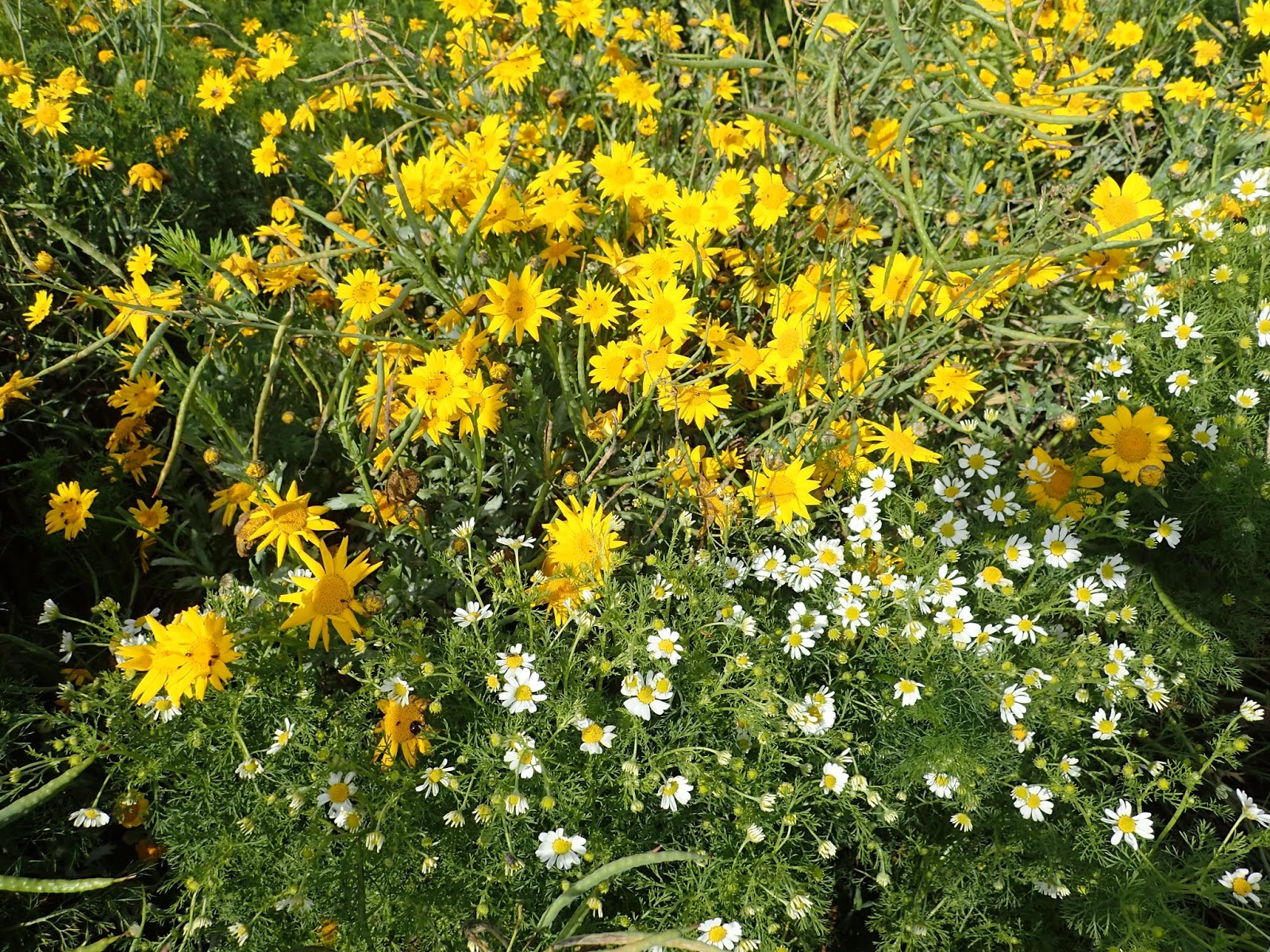
Last week I was up at Ken Hill again in Norfolk and had a great time setting up the vegetation plots. I used a high-accuracy GPS hired from SCCS who were exceptionally helpful. It all went rather well despite the horrendous weather in the first few days but it was the arable plants that really got my blood pumping. Above and below is the biggest patch of Corn Marigold I have ever seen. I have rarely seen this apart from occasionally seeing it around Rugeley when I was younger and then it was always only one or two plants.
What is it about arable plants? I think it's the fact there is a really useful index from Plantlife which works by accumulating the scores of qualifying plants for a site. So this clearly appeals to the collector part of my brain. So last week I was listing these arable plants like Panini stickers in my Transformers album when I was twelve. They are often quite restricted on sites too, persisting only in tiny pockets. So you really feel like you've found treasure when you get one of the good ones.
Before we go any further though, the title of this post comes not from the Robert Burns poem itself, but from the song from the opening credits of the film the Wicker Man. Someone once tried to tell me this was a horror film! Pah. It's one of my favourite movies and has such a magic folk music soundtrack. I always feel nostalgic for an era I never actually lived in when I watch this. Anyway, back to the arable plants...
So Corn Marigold scores 7 being red listed as Vulnerable.
Nearby there was more Stinking Chamomile than I have ever seen. I immediately called this corner of the field "Stink City" then realised it was time to stop talking to myself.
This stuff really does honk but I kinda like it. It's also red listed as Vulnerable and also scores 7. That's 14 in total. Here are the two growing together.
Everywhere across the site is Corn Spurrey. I didn't manage a photo of this but it's there. It's another Vulnerable red listed species scoring 7. That's 21 for this field alone. Oh no wait, I also had my favourite arable plant there tucked a way in the corner. The fantastic Night-flowering Catchfly.
You guessed it, it's another Vulnerable red listed species scoring 7. That's 28 for the field and site in total.
At the other end of the site I stumbled across a mass of the diminutive Field Woundwort in one plot. This species is red listed as Near Threatened and scores 6. That's 34 for the site. Not the best photo but my camera ran out of battery at this point.
In the same plot was a single plant of Dwarf Spurge, also Near Threatened and scoring 6, that's 40. This is was taken on my phone so it's not great.
And a single plant of Sharp-leaved Fluellen was also present here. A local species scoring 2. That's 42 in all.
Last month I found a few Prickly Poppies to the south, these are Vulnerable too scoring 7. So that's a score of 49.
In the same sandy area to the south there was plenty of Venus's Looking-glass. This species scores 3 being local, making 52 for the whole site. Whichever soil type you assess this by, this is now considered of national significance by Plantlife.
Other species present that also score include:
Bur Chervil 3 - 55
Henbit Dead-nettle - 1 - 56
Black-grass - 2 - 58
Black Mustard - 2 - 60
Bugloss - 1 - 61
Common Stork's-bill - 1 - 62
Common Cudweed - Near Threatened scores - 6 - 68
Small-flowered Crane's-bill - 2 - 70
Dwarf Mallow - 2 - 72
Smooth Tare - 2 - 74
Wild Radish - 1 - 75
Field Madder - 1 - 76
Flixweed - 3 - 79
The fresh-hold for a site of international significance is 70 for clays and sandy soils that the site is best described as. All these species were recorded in four days in June so I suspect there will be more to be found in July. Late summer is often really good for arable plants so I look forward to the next visit.
And the first Hoary Mullein (nationally scarce) that I think I have ever seen up close (rather than at 70 mph on the motorway by Bury St. Edmonds).
I completed the third invertebrate survey and got the greatest number of field dets from a day's surveying that I have ever managed, 251 species in all. I wonder how much further this can go? Is 300 field dets possible? The highlight for me was seeing this awesome staph that I have wanted to see for some time. Oxyporus rufus. I picked this up on the lovely sandy field to the south using the suction sampler. It feeds on mushrooms. Look at those mandibles!
As if I didn't have enough leatherbugs last time I also picked up Spathocera dalmanni from the Plain in the suction sampler (this one is a stock photo from Sussex). Yet another nationally scarce bug. Also in the same area I swept the tachinid fly Cistogaster globosa (along with plenty of it's host Bishope's Mitre Shieldbugs). That's 460 species of invertebrate from three day's surveying so far. This doesn't include the 24 tubes of specimens yet either. Of these 460 species, 25 (5.4%) have some form of conservation status.
This really is a great site with a wealth of interesting early successional species. Whatever will I find next month?! I am hoping for Red-tipped Cudweed which would be a lifer. A MASSIVE thank you yet again to the Padwicks for their hospitality.
Oh I forgot, here is the GPS in use. I love that the accuracy (2 cm) is less than the thickness of the pole.
Yesterday morning was my first day in my part time role at the Trust. I started early by heading out to Butcherlands to finish the bird survey. I have, since the last visit I reported, confirmed breeding of the Dartford Warblers there. I was just getting to that area when in the distance, around 100 m away among the cacophony of Garden Warblers and Whitethroats, I heard what I thought was a Sedge Warbler. That was odd as I had a migrant Sedge Warbler last time. So I headed towards it and soon realised I had something quite different. It sounded like a Garden Warbler singing twice as fast but this was preceded by some unusual repetitive notes, not unlike Swallow or Starling alarm calls.
What on Earth was this? I can tell you hearing a singing bird in Britain that I don't recognise is a thrilling event. My heart was beating like a big clock in fear it would get away without me seeing it. It had moved from the big willow to the left of the image above and was moving away from me rapidly, singing from the bramble clumps. I headed towards it, filming to get a sound recording with my camera. It wasn't a warbler I knew from Europe, so it had to be one I had never heard singing. Through a process of elimination my money was on a Sylvia warbler and I thought maybe Subalpine Warbler. I rounded one bramble to see it sat right out in the open atop a bramble singing its heart out. A massive yellow warbler with a sharp crest and a big pale bill. Obviously a Hippolais warbler!!!
So that meant it had to be either Melodious or Icterine Warbler. I had good views but not good enough for a photo so I had to rely on behaviour, colour, timing, location and the sound recording. I was fairly convinced after listening to the two on Xeno-Canto that it was Melodious Warbler, which from memory was also more likely here,and this was soon verified by a variety of more experienced birders. How exciting. Here is the best of the recordings I made.
I have only seen one before in the autumn of 2001 when I was a volunteer at Dungeness RSPB at the start of my career. It was low down in some Rock Samphire in front of the nuclear power station, certainly not singing from the top of a bush. It felt like a lifer to be fair. All this happened between 7.00 am and 7.30 am and by 9.30 when I got back to the same location it was nowhere to be seen. So I think it is long gone. This was by far the best bird I have found on the reserves in the last 11 years. Being possibly my last time I do this survey, it was a real treat to see this and I did well up a bit with excitement. Butcherlands just keeps throwing up exciting records.
I didn't see or hear the Darfords this time, they have finished already. I did however add another new bird to the survey. A singing Reed Warbler in a hedge. Which makes NINE warblers this year from the survey.
Also, some of those weird asperitas clouds I saw last autumn when driving. Strange that these are the most recently named clouds but are some of our most distinctive. And that I have only seen them in the last two years.


 Posts
Posts